Suyeong District: A Central Hub of Busan's Coastal Charm
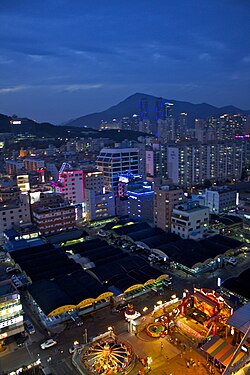
Located in the heart of Busan, South Korea, Suyeong-gu (Suyeong District) serves as a vital urban and cultural center. Known for its vibrant coastal atmosphere and strategic importance, this autonomous district offers a unique blend of historical significance and modern metropolitan convenience.
Historical Roots and Etymology
The name 'Suyeong' carries deep historical weight. It is derived from Gyeongsang JwaSuyeong, which refers to the naval command of the Gyeongsang region. Historically, the term 'JwaSuyeong' indicated a position to the left when facing south from Seoul, marking this area as a significant military and administrative site for the navy.
The modern district was officially established in 1995 after separating from the Nam District. Today, it remains a key part of the Yeongnam region within the provincial-level city of Busan.
Geography and Urban Structure
Suyeong District covers a total area of approximately 10.21 km² (3.94 sq mi). It is bordered to the North-East by the Suyeonggang River, which helps define its natural landscape. Due to its central location and coastal access, the district is highly urbanized, boasting a high population density.
Administrative Divisions
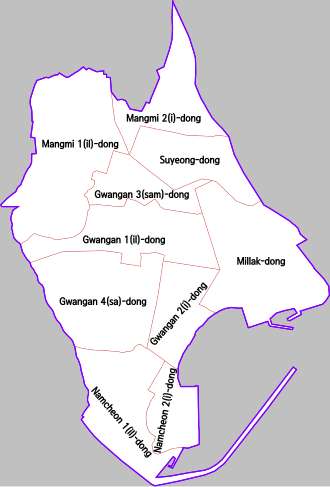
The district is organized into five legal dong (neighborhoods), which are further subdivided into ten administrative dong to manage the local population effectively:
- Namcheon-dong (comprising two administrative dong)
- Suyeong-dong
- Mangmi-dong (comprising two administrative dong)
- Gwangan-dong (comprising four administrative dong)
- Millak-dong
Transportation and Connectivity
One of Suyeong's greatest strengths is its accessibility. The district is a major node in the Busan subway system. Busan Subway Line 2 runs through the district, featuring five stations stretching from Millak to Namcheon. Furthermore, Suyeong Station serves as the southern terminal for Line 3, making the district a critical transfer point for commuters and travelers across the city.
Key Facts
- Total Population: 172,329 (as of 2024)
- Population Density: Approximately 16,880 to 17,768 inhabitants per km²
- Major Landmark: Gwangalli Beach in Gwangan-dong
- Local Dialect: Gyeongsang dialect
- Education: Home to the Busan Japanese School
- Current Mayor: Kang Seong-tae
Summary of Suyeong District Statistics
| Category | Details |
|---|---|
| Country | South Korea |
| Region | Yeongnam (Busan) |
| Area | 10.21 km² |
| Administrative Type | Autonomous District (Gu) |
| Subway Access | Lines 2 and 3 |
Frequently Asked Questions
What is the significance of the name Suyeong?
The name originates from 'Gyeongsang JwaSuyeong,' which refers to the naval command center for the Gyeongsang region.
How many administrative divisions are in Suyeong-gu?
There are five legal dong, which are subdivided into a total of ten administrative dong.
Is Suyeong-gu well-connected by public transit?
Yes, it is a major transportation hub where Busan Subway Line 2 and Line 3 intersect at Suyeong Station.
What are the main geographical features of the district?
The district is characterized by its coastal location, including Gwangalli Beach, and is bordered to the North-East by the Suyeonggang River.
Are there international educational facilities in the area?
Yes, the Busan Japanese School is located within the district.