Supreme Court of Pennsylvania: Composition and Judicial Rules
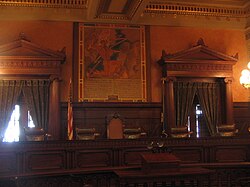
The Supreme Court of Pennsylvania serves as the highest judicial authority in the commonwealth, operating across three major urban centers: Harrisburg, Philadelphia, and Pittsburgh. The court is designed to ensure legal stability and oversight through a structured system of elections, term limits, and strict conduct codes.
Key Facts
- Seven Justices: The court is composed of seven members.
- Ten-Year Terms: Justices are elected to ten-year terms.
- Chief Justice: The position is automatically held by the justice with the longest continuous service.
- Mandatory Retirement: Justices must step down at age 75, though they can serve as senior justices until age 78.
- Retention Votes: After a term ends, a statewide yes/no vote determines if a justice remains in office.
Judicial Selection and Tenure
Justices of the Supreme Court of Pennsylvania are elected to ten-year terms and are permitted to run on party tickets. Once a term expires, the justice must undergo a retention vote—a statewide election where voters decide with a "yes" or "no" whether the judge should continue serving for another ten years.
If a justice fails to win retention, the governor appoints a temporary replacement, subject to the approval of the State Senate, until a special election is held. Historically, retention failure is rare; as of 2005, only Justice Russell M. Nigro failed to win retention following the Pennsylvania General Assembly pay raise controversy. He was subsequently replaced by Justice Cynthia Baldwin, appointed by Governor Ed Rendell.
Age Limits and Senior Status
The court enforces a mandatory retirement age of 75, effective at the end of the calendar year. However, retired justices may continue to contribute to the legal system as senior justices. In this capacity, they serve part-time on panels of the commonwealth's lower appellate courts until they reach the final mandatory retirement age of 78.
Rules of Conduct and Legal Precedents
The rules governing how judicial candidates campaign have evolved significantly. Prior to 2002, candidates were forbidden from expressing views on disputed political or legal issues. This changed following the U.S. Supreme Court ruling in Republican Party of Minnesota v. White, which found similar restrictions unconstitutional.
Under current rules (PA Code of Judicial Conduct, Canon 7 (B)(1)(c)), candidates may express political viewpoints. However, they are prohibited from making statements that commit, or appear to commit, the candidate to a specific outcome regarding cases or controversies likely to appear before the Court.
Impeachment and Historical Terms
Removal from office is rare. Only one justice, Rolf Larsen, has been removed via impeachment. In 1994, the State House issued seven counts of misconduct. While the State Senate voted against Larsen on five counts, he was convicted on one charge, meeting the required two-thirds majority for removal.
The structure of the court has also changed over time. Under the 1874 Constitution, justices served 21-year terms—the longest elected term of any office in the United States at the time—until the state Constitution was updated in 1968.
Summary of Court Composition
| Feature | Detail |
|---|---|
| Number of Justices | 7 |
| Election Term | 10 Years |
| Chief Justice Selection | Longest continuous service |
| Mandatory Retirement Age | 75 (Full), 78 (Senior) |
| Meeting Locations | Harrisburg, Philadelphia, Pittsburgh |
Frequently Asked Questions
How is the Chief Justice of Pennsylvania selected?
The justice who has provided the longest continuous service on the Supreme Court automatically becomes the chief justice.
What happens if a justice does not win a retention vote?
The governor appoints a temporary replacement, pending State Senate approval, until a special election can be conducted to fill the seat.
Can judicial candidates discuss political issues during elections?
Yes, since 2002, candidates may express political viewpoints, provided they do not commit themselves to specific rulings on cases likely to come before the court.
What is the role of a senior justice?
Senior justices are retired justices (aged 75 to 78) who serve part-time on panels of the commonwealth's lower appellate courts.
Has any justice ever been impeached?
Yes, Justice Rolf Larsen was removed from office in 1994 after the State Senate reached a two-thirds majority conviction on one of seven counts of misconduct.