Sulfur: Properties, Allotropes, and Industrial Applications
Sulfur is a versatile chemical element that plays a critical role in both industrial chemistry and biological systems. Known for its characteristic lemon-yellow color in its solid form, sulfur is a member of the chalcogens (Group 16 elements) and is found naturally in volcanic regions and mineral deposits. From its ancient use in alchemy to its modern role in producing sulfuric acid, sulfur remains one of the most economically significant elements on Earth.
As a nonmetal, sulfur is characterized by its ability to form a vast array of structures and compounds. Its unique chemistry allows it to exist in over 30 different solid forms, more than any other element, making it a subject of intense scientific study.

Key Facts
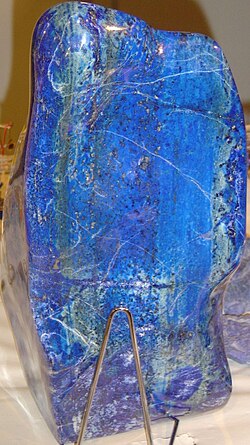
- Atomic Number: 16
- Symbol: S
- Standard Atomic Weight: 32.06 ± 0.02
- Appearance: Lemon yellow sintered microcrystals
- Common Oxidation States: −2, +2, +4, +6
- Primary Allotrope: Cyclooctasulfur (S8)
- Global Production (2011): 69 million tonnes
Physical and Chemical Properties
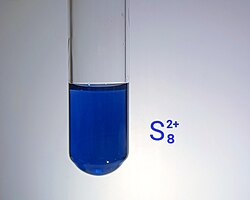
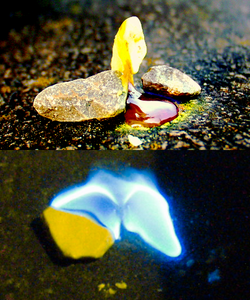
At standard temperature and pressure, sulfur is a solid. One of its most striking physical transitions occurs during heating: as a solid, it is lemon yellow, but when burned, it melts into a blood-red liquid and emits a distinct blue flame.
Sulfur exhibits sublimation—the process where a substance transitions directly from a solid to a gas—which becomes noticeable between 20 °C and 50 °C and occurs readily in boiling water. Chemically, sulfur is known for its slow hydrolysis under normal conditions, primarily forming hydrogen sulfide and sulfuric acid.
Allotropes and Molecular Structure
Sulfur is famous for its allotropes, which are different structural forms of the same element. The most common form is S8, a crown-shaped ring of eight sulfur atoms.
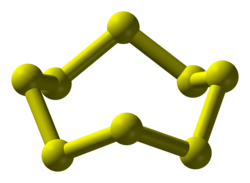
Beyond S8, other rings such as S6 and S7 exist, with S7 appearing as a deeper yellow. Scientists have also prepared larger rings, including S12 and S18. Recent research has even observed parallel sulfur chains growing inside single-wall carbon nanotubes.
![Two parallel sulfur chains grown inside a single-wall carbon nanotube (CNT, a). Zig-zag (b) and straight (c) S chains inside double-wall CNTs[50]](/images/e7/1d/e71d6b758c343676931514d980fb2510b3eaf148f7ffce2ee1fe9afd8a7b6365.jpg)
Natural Occurrence and Production

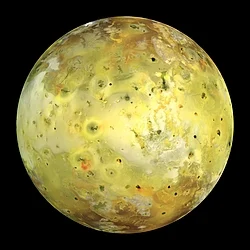
Sulfur is a primordial element found in various natural environments. It is frequently associated with volcanic activity; for example, the yellow and orange hues of Jupiter's moon Io are caused by elemental sulfur and sulfur compounds deposited by volcanoes.
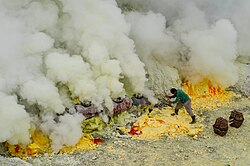
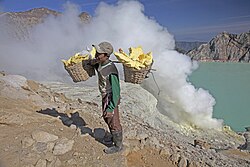
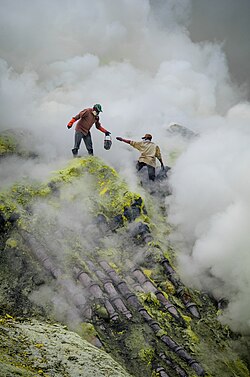
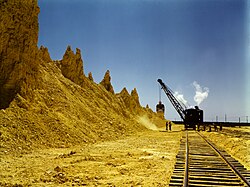
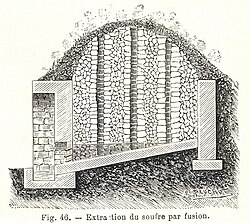
On Earth, sulfur is extracted through various methods. Traditional mining, such as that seen at the Ijen Volcano in Indonesia, involves hazardous conditions where miners collect sulfur blocks from volcanic vents.
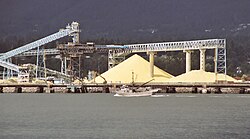
In modern industry, sulfur is often recovered as a byproduct of hydrocarbon processing. Large stockpiles are common in regions like Alberta, Canada, and North Vancouver, British Columbia.
Global Production Statistics
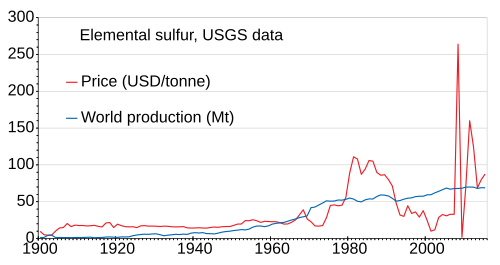
The production of sulfur has increased steadily since 1900. In 2011, global production reached 69 million tonnes. The leading producers include China, the United States, Canada, and Russia.
Industrial and Biological Applications
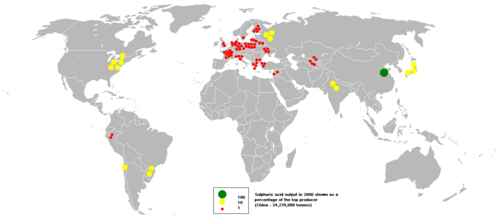
The most significant industrial application of sulfur is the production of sulfuric acid (H2SO4), a cornerstone of the chemical industry used in everything from fertilizer production to mineral processing.
Diverse Uses of Sulfur
- Agriculture: Used in the creation of fertilizers, fungicides, and pesticides.
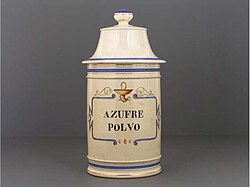
- Medicine: Historically used for its antifungal, antibacterial, and keratolytic properties to treat acne, rosacea, and scabies.
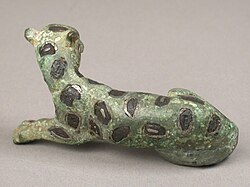
- Arts and Jewelry: Used in niello (a black mixture of metal and sulfur) for decorative metalwork, such as Roman brooches.
- Technology: Utilized in the development of specialized batteries.
![Sulfur has antifungal, antibacterial, and keratolytic activity; in the past it was used against acne vulgaris, rosacea, seborrheic dermatitis, dandruff, pityriasis versicolor, scabies, and warts.[109] This 1881 advertisement baselessly claims efficacy against rheumatism, gout, baldness, and graying of hair.](/images/25/73/25733abe40180f396f45fe861ece84bbd2a7368478736aa02afed6c7509f8162.png)
Biological Role
Sulfur is essential for life. It is a key component of proteins, specifically in amino acids like cysteine and methionine. In proteins, sulfur forms disulfide bridges, which are covalent bonds that help stabilize the three-dimensional structure of protein helices.
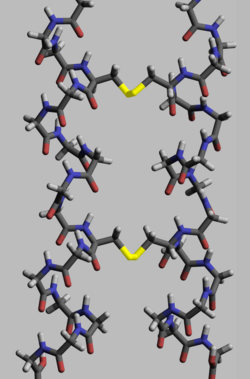
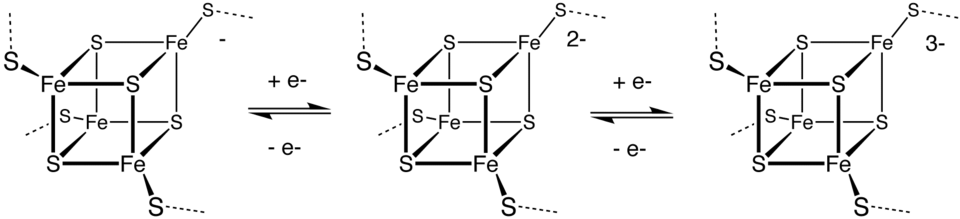
Sulfur also appears in various organic metabolites and metalloproteins, where it can provide catalytic effects within enzymes by facilitating electron flow.
Summary of Sulfur Properties
| Property | Value/Description |
|---|---|
| Melting Point (α-S8) | 115.21 °C (388.36 K) |
| Boiling Point | 444.6 °C (717.8 K) |
| Density (α-S8) | 2.07 g/cm3 |
| Mohs Hardness | 2.0 |
| Electronegativity | 2.58 (Pauling scale) |
| Common Isotopes | S-32 (94.99%), S-34 (4.25%), S-33 (0.75%) |
Safety and Environmental Impact
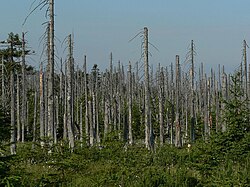
While elemental sulfur is relatively stable, its compounds can be hazardous. Sulfur dioxide (SO2), produced during the combustion of sulfur-containing fuels, is a primary contributor to acid rain, which can devastate forests and aquatic ecosystems.
For safety and transport, sulfur is categorized using the NFPA 704 diamond, which indicates its flammability and reactivity risks.

Frequently Asked Questions
What are the most common allotropes of sulfur?
The most common allotrope is cyclooctasulfur (S8), which consists of eight sulfur atoms in a crown-shaped ring. Other known forms include S6, S7, S12, and S18.
How is sulfur used in the human body?
Sulfur is an essential nutrient found in amino acids like cysteine and methionine. It is critical for forming disulfide bridges that stabilize the structure of proteins.
What is the relationship between sulfur and acid rain?
When sulfur-containing materials are burned, they release sulfur dioxide (SO2) into the atmosphere. This gas can react with water vapor to form sulfuric acid, which falls as acid rain.
Why is sulfur used in dermatology?
Sulfur possesses antifungal, antibacterial, and keratolytic activities, making it effective for treating skin conditions such as acne vulgaris, seborrheic dermatitis, and scabies.
Where is most of the world's sulfur produced today?
Modern sulfur production is largely a byproduct of hydrocarbon recovery. Leading producing nations include China, the United States, Canada, and Russia.