Sugar: Chemistry, Production, and Health Impacts
Sugar refers to a class of sweet-tasting, soluble carbohydrates widely used in food. While often used interchangeably with table sugar, the term encompasses a variety of simple and compound sugars that provide energy to the body. From the natural sweetness of fruits to the industrial production of refined crystals, sugar plays a central role in human nutrition and global economics.
Key Facts
- Simple sugars (monosaccharides) include glucose, fructose, and galactose.
- Compound sugars (disaccharides) are formed by two bonded monosaccharides, such as sucrose (glucose + fructose).
- Global production reached an estimated 194 million tonnes in 2023–2024.
- Primary sources of commercial sugar are sugarcane and sugar beets.
- Health guidelines suggest limiting free sugars to less than 10% of total daily energy intake.
The Chemistry of Sugar
At its most basic level, sugar is categorized by the complexity of its molecular structure. These substances are soluble carbohydrates that the body processes for energy.
Monosaccharides and Disaccharides
Monosaccharides, or simple sugars, are the most basic units of carbohydrates. Examples include glucose, fructose, and galactose. When two of these simple sugars bond, they form disaccharides, also known as double sugars. Common examples include:
- Sucrose: A combination of glucose and fructose (the primary component of white table sugar).
- Lactose: A combination of glucose and galactose.
- Maltose: A combination of two glucose molecules.
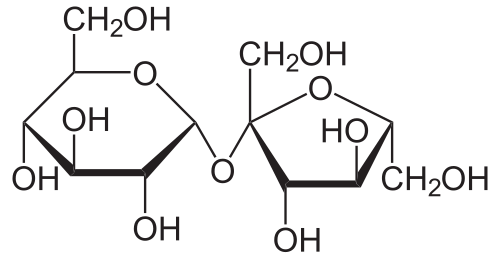
During the process of digestion, the body uses hydrolysis to break these compound sugars back down into simple sugars for absorption.
Polysaccharides and Other Sweeteners
Longer chains of saccharides are not classified as sugars; instead, they are called oligosaccharides or polysaccharides. A primary example is starch, a glucose polymer found in plants and a major energy source in human diets. It is important to note that some sweet-tasting substances, such as glycerol, sugar alcohols, and ethylene glycol, are not chemically classified as sugars.
Global Production and Sources
Sugar is primarily extracted from two main crops: sugarcane and sugar beets. The demand for these crops has historically driven significant economic shifts, industrialization, and colonization.
Sugarcane
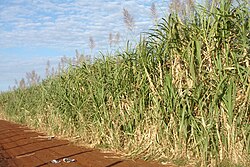
Sugarcane is a major global crop, accounting for roughly 21% of global crop production between 2000 and 2021. The Americas lead in production, contributing 52% of the world total. In 2022, global sugarcane production was 1.9 billion tonnes, with Brazil (38%) and India (23%) as the top producers.
Sugar Beet
Sugar beets are the other primary source of commercial sugar. In 2022, global production reached 260 million tonnes, with Russia leading the market at 18.8% of the world total, followed by France, the United States, and Germany.
![World production of raw sugar, main producers[29]](/images/cd/1a/cd1aa0332c493b076c08e829dc1667900088f74bf41a2a5a546fddc5b897eeaf.webp)
Sugar Content in Common Foods
Sugars occur naturally in many fruits and vegetables. The following table outlines the sugar composition of various food items.
| Food Item | Total Sugars (g/100g) | Free Fructose (g/100g) | Free Glucose (g/100g) | Sucrose (g/100g) |
|---|---|---|---|---|
| Apple | 10.4 | 5.9 | 2.4 | 2.1 |
| Banana | 12.2 | 4.9 | 5.0 | 2.4 |
| Grapes | 15.5 | 8.1 | 7.2 | 0.2 |
| Carrot | 4.7 | 0.6 | 3.6 | 0.5 |
| Red Beet | 6.8 | 0.1 | 6.5 | 0.5 |
Forms, Uses, and Consumption
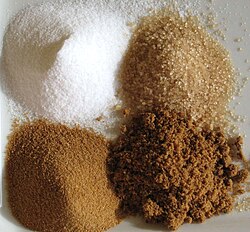
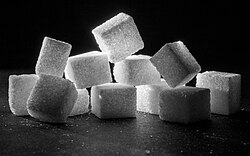
Sugar is processed into various forms depending on the desired crystal size and moisture content. Common forms include granulated, powdered, and liquid sugars. Brown sugars, such as Muscovado, differ in their refining process and moisture levels.
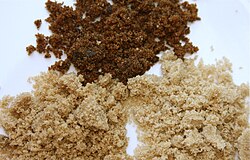
Consumption patterns have shifted dramatically over centuries. In the United Kingdom, per capita consumption rose from approximately 2 pounds per year in 1650 to 90 pounds by the early 20th century. Today, sugar provides roughly 10% of daily calories in a standard 2000 kcal diet worldwide.
Nutrition and Health Effects
While sugar provides a quick source of energy, excessive intake of free sugars—those added during manufacturing or present in honey and syrups—is linked to several health risks.

Dietary Recommendations
The World Health Organization (WHO) recommends limiting free sugar intake to less than 10% of total energy needs (approximately 50g or 12 teaspoons per day) to reduce disease risk. The American Heart Association provides stricter guidelines: 36g (9 teaspoons) for adult men and 25g (6 teaspoons) for women.
Health Risks
Added sugars provide excess calories without nutritional benefit. High consumption is associated with:
- Obesity and Metabolic Syndrome: Excess calories can lead to overweight and increased disease risk.
- Tooth Decay: Sugars are a primary contributor to dental caries.
- Nutritional Displacement: High sugar intake can replace nutrient-dense foods in the diet.
Sugar Beyond Earth
Interestingly, sugar-like molecules have been detected in interstellar space. In 2000, astronomers found glycolaldehyde. By 2019 and 2020, true sugar was collected and detected in samples from asteroids, including asteroid 101955 Bennu.
Frequently Asked Questions
What is the difference between a monosaccharide and a disaccharide?
A monosaccharide is a simple sugar consisting of a single molecule (e.g., glucose), while a disaccharide is a compound sugar made of two bonded monosaccharides (e.g., sucrose).
Which countries produce the most sugarcane?
Brazil and India are the world's leading sugarcane producers, with Brazil producing 38% and India producing 23% of the global total in 2022.
What are "free sugars"?
Free sugars are sugars added to foods during manufacturing, as well as sugars naturally present in honey, syrups, and fruit juices.
How much sugar is recommended per day?
The WHO recommends less than 10% of total energy intake (about 50g), while the American Heart Association suggests limits of 25g for women and 36g for men.
Is sugar found in space?
Yes, sugar-like molecules such as glycolaldehyde have been detected in interstellar space, and true sugar was found in samples from asteroids in 2019 and 2020.