Subaru Legacy: A History of Performance, Awards, and Motorsports
The Subaru Legacy has long been more than just a reliable family vehicle. Since its inception, it has carved out a reputation for blending practicality with high-performance engineering. From dominating sales charts in the early 1990s to conquering the grueling terrains of the World Rally Championship (WRC), the Legacy has consistently pushed the boundaries of what a sedan or wagon can achieve.
Key Facts
- Sales Milestone: Named the number-one-selling 4-wheel drive car in the US in 1990.
- WRC Victory: Colin McRae secured a historic win at Rally New Zealand in 1993.
- Speed Record: A Generation III model reached 270.532 km/h (168.101 mph) in 1998.
- Endurance: Set an FIA World Land Endurance Record in 1989, averaging 138.780 mph over 100,000 km.
- Engineering: High-performance variants utilize Bilstein suspension and turbocharged boxer engines.
Industry Recognition and Awards
The Subaru Legacy quickly gained traction for offering high-end features at an accessible price point. In 1990, R.L. Polk & Company identified it as the top-selling 4-wheel drive vehicle in the United States based on 1989 registration data. During the same period, it was noted by AutoGuide as the most affordable sedan or wagon to offer both Anti-lock Braking System (ABS) and 4-wheel drive.
International critics were equally impressed; the Automotive Journalists Association of Canada (AJAC) named it the "1990's Best New Sedan." More recently, the Legacy Outback shared the Top Gear Car Of The Year title with the Ford Mondeo in 2007.
Performance Engineering and Model Variants
Subaru's commitment to performance is evident in its engine evolution. The current Legacy products utilize the EZ series of flat-6-cylinder engines, which succeeded the EG series previously found in the Subaru SVX. To compete with rally-homologated standards, Subaru developed versions featuring tuned turbocharged engines and Bilstein suspension (a high-performance shock absorber system).
These high-performance models were marketed under various names depending on the body style and region:
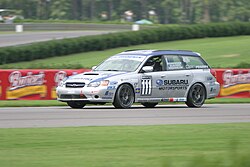
- GT-B: Turbocharged wagons with Bilstein suspension.
- Spec B / B4-RSK: Turbocharged sedans with Bilstein suspension.
- 2.5GT: The top-tier offering for the Legacy/Liberty range in Australia.
In North America, the evolution moved from the Sport Sedan and Touring Wagon to the GT and GT Limited. The Spec B, which became a regular production model in 2007, is distinguished by its exclusive interior, 18-inch wheels, and a transition from a 5-speed to a 6-speed manual transmission.
Performance Comparison Table
| Model/Variant | Key Feature | Notable Specification |
|---|---|---|
| WRX STI Equivalent | Turbocharged 2.0L | 205 kW (275 hp) |
| Spec B (2006) | Bilstein Suspension | 5-speed manual transmission |
| Spec B (2007+) | Bilstein Suspension | 6-speed manual transmission |
| Gen III (1998) | Turbocharged Wagon | 270.532 km/h top speed |
Motorsports Legacy
World Rally Championship (WRC)
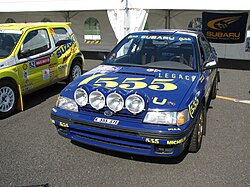
Beginning in 1990, the Subaru World Rally Team, supported by Prodrive, campaigned the Legacy in the WRC and British Rally Championship. While initially struggling, the car showed potential with Markku Alen's third-place finish at the 1991 Swedish Rally. The arrival of Ari Vatanen and Colin McRae in 1992 accelerated the car's success, with both drivers securing second-place finishes.
The pinnacle of the Legacy's rally career came in 1993. After a third-place finish in Sweden and a strong showing at the Acropolis Rally, Colin McRae secured a victory at Rally New Zealand, defeating François Delecour. This win marked the Legacy's final WRC triumph before the Impreza took over the primary role.
Beyond the WRC, the Legacy proved its durability in the 38th Safari Rally in 1990. It was the only Group N car to finish the event—widely considered the world's most grueling rally—placing 8th overall.
Super GT and Circuit Racing
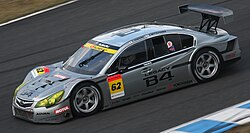
The Legacy's racing pedigree extended to the Japanese Super GT series (GT300 class). R&D Sport developed a grand tourer based on the fifth-generation model featuring a turbocharged boxer-4 engine. Originally utilizing all-wheel drive, the team switched to a Front-engine, Rear-wheel drive (FR) layout in 2010, which led to their first victory at the 39th Pokka Summer Special.
Speed and Endurance Records
Subaru has used the Legacy to set several benchmarks in speed and endurance. In 1998, a Generation III Legacy set a world speed record for mass-produced turbocharged station wagons (1,600 cc-2,000 cc class) at 270.532 km/h in Colorado, surpassing a 1993 record of 249.981 km/h.
Earlier, between January 2 and 21, 1989, three Japanese-spec RS sedans tackled the FIA World Land Endurance Record at the Arizona Test Center. They maintained an average speed of 138.780 mph over 100,000 km, completing the feat in just over 18.5 days with pit stops every two hours.
Frequently Asked Questions
Which rally driver won the Legacy's final WRC victory?
Colin McRae secured the Legacy's final WRC win at Rally New Zealand in 1993.
What makes the Spec B model different from standard Legacys?
The Spec B features an improved Bilstein suspension system, 18-inch wheels, an exclusive interior, and a navigation system (which was unique for manual transmission Legacys prior to 2010).
What was the Legacy's achievement in the Safari Rally?
In 1990, the Legacy was the only Group N car to finish the 38th Safari Rally, finishing 8th overall in one of the world's most difficult races.
What engine series is used in current Legacy performance models?
Current Legacy products use the EZ series of flat-6-cylinder engines, which replaced the older EG series.
What speed record did the Generation III Legacy set?
On April 23, 1998, it set a world speed record for mass-produced turbocharged station wagons in the 1,600 cc-2,000 cc class, reaching 270.532 km/h (168.101 mph).