Student Councils: Global Structures and Governance Models
Student councils serve as the primary bridge between the student body and educational administrations. Depending on the region, these organizations range from powerful political entities with institutional authority to social clubs focused on event planning and fundraising. While some operate as independent democratic bodies, others are integrated into the school's formal management structure.
In many countries, student councils join larger national networks to coordinate efforts. For example, the United States has the National Association of Student Councils, Canada utilizes the Canadian Student Leadership Association, and the United Kingdom employs an organization called Involver to provide training and support.
Key Facts
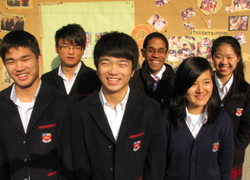
- Institutional Power: In countries like Germany and Spain, student councils act as formal political mediators.
- Leadership Titles: While the US typically uses "Student Body President," British Empire legacy systems (Australia, India, Canada) often use the title "School Captain."
- Legal Mandates: In Norway and Wales, the establishment of student councils is a statutory requirement.
- Diverse Selection: Members are chosen through various methods, including secret ballots, teacher nominations, and interviews.
Regional Leadership Models

The School Captain System
In the UK, Australia, India, and other former British Empire territories, the school captain is a functional equivalent to a student body president. Usually appointed or elected in their final year, the captain represents students to faculty and the wider community. In some institutions, this role merges with that of the head prefect. In the UK specifically, "Head Boy" and "Head Girl" are more common designations.
The Prefect and Peer Support System
Many UK schools utilize a prefect system where final-year students take on specialist roles in sports, public relations, or community service. Additionally, peer support schemes often pair Year 10 students with Year 7 newcomers to ease the transition into secondary education.
National Implementations and Legal Frameworks
European Models: Germany, Greece, and Italy
Germany emphasizes student representation across all levels. Every school has a council, and major changes to school life require their agreement. This scales up to District and State councils, with the state-level body receiving a budget between €40,000 and €70,000 for material costs.
In Greece, student representation is viewed as a cornerstone of democracy. Public secondary schools have a 15-member council, and each class has a 5-member council. However, as of 2024, these bodies often have limited actual power, primarily serving an educational purpose in teaching students how to vote.
Italy utilizes the rappresentante d’istituto (institute representative), an elected student who sits on the school's main governing body, the Consiglio d’Istituto. These representatives are elected annually using the D'Hondt method.
Asian Models: Indonesia, Iran, and Myanmar
In Indonesia, the government mandates the OSIS (Organisasi Siswa Intra Sekolah) in all junior and senior high schools. OSIS manages extracurriculars like art galleries and music shows. While the president is voted in by students, the general committee is selected by teachers and former members.

Iran's system involves annual elections every November. Councils act as the main communication channel between students and officials, with a hierarchy that extends from school and city levels up to a National Student Parliament.
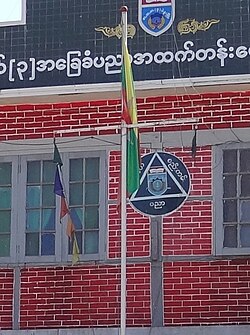
Myanmar employs a teacher-student joint council system known as the School Council (SC). This system is integrated with a "House system" and is managed by the Ministry of Education. The principal holds the highest position in this structure.
The Americas: Chile and the Philippines
Chile's centros de alumnos (students' centres) are present in all high schools and most primary schools, formalized by Supreme Decree #524 in 1990 to foster critical judgment and democratic participation.
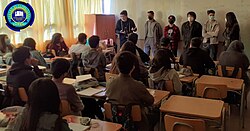

In the Philippines, public school governments are categorized by level: the SSLG (Supreme Secondary Learner Government) for Grades 7-12 and the SELG (Supreme Elementary Learner Government) for Grades 1-6. These positions are typically elected separately by the student body.
Comparative Summary of Student Governance
| Country | Primary Title/Body | Selection Method | Key Characteristic |
|---|---|---|---|
| Germany | Student Council | Elected | Must agree to major school changes |
| Indonesia | OSIS | Mixed (Voted/Selected) | Government-mandated for all high schools |
| Italy | Rappresentante d’istituto | D'Hondt Method Election | Sits on the main governing board |
| Myanmar | School Council (SC) | Joint Teacher-Student | Integrated with a House system |
| Philippines | SSLG / SELG | Direct Election | Separate elections for each position |
| Israel | National Youth Council | Democratic Election | Participates in Knesset committees |
Myanmar House System Details
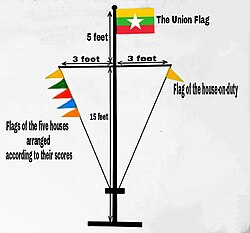
The Myanmar School Council operates using a specific house system where students compete for awards. The flags of these houses are flown on a single pole, with the highest-scoring house placed at the top.
![Organization of School Council[49]: 35](/images/6a/77/6a77a4f30a3841fe2e8ec80d893ed5c0f3e1e6b08f3ac983fd94ba7dbabb5dbd.jpg)
House Assignments
- Anawyahta: Orange (Monday)
- Kyansittha: Yellow (Tuesday)
- Bayinnaung: Green (Wednesday)
- Alaungphaya: Red (Thursday)
- Bandula: Blue (Friday)
Council Composition
Depending on the school size, the council typically consists of 18 to 20 members, including the Principal (President), a teacher (Vice-president), a student Secretary and Joint-secretary, five house teachers, five house student leaders, and 4-6 class representatives.
Frequently Asked Questions
What is the difference between a Student Body President and a School Captain?
While both lead the student body and interact with faculty, the title "Student Body President" is common in the US, whereas "School Captain" is typically used in countries with British Empire legacy school systems, such as Australia, India, and Canada.
How does the German student council system differ from others?
The German system is highly institutionalized; student councils must agree to major changes affecting school life, and there is a structured hierarchy leading up to a state-level representation with a dedicated budget.
What is OSIS in Indonesia?
OSIS (Organisasi Siswa Intra Sekolah) is a government-mandated student organization in all Indonesian junior and senior high schools, primarily responsible for organizing extracurricular activities.
Do student councils always have real power?
No. While some have institutional power (like in Germany), others are primarily educational. In Greece, for example, councils often provide suggestions to staff without a guarantee of implementation, serving more to teach students about democratic voting.
What is the SSLG in the Philippines?
The SSLG, or Supreme Secondary Learner Government, is the official student government for public educational institutions catering to students in Grades 7 through 12.