Striped Hyenas: Cultural Folklore, Human Interaction, and Natural History
The striped hyena is a creature of profound contradiction. While biologically a scavenger and predator, in the human imagination, it has evolved into a symbol of everything from treachery and vampirism to love and fertility. Across the Middle East, Asia, and North Africa, this animal has left an indelible mark on literature, religion, and local customs.
From the ancient tombs of Egypt to the remote valleys of Pakistan, the striped hyena's relationship with humans is complex, ranging from fear and pest control to mystical reverence and domestication.
Key Facts
- Cultural Symbols: Often viewed as symbols of stupidity or treachery in Middle Eastern folklore, but associated with fertility in parts of Asia.
- Dietary Impact: Known to prey on livestock such as goats, sheep, and poultry, and occasionally damage melon and date plantations.
- Human Interaction: Generally timid around humans, though rare predatory attacks on children have been recorded historically.
- Tameability: Capable of being fully trained and affectionate if raised from a young age, despite a persistent strong odor.
- Mythological Links: Associated with jinn in the Near East and werewolves in ancient Greek belief.
Folklore, Religion, and Mythology
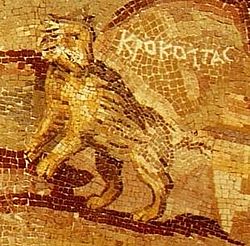
In Middle Eastern literature, the striped hyena is frequently cast as a symbol of treachery. In the Near and Middle East, they are often regarded as physical incarnations of jinn (supernatural spirits). Historical texts provide vivid, if fantastical, accounts of the animal. Zakariya al-Qazwini (1204–1283) described a "Hyena People" capable of identifying their own among thousands, while Al-Doumairy (1406) characterized them as vampiric creatures that targeted brave individuals at night.
In other regions, the perception shifts. In Afghanistan, India, Pakistan, and Palestine, the hyena is feared but also linked to love and fertility. Among the Baloch people, folklore suggests that magicians ride striped hyenas under the cover of night.
The animal also appears in religious and linguistic contexts. The Hebrew word for hyena, tsavoa, means "colored creature." Some scholars suggest that the Biblical Valley of Zeboim (1 Samuel 13:18) refers to locations in Israel known as Shaqq al-Diba ("cleft of the hyenas") or Wadi Abu Diba ("valley of the hyenas"). In Gnosticism, the Archon Astaphaios is depicted with the face of a hyænid.
Predation and Conflict with Humans
Livestock and Crop Damage
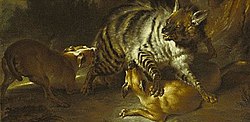
Striped hyenas are often implicated in the loss of livestock, particularly poultry, dogs, sheep, and goats. While larger animals are sometimes reported as prey, these instances may actually be cases of scavenging. Significant reports of such attacks occur in Egypt, Ethiopia, India, Iraq, and Morocco. In Turkmenistan, they are known to kill dogs and sheep, while mid-twentieth-century reports from Iraq mentioned the killing of donkeys and horses.
Beyond livestock, these animals occasionally damage agriculture, specifically targeting date palms in Egypt and Israel, as well as watermelon and honey melon fields in Turkmenistan.
Attacks on Humans and Grave Desecration
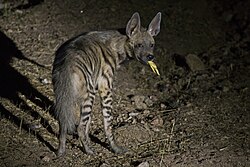
Under normal circumstances, striped hyenas are extremely timid. However, rare predatory events have occurred. In the 1880s, a hyena in the Erivan Governorate wounded 25 children and 3 adults over one year. Similar attacks on children were reported in Azerbaijan during the 1930s and 1940s, and in India during the 1960s and 70s. Despite these outliers, a five-year census in Madhya Pradesh, India, showed that hyenas caused the fewest human deaths compared to other wild animals like tigers, leopards, and sloth bears.
While attacks on the living are rare, hyenas are opportunistic scavengers of human corpses. In Turkey, stones are traditionally placed on graves to prevent hyenas from digging up bodies.
Hunting and Domestication
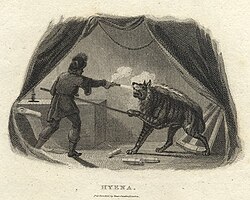
Historically, striped hyenas were hunted as pests rather than sporting quarry. In Ancient Egypt, peasants hunted them to protect crops. Conversely, Algerian and British hunters in India often viewed killing hyenas as beneath their dignity due to the animal's perceived cowardice. When cornered by dogs, hyenas often feign death for long periods.
Unique hunting methods exist in various cultures. In Kandahar, hunters known as payloch enter dens naked and use magic formulas to induce a hypnotic state in the animal. Similarly, some Mesopotamian Arab hunters believed hyenas understood Arabic and would "flatter" them to lure them into nooses.
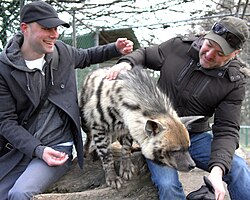
Despite their wild nature, striped hyenas are easily tamed, especially when young. Ancient Egyptians reportedly used them for hunting. When raised firmly, they can become as affectionate as dogs, though they retain a powerful, permanent scent.
Dietary and Magical Uses
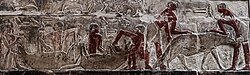
Evidence from the tomb of Mereruka in Sakkara suggests that Old Kingdom Egyptians may have force-fed hyenas to fatten them for food, though some archaeologists argue these were actually aardwolves. Historical records also note that Bedouins, Tuaregs, and Somali people have eaten hyena meat, sometimes treating it as medicine.
In folk magic, almost every part of the hyena's body has been used as an amulet. Ancient Greeks and Romans believed hyena parts could ward off evil or ensure love. In West and South Asia, these beliefs persist: Iranian folklore mentions a protective stone found in the body, while in Pakistan, hyena teeth are placed over churns to preserve the baraka (blessing) of milk. Various body parts, including the pelt and fat, are used in traditional medicine to treat rheumatism or as aphrodisiacs.
| Category | Common Perceptions/Impacts | Regional Examples |
|---|---|---|
| Folklore | Treachery, Jinn, Love, Fertility | Middle East, Afghanistan, Pakistan |
| Predation | Livestock (Sheep, Goats, Poultry) | Egypt, India, Turkmenistan, Iraq |
| Human Conflict | Rare attacks on children; grave scavenging | Turkey, Azerbaijan, India |
| Magic/Medicine | Amulets for love, virility, and healing | Greece, Rome, Iran, Pakistan |
| Domestication | Tameable, affectionate, strong odor | Ancient Egypt |
Frequently Asked Questions
Are striped hyenas dangerous to humans?
Generally, striped hyenas are extremely timid and avoid human contact. While there are historical records of rare attacks on children in regions like India and Transcaucasia, they are far less dangerous to humans than other large predators like tigers or leopards.
Can striped hyenas be kept as pets?
They are capable of being tamed and trained, particularly if they are young. They can form strong bonds with humans and even other dogs, although they possess a very strong natural odor that cannot be removed by bathing.
What do striped hyenas eat in the wild?
They are primarily scavengers but also prey on livestock such as goats, sheep, and poultry. They have also been known to damage agricultural crops, including date palms and melons.
Why are hyenas mentioned in ancient folklore?
Because of their scavenging habits and nocturnal nature, they often became symbols of the supernatural. In the Middle East, they were linked to jinn, while in ancient Greece and Rome, they were associated with vampirism and love magic.
How did ancient people hunt striped hyenas?
Methods varied from standard trapping to psychological tactics. Some hunters in Mesopotamia and Afghanistan used flattery or magic formulas to hypnotize the animals in their dens before capturing them with nooses.