Stony Brook Meetinghouse: A Historic Quaker Landmark in Princeton
Nestled at the intersection of Quaker Road and Princeton Pike in Princeton, New Jersey, the Stony Brook Meetinghouse stands as a testament to the early European settlement of the region. Established by the Religious Society of Friends, commonly known as Quakers, this site has served as a spiritual and communal anchor for nearly three centuries.
The history of the site begins around 1696, when six Quaker families became the first Europeans to settle in the Princeton area, building their homes near the Stony Brook. In 1709, the foundation for a formal community was laid when Benjamin Clark deeded nine and three-fifths acres in trust to Richard Stockton and others to establish a burial ground and a meeting house.
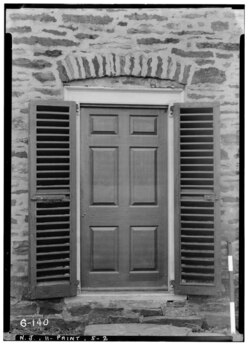
Architectural Evolution and Revolutionary History
The first meeting house was constructed in 1726. However, after the original structure was lost to fire, a second stone building was erected in 1760 on the same foundation, designed to remain as close to the original architecture as possible.
During the American Revolution, the meeting house played a silent but strategic role. By the time of the Battle of Princeton in 1777, the building sat at the edge of open fields. It provided a clear line of sight to the opening skirmish at William Clarke's orchard. While the area is now densely wooded due to the Institute Woods and Princeton Battlefield State Park, the meeting house remains connected to the Clarke house via trails that have existed since the early 1700s.
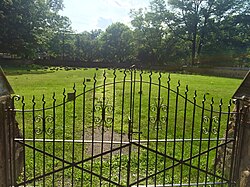
The Stony Brook Cemetery
Adjoining the meeting house and the First Day School (the Quaker term for Sunday School) is the historic cemetery. Enclosed on three sides by a stone wall, it was the most prominent burial ground in Princeton prior to the Revolutionary War.
The cemetery reflects the Quaker commitment to simplicity and the equality of all people. To avoid vanity and social hierarchy, elaborate grave markers were discouraged. Consequently, many graves remain unmarked, or are identified only by plain stones listing the name and dates of birth and death. This tradition is evident even among the site's most prominent figures; for instance, while founder Richard Ridgway is buried here, his specific marker is unknown.
Noted Interments
- Richard Stockton (1730–1781): A distinguished lawyer, jurist, and legislator who signed the Declaration of Independence.
- Charles Smith Olden (1799–1876): A Republican politician who served as the 19th Governor of New Jersey from 1860 to 1863.
- Richard Ridgway: An early settler who arrived from England in 1690 and donated land for the use of the Quaker Friends.
Education and Community Growth
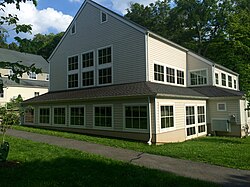
Education has always been central to the Stony Brook community. Shortly after the meeting house was built, the Quakers established a school for their children, which operated until approximately 1901. In the 1950s, a multi-purpose building was added to support the First Day School.
The tradition of learning was revitalized in 1987 when the Princeton Friends School returned to the site. The school has since expanded significantly, completing a $1.8 million schoolhouse in 1997 and breaking ground for a second building in 2007. The campus also utilizes a schoolmaster's house from the 1800s for its arts curriculum and a 225-year-old Quaker farmhouse for administrative offices.
Key Facts
- Founded: 1726 (Original structure).
- Current Building: Stone structure built in 1760.
- NRHP Status: Added to the National Register of Historic Places on October 10, 1989.
- Location: 470 Quaker Rd, Princeton, New Jersey.
- Affiliation: Princeton Monthly Meeting of the Philadelphia Yearly Meeting.
| Category | Details |
|---|---|
| Denomination | Quaker (Religious Society of Friends) |
| Historic District | Princeton Battlefield / Stony Brook Village |
| NRHP Reference No. | 89000761 |
| Worship Schedule | First Day (Sunday) at 9:00 & 11:00 am |
Frequently Asked Questions
What is a First Day School?
First Day School is the Quaker expression for Sunday School, providing religious and community education for children.
Who is buried at the Stony Brook Cemetery?
The cemetery holds several notable figures, including Richard Stockton, a signer of the Declaration of Independence, and Charles Smith Olden, the 19th Governor of New Jersey.
Why are many of the graves in the cemetery unmarked?
Quakers traditionally emphasized simplicity and the equality of all persons, which led them to discourage elaborate grave markers in favor of plain or unmarked stones.
Is the meeting house still in use today?
Yes, the Princeton Monthly Meeting continues to hold worship services there on Sundays (First Day), and the Princeton Friends School uses the space for its weekly "Settling In" meetings.
How does the meeting house relate to the Battle of Princeton?
During the 1777 battle, the meeting house was located at the edge of open fields, providing a direct line of sight to the initial skirmish at William Clarke's orchard.