Statue of Liberty National Monument: Access, Jurisdiction, and Administration
The Statue of Liberty National Monument stands as one of the most iconic landmarks in the world, situated in the Upper New York Bay. Positioned east of Liberty State Park in Jersey City, New Jersey, and southwest of Battery Park at the southern tip of Manhattan, the monument serves as a gateway to American history. While entrance to the monument itself is free, the unique geography of the site requires all visitors to utilize ferry services for access.
Since 2007, Statue City Cruises has held the concession to operate ticketing and transportation, taking over from the Circle Line, which had managed the service since 1953. To ensure security and safety, the U.S. Park Police patrol the surrounding waters and enforce strict restrictions on private boat landings.
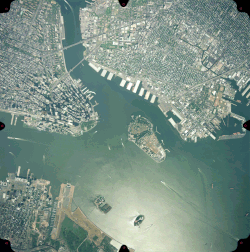
Visiting the Monument and Ellis Island
Visitors can begin their journey by purchasing tickets at two primary locations: Castle Clinton in Battery Park or the Communipaw Terminal in Liberty State Park. The ferry system is designed for convenience, with all boats stopping at both Liberty Island and Ellis Island, allowing passengers to visit both sites and choose their preferred departure point for the return trip.
Accessing the Statue's Interior
Depending on how deep a visitor wishes to explore the Statue of Liberty, different tickets are required:
- Pedestal Access: Visitors must obtain a complimentary ticket in addition to their ferry fare to enter the pedestal.
- Crown Access: To climb the 154 stairs to the crown, a special ticket is required. These are highly limited and can be reserved up to one year in advance. Access is restricted to 10 people per group, three groups per hour, totaling 240 visitors per day. Those ascending must undergo a second security screening and may only bring cameras and medication; all other items must be stored in provided lockers.
Ellis Island and Special Tours
Beyond the main museum, visitors interested in the south side of Ellis Island—specifically the Ellis Island Immigrant Hospital—must purchase a "Hard Hat Tour" ticket, which requires an additional fee.
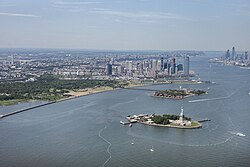
Recent Operational Changes
To combat overcrowding, the National Park Service (NPS) announced a ban on tour groups in specific areas, including the Ellis Island museum and the Statue of Liberty's observation deck, effective May 16, 2019. Although tour groups represent only 1,000 of the 24,000 daily visitors, the NPS noted that they frequently obstruct pedestrian flow.
Additionally, following a 2020 storm that partially sank the ferry landing at Liberty State Park, a temporary landing was established at the Central Railroad of New Jersey Terminal. During the subsequent repairs to the barge, ferry service from Liberty State Park was suspended annually from January to March.
Key Facts
- Daily Visitors: Approximately 24,000 people visit the site daily.
- Crown Capacity: Limited to 240 people per day via 30 total group slots.
- Crown Ascent: Requires climbing 154 stairs.
- Transportation: Exclusively managed by Statue City Cruises since 2007.
- Security: Private boat landings are prohibited and enforced by U.S. Park Police.
Complex Jurisdiction and Sovereignty
The legal status of the islands is a unique result of colonial land grants, provincial directives, interstate compacts, and U.S. Supreme Court rulings. While both islands have been federal property since the early 19th century—Liberty Island since 1800 and Ellis Island since 1808—their state jurisdiction is split.
Liberty Island and the original 3.3 acres (13,000 m²) of Ellis Island are exclaves of New York (territories completely surrounded by another jurisdiction), meaning they are part of New York City despite being surrounded by New Jersey waters. Conversely, the 24 acres (97,000 m²) of Ellis Island created through land reclamation belong to New Jersey. In all cases, federal government authority takes precedence, with remaining jurisdiction falling to the respective state.
| Feature | Liberty Island | Ellis Island (Original) | Ellis Island (Reclaimed) |
|---|---|---|---|
| Federal Ownership | Since 1800 | Since 1808 | Federal |
| State Jurisdiction | New York | New York | New Jersey |
| Land Area | N/A | 3.3 acres | 24 acres |
Administrative History
The monument has been managed by a series of superintendents to ensure its preservation and operation. Notable leadership includes David Moffit, who served the longest tenure from 1977 to 1987, and the current superintendent, John Piltzecker, who assumed the role in 2013.
Frequently Asked Questions
How do I get to the Statue of Liberty and Ellis Island?
Visitors must use the ferry service operated by Statue City Cruises, with departures available from either Battery Park (Castle Clinton) in New York or Liberty State Park (Communipaw Terminal) in New Jersey.
Can I book a trip to the crown of the statue?
Yes, but special tickets are required and can be reserved up to one year in advance due to strict daily limits of 240 people.
What is a "Hard Hat Tour"?
A Hard Hat Tour is a specialized, paid tour that allows visitors to explore the south side of Ellis Island, specifically the Ellis Island Immigrant Hospital.
Why are tour groups banned from certain areas?
The National Park Service implemented these bans in 2019 to reduce overcrowding and prevent the blockage of pedestrian flow in high-traffic areas like the observation deck and museum.
Which state owns the islands?
It is a split jurisdiction: Liberty Island and the original part of Ellis Island belong to New York, while the reclaimed land on Ellis Island belongs to New Jersey, though both are federal property.