St Patrick's Blue: The History of Ireland's Forgotten National Colour
While green is globally recognized as the primary colour of Ireland, history reveals a more complex palette. For centuries, a specific shade known as St Patrick's Blue served as a symbol of authority, chivalry, and national identity. From royal armorials to sporting jerseys, this hue played a pivotal role in the visual representation of the Irish state and its people.
Origins and Heraldic Roots
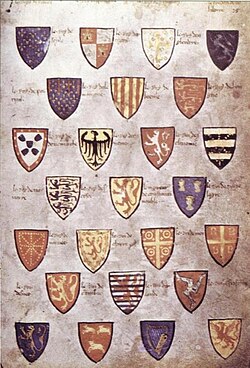
The association of blue with Irish authority dates back to the late 13th century. The Armorial Wijnbergen, a French roll of arms, contains one of the earliest records: a shield featuring a gold harp on a blue field, labeled Le Roi d'Irlande (the King of Ireland).
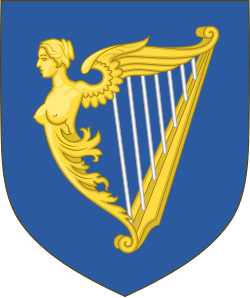
This heraldic tradition continued through the centuries. Irish monarchs since Edward IV utilized an azure (bright blue) field for their Irish arms. While the original device featured three crowns, Henry VIII later replaced them with the harp. This design remains the basis for the arms of the modern Irish state and is still visible in the lower left quarter of the United Kingdom's Royal Standard.
The Order of St Patrick
In 1783, the Order of St Patrick was established as the senior order of chivalry in the Kingdom of Ireland. To distinguish its members from the Order of the Garter (dark blue) and the Order of the Thistle (green), a distinct shade was required. Orange was rejected due to its sectarian associations with Orangeism, leading to the selection of a lighter, "sky blue" for the order's mantles, ribands, and enamel badges.
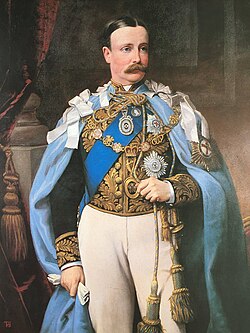
Although the term "St Patrick's Blue" became widely used, the Order never officially adopted the name. The exact shade evolved over time; for instance, Lord Iveagh used a sky blue tinged with green in 1895, a choice confirmed in 1903.
Debates on Tradition and Authenticity
Historians and nationalists have long debated whether blue was a genuine national colour or a later invention. Jim Smyth argued that the adoption of the colour and the Saint Patrick's Saltire was an "invention of tradition." Conversely, Shane Leslie suggested the blue-green hue might be a remnant of the woad-stain used by ancient Celts.
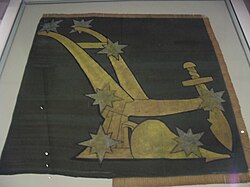
The colour's significance extended into revolutionary movements. Constance Gore-Booth viewed blue as the "old colour of Ireland" and integrated it into the regalia of the Irish Citizen Army (ICA). Scientific analysis of the Starry Plough, the ICA's famous banner, revealed that it was originally a rich deep blue poplin before being changed to green prior to the 1916 Easter Rising.
Other figures, such as antiquarian nationalist Francis Joseph Bigger, dismissed the colour and the associated flag as "fakes," while modern scholars like Peter Alter and Christina Mahony have defended its historicity.
Key Facts
- Earliest Record: Found in the late 13th-century Armorial Wijnbergen.
- Royal Arms: The azure field with a gold harp has been used by Irish monarchs since the time of Henry VIII.
- Chivalry: The Order of St Patrick (est. 1783) used sky blue to avoid sectarian associations with orange.
- Mythology: Flaitheas Éireann, the personification of Irish sovereignty, was sometimes depicted in a blue robe.
- Revolutionary Use: The Starry Plough banner was originally deep blue before being changed to green in 1916.
Former Use in Society and Sport
During the 19th and early 20th centuries, St Patrick's Blue was a staple of formal Irish attire. In 1868, Princess Alexandra wore a dress of the colour during a visit to Ireland. By 1886, it was a popular choice for Irish-themed dress codes, with the Freeman's Journal noting that blue poplin ties often appeared green in certain lights.
In sports, the Ireland national football team (organized by the IFA, now the Northern Ireland team) wore St Patrick's blue jerseys from 1882 until 1931. The Football Association of Ireland (FAI) also utilized a blue change strip during the 1924 Olympics and wore a commemorative blue jersey in 2021 to mark the FAI's 100th anniversary.
Political and Military Applications
In the 1930s, the Army Comrades Association adopted blue shirts, leading to their nickname, the Blueshirts. This quasi-fascist movement explicitly rejected green to distance itself from republican opponents. W. T. Cosgrave defended the choice as being in "traditional, national accord" with Irish history.
Other notable uses include the original uniforms of the Irish Army Band and the "Blue Hussars" (the Mounted Escort ceremonial cavalry from 1932–48). Even Aer Lingus incorporated St Patrick's Blue into its air hostess uniforms in 1970, before transitioning to a corporate scheme of bottle green and strong blue in 1975.
| Category | Application | Period/Context |
|---|---|---|
| Heraldry | Royal Arms of Ireland | Late 13th Century – Present |
| Chivalry | Order of St Patrick Mantles | Established 1783 |
| Politics | Blueshirts Uniforms | 1930s |
| Sports | IFA National Team Jerseys | 1882 – 1931 |
| Military | Blue Hussars (Mounted Escort) | 1932 – 1948 |
Frequently Asked Questions
Why was blue used instead of green for the Order of St Patrick?
The Order needed a colour that differed from the Order of the Garter (dark blue) and the Order of the Thistle (green). Orange was considered but rejected because of its sectarian association with Orangeism, leading to the choice of sky blue.
Is St Patrick's Blue still used today?
While no longer the primary national colour, it appears in the Royal Standard of the UK and is occasionally used for commemorative events, such as the Republic of Ireland's 2021 friendly match against Qatar.
What is the Starry Plough and how does it relate to blue?
The Starry Plough is the banner of the Irish Citizen Army. Although now associated with green, scientific analysis proves the original banner was made of a rich deep blue poplin.
Who argued that St Patrick's Blue was a "fake" colour?
Antiquarian nationalist Francis Joseph Bigger considered both St Patrick's blue and the Saint Patrick's Flag to be "fake," viewing them as inventions rather than authentic traditions.
How did the "Blueshirts" use this colour?
The Army Comrades Association wore blue shirts in the 1930s to distinguish themselves from republican opponents who wore green, claiming the colour was in accord with Irish history.