St. Louis Cathedral: A Historic Landmark of New Orleans
Standing as a sentinel in the heart of the French Quarter, the Cathedral-Basilica of Saint Louis, King of France—commonly known as St. Louis Cathedral—is one of the most iconic structures in the United States. Serving as the seat of the Archdiocese of New Orleans, it holds the distinction of being one of the oldest cathedrals in continuous use in the country, alongside the Royal Presidio Chapel in Monterey, California.
Dedicated to Saint Louis (King Louis IX of France), the cathedral is situated on Place Jean-Paul II, facing the Mississippi River and overlooking the historic Jackson Square. It is flanked by two other significant landmarks: the Cabildo and the Presbytère.
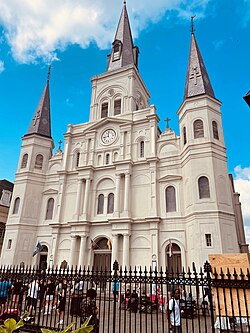
Key Facts
- Founded: 1720
- Location: Jackson Square, New Orleans, Louisiana
- Architectural Styles: Spanish Colonial (Renaissance) and French Neo Gothic
- Status: Cathedral and Minor Basilica
- Dedication: Saint Louis (King Louis IX of France)
- Current Administration: Archdiocese of New Orleans
A History of Resilience and Reconstruction
The site has hosted three distinct Catholic churches since the founding of New Orleans in 1718. The first was a modest wooden structure, followed by a larger brick and timber church completed in 1727. However, this second iteration was destroyed during the Great New Orleans Fire on March 21, 1788.
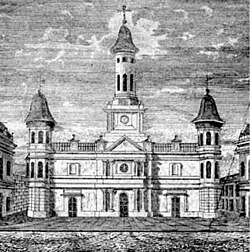
Under Spanish rule, a third church was begun in 1789 and completed in 1794. This structure was elevated to cathedral rank in 1793. In 1819, a central tower featuring a clock and a bell named "Victoire"—commemorating the 1815 Battle of New Orleans victory—was added to the building.
![1895 recreation[3] of the Church of St. Louis of 1794, as it looked after it was rebuilt by the Spaniards](/images/30/ce/30cea3df0561a0de4449c8260e6e03226043efe1c2472046b74e801afa05ea1d.jpg)
The 19th Century Transformation
By 1834, the growing congregation necessitated a larger space. Plans were developed by Jacques Nicolas Bussière de Pouilly, and in 1849, the diocese contracted John Patrick Kirwan to execute the enlargement. The project was fraught with difficulty; during construction in 1850, the central tower collapsed, leading to the replacement of both De Pouilly and Kirwan.
Because the reconstruction required the demolition of nearly all original walls, very little of the 1789 Spanish Colonial structure survived. The current building primarily dates to the 1850s, though the 1819 "Victoire" bell was preserved and reused.
Trials and Triumphs
The cathedral has survived numerous crises over the last century. In 1909, a dynamite bomb damaged the galleries and blew out windows. A foundation collapse in 1916 forced the building to close for a year of repairs.
The cathedral also reflects the cultural evolution of New Orleans. A 1906 census noted that services were offered in both English and French. By 1910, the sacramental register switched to English, and by the 1920s, the vast majority of parishioners were English speakers.
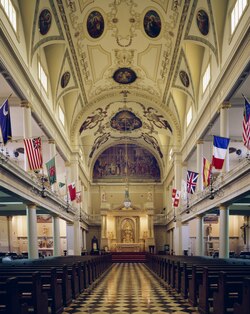
Modern Era and Natural Disasters
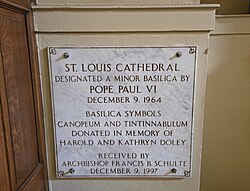
In 1964, Pope Paul VI designated the cathedral as a minor basilica, a title of honor granted to certain churches. This prestige was further highlighted by a visit from Pope John Paul II in September 1987.
The building faced severe challenges during Hurricane Katrina in 2005. High winds damaged the ornamental gate in St. Anthony's Garden and broke a marble statue of Jesus Christ. Water intrusion through the roof severely damaged the Holtkamp pipe organ, which was donated by Elise Cambon. The organ was sent for rebuilding and reinstalled in June 2008.
Summary of Cathedral Specifications
| Feature | Detail |
|---|---|
| Denomination | Catholic Church |
| Archdiocese | Archdiocese of New Orleans |
| Groundbreaking | 1789 (Third structure) |
| Completion | 1850s |
| Key Architectural Elements | Central tower, Holtkamp pipe organ, "Victoire" bell |
Frequently Asked Questions
Why is St. Louis Cathedral significant in U.S. history?
It is one of the oldest cathedrals in continuous use in the United States, serving as a spiritual and architectural anchor for New Orleans since the early 18th century.
What happened to the original 1789 structure?
Most of the 1789 Spanish Colonial structure was demolished during the major reconstruction and enlargement project of the 1850s, though the 1819 bell was saved.
How did Hurricane Katrina affect the cathedral?
The storm damaged the roof, the ornamental gate in St. Anthony's Garden, a marble statue of Jesus, and the Holtkamp pipe organ, which required extensive rebuilding.
What is the meaning of the "Victoire" bell?
The bell was embossed with the name "Victoire" to commemorate the victory at the Battle of New Orleans in 1815.
What is the current status of the cathedral's administration?
The cathedral is the seat of the Archdiocese of New Orleans. In November 2025, it was included in a Chapter 11 bankruptcy filing by the Archdiocese to resolve numerous sex abuse lawsuits.