St. Clair Tunnel: North America's First Underwater Rail Link
In 1891, the landscape of North American transportation changed forever with the opening of the St. Clair Tunnel. Developed by the St. Clair Tunnel Company—a subsidiary of the Grand Trunk Railway (GTR)—this ambitious project eliminated the need for slow, cumbersome rail ferries to move cargo across the St. Clair River. By connecting the GTR with its subsidiary, the Chicago and Grand Trunk Railway (the predecessor to the Grand Trunk Western Railroad), the tunnel created a seamless flow of trade and travel.
Engineering a Marvel of the 19th Century
Designed by Joseph Hobson, the tunnel was a triumph of Victorian engineering. To overcome the challenges of underwater construction, Hobson utilized innovative techniques for excavating in a compressed air environment (a method used to keep water out of the excavation site by increasing internal air pressure). Central to this effort was the Beach tunnelling shield, an invention by Alfred Ely Beach that allowed workers to safely remove material while leaving behind a continuous iron tube.
The resulting structure stretched nearly 7,000 feet in total length, with the distance from portal to portal measuring 6,025 feet (1,836 m). Despite the river being only 2,290 feet wide at the crossing, the tunnel's path was longer to accommodate the necessary approach and depth. The tube featured a diameter of 19 feet 10 inches (6.05 m) and housed a single standard gauge track. This massive undertaking cost $2.7 million, which is equivalent to approximately $96.8 million in 2025.
Freight trains were the first to utilize the route, followed by passenger services in 1892.
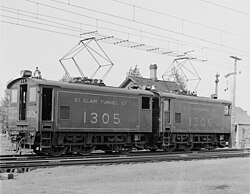
The Evolution of Locomotives
While steam locomotives initially powered the trains, they posed a significant risk: the danger of suffocation for crews if a train stalled inside the tunnel. To solve this, the railway installed catenary wires—overhead electrical lines—by 1907, allowing for the introduction of electric locomotives.
On May 17, 1908, electric locomotives built by Baldwin-Westinghouse entered regular service. By 1909, a fleet of six locomotives was in operation. These powerful machines weighed 65 short tons each and were powered by three 240 hp (180 kW) single-phase motors operating on a 3,300-volt, 25 cycle current. To handle 1,000 short ton trains on the 2% grade, the railway typically used double heading (employing two locomotives at the front of a train). These trains traveled at speeds between 20 and 30 miles per hour across the 4-mile electric line.
Corporate Transitions and Retirement
In 1923, the Grand Trunk Railway was nationalized by the Canadian federal government and merged into the Canadian National Railway (CN). CN took over the tunnel company and the Grand Trunk Western subsidiary, maintaining operations for several more decades. The electric locomotives remained in use until 1958 and were scrapped in 1959. Their retirement coincided with the withdrawal of steam locomotives, as modern diesel engines did not present the same air quality concerns in the short tunnel.
Operational Challenges and Legacy
As the era of post-World War II logistics arrived, the physical dimensions of freight cars began to increase. The St. Clair Tunnel, fixed in its 19th-century diameter, became a bottleneck. Canadian National was forced to return to rail ferries for oversized cargo, including chemical tankers, automobile carriers, intermodal cars, and hicube boxcars (extra-tall freight cars).
Despite these limitations, the tunnel's historical significance is undisputed. It has received numerous prestigious designations:
- 1991: Designated a Civil Engineering Landmark by both the American and Canadian Societies of Civil Engineers.
- 1992: Recognized as a National Historic Event by Parks Canada.
- 1993: Declared a U.S. National Historic Landmark.
Key Facts
- Opened: 1891 by the St. Clair Tunnel Company.
- Length: 6,025 feet (1,836 m) from portal to portal.
- Construction Cost: $2.7 million (approx. $96.8 million in 2025).
- Technology: Used the Beach tunnelling shield and compressed air excavation.
- Electric Era: Baldwin-Westinghouse electric locomotives operated from 1908 to 1958.
- Power: 3,300-volt, 25 cycle, single phase current.
| Feature | Detail |
|---|---|
| Tube Diameter | 19 feet 10 inches (6.05 m) |
| Track Configuration | Single standard gauge track |
| Electric Loco Weight | 65 short tons (59.0 t) |
| Max Draw Bar Pull | 40,000 lbf (180 kN) |
| Operating Speed | 20 to 30 mph (32 to 48 km/h) |
Frequently Asked Questions
Why were electric locomotives introduced in the St. Clair Tunnel?
Electric locomotives were introduced in 1908 to replace steam engines because of safety concerns regarding suffocation if a train were to stall inside the tunnel.
What was the Beach tunnelling shield?
The Beach tunnelling shield, designed by Alfred Ely Beach, was a specialized piece of equipment used to protect workers and assist in the removal of material during the excavation of the tunnel.
Why did Canadian National eventually return to using rail ferries?
After World War II, freight cars became larger. High-cube boxcars and other oversized equipment exceeded the tunnel's diameter, making it impossible for them to pass through.
Who designed the original St. Clair Tunnel?
The tunnel was designed by Joseph Hobson, who implemented original techniques for excavating in compressed air environments.
What honors has the tunnel received for its engineering?
The tunnel is a U.S. National Historic Landmark, a Canadian National Historic Event, and a Civil Engineering Landmark recognized by both the American and Canadian Societies of Civil Engineers.