St Andrew's Cathedral: A Gothic Revival Landmark in Inverness
Situated near the banks of the River Ness in the heart of Inverness, St Andrew's Cathedral (known in Scottish Gaelic as Cathair-Eaglais Inbhir Nis) stands as a testament to 19th-century faith and architecture. As the seat of the Bishop of Moray, Ross and Caithness, this cathedral serves as a spiritual hub for the Scottish Episcopal Church and holds a unique place in British ecclesiastical history.
The cathedral is distinguished not only by its beauty but by its geography; it is the northernmost extant diocesan cathedral in mainland Britain. While other historic sites like Dornoch, Fortrose, and Elgin Cathedrals exist, they no longer function as diocesan cathedrals. Furthermore, St Andrew's holds the honor of being the first new Protestant cathedral completed in Great Britain following the Reformation.
Key Facts
- Location: Inverness, Scotland, near the River Ness.
- Denomination: Scottish Episcopal Church (High Church).
- Construction Period: 1866–1869.
- Architectural Style: Gothic Revival.
- Unique Record: Home to the world's most northerly peal of change-ringing bells.
- Materials: Built with red Tarradale stone and Peterhead granite columns in the nave.
History and Architecture
The vision for the cathedral was driven by Bishop Robert Eden, who determined that the united Diocese of Moray, Ross and Caithness required a central seat in Inverness. The congregation's roots trace back to 1853, when it began as a mission on the east side of the River Ness.
Construction officially commenced in 1866, with the foundation stone laid by Charles Longley, the Archbishop of Canterbury. The building was designed by local architect Alexander Ross in the Gothic Revival style—an architectural movement that sought to revive medieval Gothic forms. Although the original plans featured two giant spires, a lack of funding meant these were never constructed.
The structure is characterized by its use of red Tarradale stone, while the interior nave is supported by sturdy columns crafted from Peterhead granite.
Artistic and Musical Treasures
Stained Glass
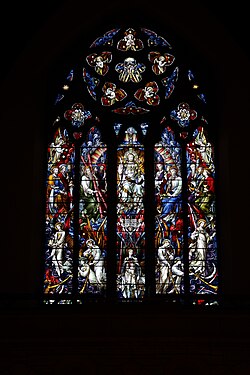
The cathedral's interior is illuminated by exquisite stained glass designed and installed by the renowned firm Hardman & Co. The most prominent of these is the Great West Window, which depicts "Christ in Majesty at the Last Judgement" and was installed as a memorial to Bishop Eden.
The Bells
St Andrew's is globally recognized for its ring of ten bells. These are noted as the most northerly peal of change-ringing bells (a style of ringing where bells are rung in a series of mathematical patterns) in any church in the world. The tenor bell in this set weighs 17 cwt.
Cathedral Administration and Leadership
The cathedral is currently under the leadership of Bishop Mark Strange. Throughout its history, the role of Provost has been held by various leaders, from the founding Bishop Robert Eden to the current Provost, Sarah Murray, who has served since 2017.
The musical tradition of the cathedral is equally rich, having been shaped by a long line of organists and directors of music, including the current Director of Music and Organist, Adrian Marple.
| Feature | Detail |
|---|---|
| Founder | Bishop Robert Eden |
| Architect | Alexander Ross |
| Built | 1866–1869 |
| Diocese | Moray, Ross & Caithness |
| Key Material | Red Tarradale stone & Peterhead granite |
| Notable Art | Hardman & Co. stained glass |
Frequently Asked Questions
What makes St Andrew's Cathedral historically unique?
It was the first new Protestant cathedral to be completed in Great Britain since the Reformation and remains the northernmost extant diocesan cathedral in mainland Britain.
Who designed the cathedral?
The cathedral was designed by Alexander Ross, an architect based in the city of Inverness.
What is special about the cathedral's bells?
The cathedral houses a ring of ten bells, which are the most northerly peal of change-ringing bells in a church anywhere in the world.
What is depicted in the Great West Window?
The Great West Window, created by Hardman & Co., depicts "Christ in Majesty at the Last Judgement" and serves as a memorial to Bishop Robert Eden.
Why does the cathedral not have its original spires?
Although the original design by Alexander Ross included two giant spires, they were not built due to a lack of funds during the construction period.