Sporting Nationalism: How Athletics Shape National Identity Across the Globe
Sports are rarely just about games; they are powerful vehicles for expressing national identity, resisting colonial influence, and fostering unity. From the frozen rinks of Canada to the cricket pitches of India, athletic competition often mirrors the political and social evolution of a nation. By examining how different countries utilize sport, we can see a clear pattern of how physical competition helps define who a people are and where they stand in the world.
Canada: Balancing Autonomy and American Influence
Canada's sporting journey began with a strong tie to the Anglo-Saxon world, a remnant of its history within the British Empire. However, following World War I, Canadians shifted toward North American sports, viewing them as less exclusionary and a means to pursue greater autonomy through sporting nationalism—the use of sports to build a distinct national identity.
Ice hockey stands as the most significant unifying force in the country. Yet, this nationalism is complex. Professor Bruce Kidd notes a cultural ambiguity in the sport because the National Hockey League (NHL), while founded in Canada, is primarily driven by the American market. This "Americanization" of sport has been evident since the 1960s, leading the Canadian government to protect domestic interests, such as restricting American involvement in the Canadian Football League.
![Canadians during a 2010 Winter Olympics gold medal match against the United States[24]](/images/9d/e9/9de9d3bb64faf78260cdcd8eb461d784b5c420d3a74a05f1dc7642abf53622b7.jpg)
In the 21st century, the Canadian government has shifted its focus toward funding high-level international performance over grassroots athletics, believing that international victories are essential for nation-building.
Cuba: Baseball as a Tool for Independence
In Cuba, baseball served as more than a pastime; it was a critical tool for colonial Cuba to assert its uniqueness and independence from Spain. Following the achievement of independence, the sport continued to play a pivotal role in shaping Cuba's complex diplomatic and cultural relations with the neighboring United States.
India: From Colonial Resistance to Global Dominance
The Era of British India
During the colonial period, sports became a battleground for identity. Football emerged as an equalizing game that bridged class divides and aligned with global anti-imperialist movements, particularly in left-wing regions like West Bengal and Kerala. At the time, British narratives often characterized Indians as effeminate to justify colonial superiority. Indians resisted these stereotypes through physical prowess, viewing victories over British teams as a vital part of a national revival.
![Kodi Rammurthy Naidu lifting an elephant; his strongman efforts were meant to counter British accusations of Indian effeteness[31]](/images/87/b8/87b87d132ccdcbf2de92a8ed3823deab0a69aaa5d653544e18dd8813405ea166.png)
Postcolonial Triumph and Modern Identity
The transition to independence was marked by a symbolic victory at the 1948 Summer Olympics, where the Indian hockey team defeated Great Britain 4–0 at London's Empire Stadium. For athletes like Balbir Singh Sr., the sight of the Tiranga (the Indian national flag) rising was a profound realization of the freedom his father had fought for.
By the 1990s, cricket—a sport introduced by the British—was reclaimed as a symbol of India's economic growth and global success. Icons like Sachin Tendulkar became vessels for national aspirations. However, this passion can be intense; in some instances, Indian supporters of the Pakistani cricket team have faced imprisonment following India–Pakistan matches.
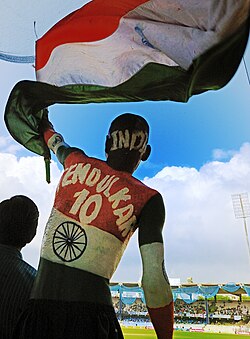
Parallel to global sports, there has been a push to revive ancient physical cultures and traditional games, such as kabaddi and kho kho. These are sometimes integrated into projects of Hindu nationalism, supported by the Rashtriya Swayamsevak Sangh (RSS), to strengthen the nation through cultural and physical rejuvenation.
United States: Unity, Exceptionalism, and Identity
American sporting traditions, consolidated in the late 19th century, have long symbolized national unity. Baseball, in particular, became the "national pastime" during the 1860s Civil War, helping to reunify the country in the war's aftermath. The tradition of the President throwing the ceremonial first pitch, started in 1910, further cemented baseball's role in the national fabric.
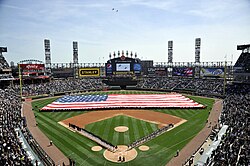
The U.S. also utilized sports and ideologies like Muscular Christianity—a movement emphasizing physical health and Christian morality—to shape its imperial encounters and foster a sense of American exceptionalism. Following the World Wars, patriotism became deeply embedded in the sporting experience, evidenced by the standard practice of playing the national anthem before games.
In the late 20th century, the National Football League (NFL) began playing a major role in shaping American identity. The league's association with military characteristics and the high visibility of African American athletes have contributed to national narratives of interracial unity and equal opportunity.
Key Facts
- Canada: Ice hockey is the primary unifying sport, though the NHL's reliance on the U.S. market creates cultural ambiguity.
- Cuba: Baseball was instrumental in asserting independence from Spain.
- India: The 1948 Olympic hockey victory over Britain served as a powerful symbol of post-colonial freedom.
- India: Traditional games like kabaddi and kho kho are linked to national rejuvenation efforts.
- United States: Baseball helped reunify the nation after the Civil War.
- United States: The NFL has influenced modern American identity through military associations and interracial representation.
| Country | Primary Sport(s) | National Significance | Key Driver |
|---|---|---|---|
| Canada | Ice Hockey | National Unity | Autonomy from British/US influence |
| Cuba | Baseball | Independence | Differentiation from Spain |
| India | Cricket, Hockey, Kabaddi | Anti-colonialism & Growth | National revival and rejuvenation |
| United States | Baseball, American Football | Unity & Exceptionalism | Post-war patriotism and reunification |
Frequently Asked Questions
How did baseball help the United States after the Civil War?
Baseball became the national pastime during the 1860s, serving as a cultural bridge that helped reunify the country in the aftermath of the conflict.
What is the significance of the 1948 Olympic hockey match for India?
Occurring one year after independence, India's 4–0 victory over the British team in London was a powerful symbol of national liberation and pride.
Why is there "cultural ambiguity" in Canadian hockey?
While hockey is central to Canadian identity, the National Hockey League (NHL) is primarily supported by the American market, leading to a tension between national pride and Americanization.
Which traditional Indian games are linked to national rejuvenation?
Kabaddi and kho kho have been identified as part of projects to bolster national rejuvenation through physical and cultural strengthening, often supported by the RSS.
How did sports counter British stereotypes in India?
By achieving success against British teams, Indians were able to resist colonial accusations of effeminacy and demonstrate their strength and superiority.