Spermatozoon: Anatomy, Function, and Biological Mechanics
The spermatozoon, commonly known as the sperm cell, is a highly specialized motile cell designed for a single primary purpose: to penetrate the protective coating of an ovum and deliver genetic material to achieve fertilization. This biological journey requires a precise combination of structural efficiency, chemical weaponry, and locomotive power.
Key Facts
- Structure: Divided into a head and a tail (flagellum) connected by a neck.
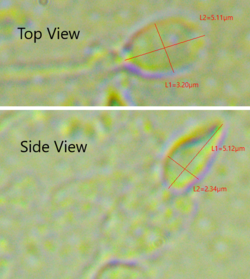
- Human Dimensions: The head is approximately 5.1 by 3.1 μm, while the tail is about 50 μm long.
- Speed: Human sperm typically propel themselves at a rate of 1 to 3 millimetres per minute.
- Chemical Tool: The acrosome contains enzymes like acrosin and hyaluronidase to breach the egg's outer layers.
- Genetic Payload: The head contains a nucleus with densely coiled chromatin fibers.
Anatomy of the Mammalian Sperm Cell
The mammalian spermatozoon is engineered for mobility and penetration, consisting of two primary regions connected by a neck.
The Head
The head is disc-shaped and houses the nucleus, where genetic information is stored in densely coiled chromatin fibers. At the anterior end of the head lies the acrosome, a thin, flattened sac derived from the Golgi body. This structure acts as a chemical reservoir, containing enzymes such as spermlysin (including hyaluronidase, corona-penetrating enzyme, zona lysin, or acrosin) that are essential for penetrating the female egg. The head also contains vacuoles.
The Tail (Flagellum)
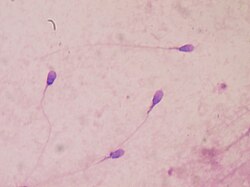
The tail, or flagellum, is the longest portion of the cell, measuring approximately 50 μm. It generates wave-like motions that propel the sperm forward through the reproductive tract and assist in the final penetration of the ovum. While previously thought to move in a symmetrical helical shape, this locomotive organ allows the cell to swim at speeds between 1 and 3 millimetres per minute.
The Process of Fertilization
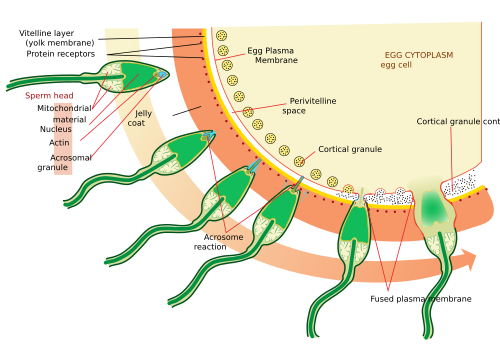
For fertilization to occur, the sperm must undergo a series of complex biological changes. As the spermatozoon approaches the ovum, it triggers the acrosome reaction. During this event, the membrane surrounding the acrosome fuses with the plasma membrane of the sperm's head, releasing the stored enzymes to digest the egg's outer coatings.
Comparative Biology and Diversity
While human sperm are well-studied, motile sperm cells exist across a vast array of organisms, including algae and seedless plants, demonstrating the evolutionary persistence of flagellar motility for reproduction.
![Motile sperm cells of algae and seedless plants[69]](/images/7d/14/7d146ff2a28df5f74b7f96b859b3c746768c1dd38cdb0bf4d4c74269b249fcee.png)
| Feature | Detail/Measurement | Primary Function |
|---|---|---|
| Head Size | ~5.1 x 3.1 μm | Genetic storage and enzyme delivery |
| Tail Length | ~50 μm | Locomotion and propulsion |
| Swimming Speed | 1–3 mm/min | Reaching the ovum |
| Acrosome Contents | Hyaluronidase, Acrosin, etc. | Penetrating the egg coating |
Frequently Asked Questions
What is the acrosome reaction?
The acrosome reaction is the process where the sperm's acrosomal membrane fuses with its plasma membrane, releasing enzymes that allow the sperm to penetrate the protective layers of the ovum.
How fast does a human sperm cell swim?
A human sperm cell typically moves at a speed of 1 to 3 millimetres per minute.
What is the function of the flagellum?
The flagellum, or tail, provides the wave-like motion necessary to propel the sperm toward the egg and helps the cell penetrate the egg's surface.
What enzymes are found in the acrosome?
The acrosome contains several enzymes used for penetration, including spermlysin, hyaluronidase, corona-penetrating enzyme, zona lysin, and acrosin.
What are the dimensions of a human sperm head?
The head of a human sperm is disc-shaped and measures approximately 5.1 μm in length by 3.1 μm in width.