Spatialism: Lucio Fontana and the Evolution of Space in Art
Founded in Milan in 1947 by the Argentine-Italian artist Lucio Fontana, Spatialism (or Spazialismo) emerged as a revolutionary movement that sought to redefine the boundaries of artistic expression. Rather than treating the canvas as a flat surface for representation, Fontana proposed a synthesis of color, sound, space, movement, and time, aiming to create a new type of art that resonated with the spirit of the post-war era.
The Philosophy of the White Manifesto
The conceptual foundations of Spatialism were first outlined in Fontana's Manifiesto blanco (White Manifesto), published in Buenos Aires in 1946. In this document, Fontana repudiated the "virtual" or illusory space characteristic of traditional easel painting. He argued that art should move beyond the two-dimensional plane and instead unite with science to project form and color into real, physical space.
To achieve this, Fontana advocated for the use of modern technology, including television and neon lighting. While five subsequent manifestos were published, they remained largely focused on the negative aspects of traditional art, defining the essence of Spatialism as "plastic emotions and emotions of colour projected upon space."
![Roberto Crippa [it], Spiralis. Photo by Paolo Monti, 1953 (Fondo Paolo Monti, BEIC).](/images/8f/f3/8ff3dd83f06c2324682b8edfeacd254c4c1c2ae81440679b02eaf8794214e262.jpg)
From Environments to Slashed Canvases
Fontana's exploration of space manifested in several groundbreaking ways. In 1947, he created the "Black Spatial Environment," a room painted entirely black. This installation is widely regarded as a precursor to Environment art, where the artwork is not a discrete object but an immersive space.
Perhaps his most iconic contribution to the movement was the physical manipulation of the canvas. Beginning in 1949, Fontana began stabbing his canvases, and by 1959, he transitioned to slashing them with a razor blade. These acts were not merely destructive; they were intended to break the surface and open the painting to the actual space behind it. A notable example of this technique is Spatial Concept Waiting (1960), currently held at the Tate in London.
Through these gestures, Fontana became one of the first European and Latin American artists to promote the idea of art as a gesture or performance, shifting the focus from the creation of a permanent physical object to the act of creation itself.
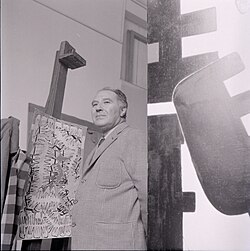
![Cesare Peverelli [it]. Photo by Paolo Monti.](/images/b0/af/b0af469bff19b65ea3f32ffbfa68332000f3ea5119f2abe97f5835a5c6b7967f.jpg)
Cyber-Spatialism: The Digital Extension
The influence of Spatialism extended into the 21st century through the work of Franco-German artists Cécile Colle and Ralf Nuhn. In 2005, they launched a project titled "Cyber-Spatialism," which updated Fontana's concepts for the digital age.
By replacing Fontana's physical slashes with computer connectors inserted into the canvases, Colle and Nuhn suggested an extension of the artwork into cyberspace. This evolution addresses the contemporary notion that in a globalized culture, physical real space is increasingly being supplanted by virtual space.
Key Facts
- Founder: Lucio Fontana, an Argentine-Italian artist.
- Origin: Established in Milan in 1947.
- Core Goal: To synthesize color, sound, space, movement, and time.
- Key Document: The Manifiesto blanco (White Manifesto), 1946.
- Signature Techniques: Slashed canvases (razor blade) and stabbed canvases.
- Legacy: Foreshadowed Environment art and the concept of art as performance.
| Phase | Key Focus | Primary Medium/Technique | Notable Example |
|---|---|---|---|
| Early Spatialism | Real space & technology | Neon, TV, Black rooms | Black Spatial Environment (1947) |
| Mature Spatialism | Physicality & Gesture | Slashed/Stabbed canvases | Spatial Concept Waiting (1960) |
| Cyber-Spatialism | Virtual space | Computer connectors | Colle and Nuhn series (2005) |
Frequently Asked Questions
What is the main goal of Spatialism?
The main goal of Spatialism was to move art beyond the illusory space of traditional painting and instead synthesize color, sound, space, movement, and time into a new form of art that existed in real space.
Why did Lucio Fontana slash his canvases?
Fontana slashed his canvases to break the two-dimensional plane of the painting, allowing the artwork to interact with the actual physical space behind the canvas, thereby embodying the movement's spatial philosophy.
What was the White Manifesto?
Published in 1946 in Buenos Aires, the White Manifesto was the foundational document of Spatialism, where Fontana called for a new "spatial" art that aligned with the post-war age and integrated science and technology.
How does Cyber-Spatialism differ from original Spatialism?
While original Spatialism focused on projecting art into physical real space, Cyber-Spatialism uses computer connectors to suggest that the canvas extends into cyberspace, reflecting the shift from real space to virtual space in globalized culture.
Is Spatialism considered a form of performance art?
Yes, Lucio Fontana is recognized as one of the first artists to promote the idea of art as a gesture or performance, emphasizing the act of creating the work over the final physical object.