South Florida
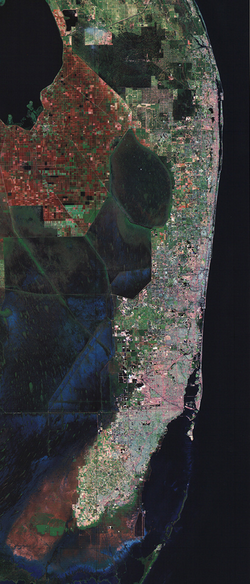
South Florida, often colloquially referred to as "SoFlo," is the southernmost region of the state of Florida and the southernmost point of the continental United States. It is uniquely distinguished as the only part of the continental U.S. to feature areas with a tropical climate. The region is a vibrant blend of urban density and wild nature, dominated by the sprawling Miami metropolitan area and the vast wetlands of the Everglades.
Beyond its urban centers, the region encompasses the Florida Keys and three prominent U.S. national parks: Biscayne, Dry Tortugas, and Everglades.
Key Facts
- Total Population: 9,484,409 (as of 2020).
- Largest City: Miami.
- Climate: The only region in the continental U.S. with tropical climate zones.
- Key Geography: Includes the Florida Keys, the Everglades, and the Miami metro tri-county area.
- Cultural Fusion: Home to "Floribbean" cuisine, blending Caribbean, Latin American, Asian, and Floridian influences.
Defining the Region
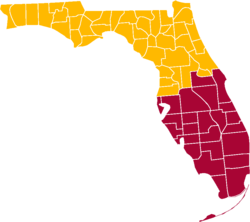
Because South Florida is a vernacular region, it has no official legal boundaries. Definitions vary depending on the source. A 2007 study by Ary Lamme and Raymond K. Oldakowski found that residents generally identify South Florida as the area from Jupiter (the northernmost town in Palm Beach County) southward.
Most commonly, the term refers to the tri-county Miami metropolitan area, consisting of Miami-Dade, Broward, and Palm Beach counties. However, other interpretations include the "Treasure Coast" (Indian River, St. Lucie, and Martin counties) and the Florida Keys (Monroe County). Interestingly, while the University of South Florida was named for its position as the state's southernmost public university in 1957, it is located in Tampa, which is considered part of Central Florida.
Demographics and Political Landscape
The population of South Florida is characterized by high levels of migration. A significant portion of the residents were born outside the United States, with over 87.2% of those foreign-born residents originating from Latin America.
| Place of Birth | Percentage of Population |
|---|---|
| Outside of the U.S. | 34.8% |
| Elsewhere in the U.S. | 33.0% |
| State of Florida | 32.2% |
Politically, the region is diverse. Democratic support is heavily concentrated in urban centers, downtown Key West, and rural communities like Immokalee and Belle Glade. Republican support is more prevalent in the coastal regions north of Pompano Beach, the Everglades, the area between Port St. Lucie and Riviera Beach, and the majority of inland rural areas.
Culture and Local Identity
The Miami Accent
A distinct regional accent has emerged in South Florida, particularly among American-born youth in Miami-Dade, Broward, Palm Beach, and Monroe counties. While based on standard American English, it shares similarities with Mid-Atlantic dialects (such as New York and Northern New Jersey). Unlike many Southern dialects, the Miami accent is rhotic (pronouncing the "r" sound) and incorporates a syllable-timed rhythm heavily influenced by Spanish.
Cuisine and Arts
South Florida is the only region in the state where ethnic foods are as popular as general American cuisine. This has led to the creation of Floribbean cuisine, a fusion of Latin American, Caribbean, Asian, and Floridian flavors. Musically, the region shows a strong preference for Latin music over country music, which is more popular in North and Central Florida.
Urban Planning and Development
The growth pattern of South Florida is unusual. Rather than a centralized city surrounded by suburbs, development is restricted to a dense, narrow strip along the coast. This leaves much of the interior as preserved natural areas or agricultural reserves. This decentralized, continuous urban corridor is expected to persist as the region grows.
Partition Proposals
Due to cultural, economic, and political frustrations with the state government in Tallahassee (located in North Florida), there have been several proposals to split Florida into two states. These are generally viewed as political statements rather than serious secession attempts.
- 2008: The North Lauderdale City Commission called for a new state comprising Palm Beach, Broward, Miami-Dade, and Monroe counties.
- 2014: South Miami's city commission proposed a partition that would have created a State of South Florida consisting of 24 counties.
Frequently Asked Questions
What counties are typically included in South Florida?
Most commonly, it refers to the tri-county area of Miami-Dade, Broward, and Palm Beach. Broader definitions include Monroe County (the Keys) and the Treasure Coast counties of Indian River, St. Lucie, and Martin.
What is Floribbean cuisine?
Floribbean is a fusion style of cooking unique to South Florida that blends influences from Floridian, Caribbean, Latin American, and Asian cuisines.
Is the Miami accent different from other Southern accents?
Yes. Unlike many Coastal Southern dialects, the Miami accent is rhotic and its rhythm is heavily influenced by the syllable-timed nature of the Spanish language.
Why is the University of South Florida in Tampa?
At the time of its founding in 1957, it was the southernmost public university in the state, which led to its name, even though Tampa is now considered part of Central Florida.
What are the primary industries in South Florida?
Tourism is by far the most significant industry in the region, supported by a smaller but vibrant agricultural sector.