South America Demographics: Population, Ethnicity, and Cultural Diversity
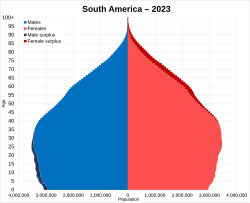
South America is a continent of immense scale and diversity, home to an estimated 418.76 million people as of 2017. From the dense urban hubs of Brazil and Argentina to the remote reaches of the Amazon rainforest, the region's demographic landscape is a complex tapestry woven from indigenous roots, colonial history, and global migration patterns.
Population and Density
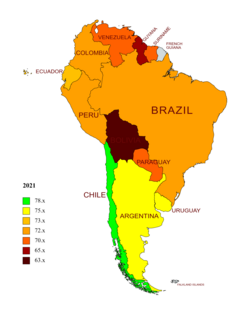
The distribution of people across South America varies significantly. Brazil stands as the most populous nation, accounting for over half of the continent's total population. In contrast, territories like the South Georgia and South Sandwich Islands maintain nearly zero population density.
| Country / Territory | Area (km²) | Population | Density (per km²) | Capital |
|---|---|---|---|---|
| Argentina | 2,766,890 | 44,293,293 | 16.0 | Buenos Aires |
| Bolivia | 1,098,580 | 11,138,234 | 10.13 | La Paz and Sucre |
| Brazil | 8,514,877 | 217,240,060 | 24.35 | Brasília |
| Chile | 756,950 | 17,789,267 | 23.5 | Santiago |
| Colombia | 1,138,910 | 47,698,524 | 41.88 | Bogotá |
| Ecuador | 283,560 | 16,290,913 | 57.45 | Quito |
| Guyana | 214,999 | 737,718 | 3.43 | Georgetown |
| Paraguay | 406,750 | 6,943,739 | 17.07 | Asunción |
| Peru | 1,285,220 | 31,036,656 | 24.14 | Lima |
| Suriname | 163,270 | 591,919 | 3.62 | Paramaribo |
| Uruguay | 176,220 | 3,360,148 | 19.06 | Montevideo |
| Venezuela | 912,050 | 31,304,016 | 34.32 | Caracas |
Urbanization is a defining characteristic of the region, with massive metropolitan areas concentrating millions of residents. São Paulo leads as the largest center with over 21 million people, followed by Buenos Aires and Rio de Janeiro.
Key Facts
- Total Population: Approximately 418.76 million (2017).
- Dominant Religion: Christianity (90%), with Catholicism being the most prevalent.
- Largest City: São Paulo, Brazil.
- Indigenous Presence: Significant populations in Bolivia (66.4%), Peru (25%), and Ecuador (25%).
- Global Diasporas: Brazil hosts the largest Japanese diaspora outside of Japan.
Ethnic Composition and Migration
South America's racial makeup is highly diverse, resulting from centuries of admixture. The population includes 180 million people of European descent, including significant Italian, German, and Spanish diasporas. Brazil and Argentina host the largest numbers of these groups, with Brazil alone having 31 million people of Italian descent and 15.7 million of German, Austrian, Luxembourger, and Swiss descent.
The region also features a substantial Mestizo population (people of mixed European and Indigenous ancestry), totaling 124 million when including Castizo and Caboclo groups. Pure Indigenous populations number approximately 27 million, primarily concentrated in the Andean regions of Peru, Bolivia, and Ecuador.
African influence is prominent, with 66 million people identifying as Black or Mulatto (mixed European and African ancestry). This is particularly evident in Brazil, Colombia, Venezuela, and the Guianas. The Guianas are also home to the Maroons, descendants of escaped African slaves who settled along the Maroni River.
Asian migration has also left a mark, with over 5 million Asians residing on the continent. Peru and Venezuela have significant Chinese populations from the 19th-century coolie trade, while Brazil hosts the largest Japanese (1.8 million) and Korean (140,000) communities.
Indigenous Peoples and Languages
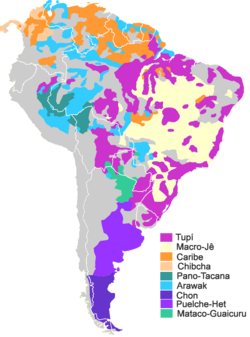
Indigenous cultures remain a vital part of the South American identity, though their prevalence varies by country:
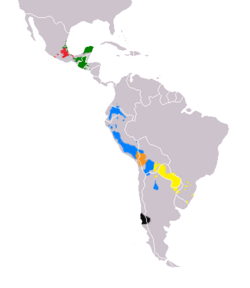
- Bolivia: The highest proportion of indigenous identification, with 66.4% of the population. The Quechua and Aymara are the largest groups.
- Peru and Ecuador: Both have indigenous populations around 25%, with Highland Quichuas dominating the Ecuadorian Sierra region.
- Brazil: While Amerindians make up 0.4% of the population, Brazil is notable for having the world's highest number of uncontacted tribes (67 confirmed as of 2007).
- Colombia: Home to at least 85 distinct cultures, including the Muisca, known for their gold work.
- Argentina and Chile: The Mapuche are among the most populous indigenous groups in these nations.
Religious Landscape
Religion is a central pillar of South American society. Approximately 90% of the population identifies as Christian, with 82% being Catholic. The remaining 8% consist of other denominations, including traditional Protestants, Evangelicals, and Orthodox Christians. However, secularism is more pronounced in certain areas; for example, 41% of Uruguayans identify as having no religion.
Frequently Asked Questions
Which country in South America has the largest population?
Brazil is the most populous country in South America, with an estimated 217,240,060 people as of 2017.
What is the most common religion in South America?
Christianity is the most common religion, practiced by about 90% of the population, with Catholicism being the dominant denomination at 82%.
Which South American country has the highest percentage of indigenous people?
Bolivia has the highest percentage, with approximately 66.4% of its population registered as indigenous in the 2001 Census.
Where is the largest Japanese population outside of Japan located?
The largest Japanese diaspora outside of Japan is located in Brazil, which is home to 1.8 million people of Japanese descent.
What are the largest metropolitan areas in the region?
The largest metropolitan areas are São Paulo (Brazil), Buenos Aires (Argentina), and Rio de Janeiro (Brazil).