SOAS University of London: A History of Global Study and Academic Evolution
The School of Oriental and African Studies (SOAS) stands as one of the world's most specialized institutions for the study of Asia and Africa. From its inception as a strategic tool of the British state to its current status as a global hub for humanities and social sciences, the school has mirrored the shifting geopolitical landscape of the last century.
Origins and Founding Mission
Founded in 1916, the School of Oriental Studies began its journey at 2 Finsbury Circus in London, occupying the former premises of the London Institution. After receiving its royal charter on June 5, 1916, the school welcomed its first students on January 18, 1917. The institution was formally inaugurated on February 23, 1917, by King George V, with notable attendees including Earl Curzon of Kedleston, the former Viceroy of India.
The British state established the school to bolster its political, commercial, and military influence across Asia and Africa. Its primary purpose was to train colonial administrators, military officers, commercial managers, missionaries, doctors, and teachers. These professionals received instruction in the languages of their postings, alongside authoritative studies of local laws, religions, customs, and history.
Beyond practical administration, the school aimed to advance British science and scholarship, positioning the University of London as a competitor to the prestigious oriental schools in Paris, Petrograd, and Berlin. In 1938, the school expanded its formal identity by adding "Africa" to its name.
![The former premises of the London Institution in Finsbury Circus which originally housed SOAS and was demolished soon after being sold in 1936[10]](/images/50/8b/508b57a1a5a7d5ca197badcb58adc38424c0dd7135b21ff4b6fa235b6c435793.jpg)
The Impact of the Second World War
The mid-1930s saw the school transition through various locations, including Vandon House and Clarence House, before moving toward its current home in Bloomsbury. However, the onset of World War II disrupted these plans; the half-completed Bloomsbury building was damaged during the Blitz in September 1940.
Following government advice, the school was evacuated in 1939 and temporarily billeted at Christ's College, Cambridge. By 1940, the institution returned to London, operating briefly out of eleven rooms at Broadway Court.
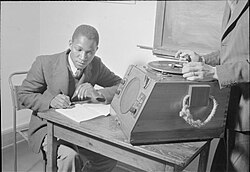
In 1942, a strategic partnership with the War Office led to the creation of State Scholarships. These were awarded to grammar and public-school boys with a talent for languages to train as military interpreters in Turkish, Persian, Japanese, and Chinese. Based at Dulwich College, these students became known as the "Dulwich boys." Notable alumni of this program include Sir Peter Parker, Ronald Dore, and Charles Dunn, the latter of whom became a distinguished Japanologist and recipient of the Order of the Rising Sun.
Post-War Expansion and Modern Era
The 1946 Scarborough Commission—officially the Commission of Enquiry into the Facilities for Oriental, Slavonic, East European and African Studies—recommended a significant expansion of Asian studies. This led to a period of growth, including the 1947 establishment of the SOAS School of Law under its first head, Seymour Gonne Vesey-FitzGerald.
While economic austerity slowed growth in the early 1950s, the appointment of Sir Cyril Philips as director in 1956 marked a turning point. Over two decades, Philips raised critical funds and broadened the school's academic remit. Today, as a college of the University of London, SOAS specializes in Languages, Humanities, Social Sciences, and Law.
The SOAS Library, housed in the Philips Building, is now the largest resource of its kind globally for materials relating to Africa and Asia. The student population has grown from fewer than 1,000 in the 1970s to over 6,000 today, with nearly half being postgraduate students. The school also maintains a partnership with the Institut National des Langues et Civilisations Orientales (INALCO) in Paris.
Institutional Evolution and Identity
In 2011, the Privy Council granted SOAS the authority to award degrees in its own name, a change that took effect for students registering from September 2013. In 2012, the school updated its visual identity. The gold SOAS tree symbol, originally created in 1989, was redesigned to feature leaves from ten different trees, representing the diverse regions the school serves:
- England: English Oak
- Asia: Bodhi, Coral Bark Maple, and Teak
- Africa: Mountain Acacia, African Pear, and Lasiodiscus
- Middle East: Date Palm, Pomegranate, and Ghaf
Key Facts
- Founded: 1916 (Royal Charter granted June 5, 1916).
- Original Purpose: Training for colonial administrators, military officers, and commercial managers.
- Library: The world's largest national resource for Asia and Africa materials.
- Student Growth: Increased from <1,000 in the 1970s to over 6,000 currently.
- Degree Status: Authorized to award degrees in its own name since September 2013.
| Feature | Detail |
|---|---|
| Founding Date | 1916 |
| Primary Focus | Asia, Africa, and the Middle East |
| Key Academic Fields | Law, Social Sciences, Humanities, Languages |
| Global Partner | INALCO (Paris) |
| Current Student Body | 6,000+ |
Student Politics and Campus Climate
SOAS is known for a highly active and politically engaged student body. In 2005, the Students' Union became the first in the UK to hold a referendum supporting the Boycott Divestment and Sanctions (BDS) movement regarding stocked goods, followed by a broader adoption of BDS directions in 2015.
Recent years have seen tensions regarding the university's investments in Israel. In 2022, students occupied management offices for nine days, resulting in eviction costs of £200,000. More recently, the suspension of seven students protesting partnerships with Haifa University led to accusations of political repression, while the university cited community safety. Additionally, disputes have arisen over the display of Palestinian flags, which the university stated violated safeguarding policies.
The campus environment has also been a subject of debate regarding antisemitism. The SOAS Jewish Society is the first of over 75 UK campus Jewish societies to declare itself anti-Zionist. However, reports have emerged of conflicting experiences; while some Jewish figures feel more comfortable at SOAS than elsewhere in the UK, others have left the institution. In 2020, The Guardian reported that a student was refunded £15,000 in fees after citing a "toxic antisemitic environment." In 2024, the administration's decision to exclude the Jewish Society from a high-level meeting on antisemitism and the advertisement for a new Jewish Chaplain led to concerns that the existing student-led society might be replaced by a top-down structure.
Frequently Asked Questions
Why was SOAS originally founded?
SOAS was established by the British state to strengthen Britain's military, commercial, and political presence in Asia and Africa by providing language and cultural training to colonial officials and other professionals.
What is the significance of the SOAS Library?
The SOAS Library is the UK's national resource for materials relating to Asia and Africa and is recognized as the largest library of its kind in the world.
How did World War II affect the school?
The school was evacuated to Christ's College, Cambridge, and its Bloomsbury building was damaged during the Blitz. It also collaborated with the War Office to train military translators, known as the "Dulwich boys."
Can SOAS award its own degrees?
Yes. Following approval from the Privy Council in 2011, all students registered from September 2013 qualify for a SOAS, University of London, award.
What does the SOAS tree symbol represent?
The symbol incorporates leaves from ten different trees, representing England (Oak), Asia (Bodhi, Coral Bark Maple, Teak), Africa (Mountain Acacia, African Pear, Lasiodiscus), and the Middle East (Date Palm, Pomegranate, Ghaf).