SMS Körös and Morava: The Life of a Danube River Monitor
The history of the river monitor SMS Körös (later renamed Morava and finally Bosna) serves as a mirror to the turbulent geopolitical shifts of Central and Eastern Europe during the first half of the 20th century. From the opening salvos of World War I to the collapse of the Axis powers in World War II, this specialized warship navigated the strategic waters of the Danube and Sava rivers, serving three different nations.
Key Facts
- Original Name: SMS Körös (Austro-Hungarian Empire).
- Later Names: Morava (Kingdom of Yugoslavia), Bosna (Independent State of Croatia).
- Primary Theater: The Danube and Sava rivers.
- WWI Role: Supported Austro-Hungarian campaigns against Serbia and Romania.
- WWII Fate: Scuttled by Yugoslav forces in 1941, later raised and sunk by a mine in 1944.
World War I: The Serbian and Romanian Campaigns
At the outbreak of World War I, the Körös was stationed at Zemun, just upstream from Belgrade. While not involved in the very first shots fired on July 28, 1914, the vessel soon became a key asset in the Austro-Hungarian effort to subdue Serbia. The conflict was characterized by a struggle for river dominance, with the Serbs receiving naval guns and mine support from Russia to counter the superior firepower of the Austro-Hungarian monitors.
In September 1914, the Körös and SMS Temes successfully breached minefields on the Sava river to engage forces near Šabac. Throughout 1915, the ship provided critical close support during the assault on Belgrade, though it suffered damage to its stack during the fighting. Following the capture of Belgrade, the vessel transitioned to escorting munitions convoys down the Danube to Lom, facilitating shipments to the Ottoman Empire.
The focus shifted in 1916 when Romania entered the war. Operating from the Belene Canal, the Körös and the Second Monitor Division conducted bombardments of the Romanian port of Giurgiu, destroying oil storage tanks, railway stations, and magazines. By 1918, the vessel's reach extended to the Black Sea; as part of Flottenabteilung Wulff (Fleet Division Wulff), it sailed to Odessa to support troops enforcing the peace agreement with Russia.
Interwar Transition and the Kingdom of Yugoslavia
The end of World War I brought a rapid succession of ownership changes. Following the Armistice of Villa Giusti in November 1918, the ship briefly served the Hungarian People's Republic before falling under the control of the newly formed Kingdom of Serbs, Croats and Slovenes (later the Kingdom of Yugoslavia). In 1920, under the Treaty of Saint-Germain-en-Laye, the vessel was officially transferred and renamed Morava.
The interwar years were marked by decline. Despite a refit between 1925 and 1926, the Yugoslav Navy struggled with budget cuts. By 1932, reports indicated a significant lack of gunnery training and naval exercises, leaving the fleet underprepared for the coming conflict.
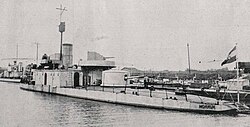
World War II and Final Fate
When the Axis powers invaded Yugoslavia on April 6, 1941, the Morava was serving as the flagship of the 2nd Mine Barrage Division on the Tisza river. After engaging German aircraft—reportedly shooting one down and capturing a Luftwaffe officer—the vessel withdrew toward Belgrade.
By April 11, 1941, the situation became untenable. Due to high water levels and low bridges that restricted movement, the commanders of the monitors Morava, Vardar, and Sava decided to scuttle their ships to prevent capture. A tragic accident occurred during the evacuation when a railway bridge exploded prematurely, killing 95 of the 110 men aboard a transport tug.
The vessel was eventually raised and repaired by the Independent State of Croatia, a puppet state of the Axis, and renamed Bosna. It served as part of a riverine police force based at Zemun. The ship's career ended in June 1944 when it struck a mine near Bosanski Novi on the River Una and sank. It was raised one final time in 1945 and broken up for scrap.
Vessel Summary
| Era | Name | Affiliation | Key Activity |
|---|---|---|---|
| WWI (1914–1918) | SMS Körös | Austria-Hungary | Serbian/Romanian campaigns; Odessa deployment |
| Interwar (1920–1941) | Morava | Kingdom of Yugoslavia | Border patrol; limited training due to budget cuts |
| WWII (1941–1944) | Bosna | Independent State of Croatia | Riverine police duties; sunk by mine |
Frequently Asked Questions
Why was the Morava scuttled in 1941?
The crew scuttled the vessel because high river water levels and low bridges prevented the monitors from navigating freely, making it impossible to retreat or maneuver effectively against the invading Axis forces.
What was the role of a river monitor?
A river monitor is a heavily armed, shallow-draft warship designed specifically for operations in rivers and coastal waters, providing fire support for ground troops and controlling strategic waterways.
How did the ship end up in Odessa?
In April 1918, the Körös was part of Fleet Division Wulff, which traveled through the mouth of the Danube and across the Black Sea to support Austro-Hungarian troops enforcing a peace agreement with Russia.
What happened to the crew after the scuttling in 1941?
Approximately 450 personnel attempted to march toward the Bay of Kotor. One large group surrendered in Sarajevo, while a smaller group reached the Bay of Kotor before being captured by the Italian XVII Corps.
How did the vessel finally sink?
While serving as the Bosna for the Independent State of Croatia, the ship struck a mine on the River Una near Bosanski Novi in June 1944.