Smart Speakers: Evolution, Technology, and Privacy in the Voice-AI Era
A smart speaker is a voice-command device equipped with an integrated virtual assistant. These devices allow users to perform interactive actions and hands-free activation using specific "wake words." Beyond simple audio playback, many smart speakers function as smart home hubs, utilizing protocols like Wi-Fi, Bluetooth, and Thread to control connected home automation devices across a local area network.
Key Facts
- Market Reach: As of summer 2022, approximately 91 million Americans (35% of adults) own a smart speaker.
- Core Technology: Uses far-field microphones and noise-cancelling software to isolate voice commands from background noise.
- Interoperability: New standards like Matter and Thread allow devices from different brands to work together.
- Accessibility: Provides critical hands-free utility for individuals with vision impairments or mobility issues.
- Security Risk: Roughly one in three IoT (Internet of Things) breaches involves a connected device.
The History of Voice-Activated Technology
The foundation for modern smart speakers was laid in 2013 with MIT's Jasper project, which pioneered the use of cloud software and multiple microphones for room-wide hands-free interaction. The commercial era began in 2014 with the launch of the Amazon Echo, powered by Alexa.
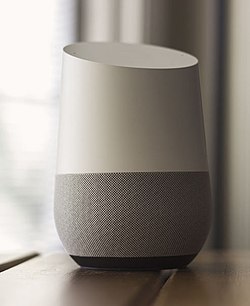
Google entered the market in 2016 with the Google Home, utilizing Google Assistant.
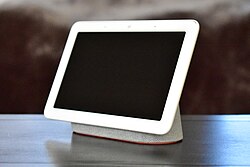
By 2017, the industry expanded into "smart displays"—devices that combine voice assistants with touchscreens—led by the Amazon Echo Show and the Google Home Hub (later rebranded as the Nest Hub).
Apple joined the trend in 2018 with the HomePod, focusing on high-fidelity audio and Siri. Other notable entries included the Sonos One (2017) and the Harman Kardon Invoke, which utilized Microsoft's Cortana. In 2019, ASUS released the Xiao-Bu speaker, though its cloud services are scheduled for termination on June 1, 2025, affecting real-time services like news and weather.
Core Features and Functionality
Audio and Voice Processing
To ensure accuracy, smart speakers employ noise suppression and echo cancellation. This allows the device to ignore background noise and focus on the user. Many models use voiceprints to recognize specific users, enabling the assistant to access personalized calendars and playlists.
Audio quality varies significantly by hardware. Entry-level devices, such as the Echo Dot or Home Mini, use a single full-range driver. High-end models, like the Echo Studio or Home Max, feature dedicated tweeters and woofers for superior sound reproduction.
Connectivity and Smart Home Integration
Most devices connect via Wi-Fi or Bluetooth and support mesh networking through peer-to-peer connections. This allows a single smartphone application to control a diverse ecosystem of smart lights, thermostats, door locks, and cameras.
Assistant Services and Routines
Virtual assistants manage daily tasks such as alarms, reminders, and weather updates. Users can create routines—sequences of actions triggered by a single phrase (e.g., "good morning")—and add "skills" or "actions" for specialized tasks like ordering food.
Specialized Applications and AI Evolution
Smart Displays
Smart displays augment voice interaction with visual data, offering web browsers and streaming apps. This technology has seen significant adoption in the hospitality sector. Marriott International partnered with Amazon in 2018 to install Echo devices, while other providers like Aiello (AVA) and Nomadix (Angie) have targeted the Asian and North American hotel markets respectively.
The Role of Artificial Intelligence
Modern speakers are transitioning from simple cloud-based commands to on-device AI and generative models. This evolution enables more natural conversations, the ability to draft emails or recipes, and the creation of original music or art based on context.
Accuracy, Privacy, and Security Challenges
Recognition Bias
Research has highlighted significant discrepancies in voice recognition accuracy. A March 2020 study by the Proceedings of the National Academy of Sciences found that the six largest tech companies misidentified words spoken by Black people more frequently than those spoken by white people. Additionally, the NAACL found that Google's speech recognition was 13% more accurate for men than for women.
Privacy Concerns
Because smart speakers must constantly listen for a wake word, privacy is a primary concern for consumers. Analysis of Echo Dots indicated that 30–38% of spurious recordings were actually human conversations. There are also concerns regarding data encryption; research from Washington University in St. Louis suggested that over 40% of transmitted Alexa data lacked proper encryption and was used for targeted advertising.
Security Vulnerabilities
Without proper authentication, smart speakers can be triggered by unauthorized users. Researchers have even demonstrated the ability to issue commands through closed windows using lasers. To mitigate these risks, experts recommend purchasing from trustworthy brands, keeping firmware updated to patch exploits, and disabling unnecessary settings.
| Category | Primary Hardware | Key Use Case | Example Devices |
|---|---|---|---|
| Entry-Level | Single full-range driver | Basic tasks, timers, alarms | Echo Dot, Home Mini |
| High-Fidelity | Separate tweeters/woofers | High-quality music playback | Echo Studio, Home Max |
| Smart Display | Touchscreen + Speaker | Visual feedback, video streaming | Echo Show, Nest Hub |
Frequently Asked Questions
What is the difference between a smart speaker and a smart display?
A smart speaker relies primarily on audio interaction, while a smart display adds a touchscreen to provide visual responses, such as images, videos, and touch-based controls for smart home devices.
How do Matter and Thread improve smart homes?
Matter and Thread are connectivity standards that allow smart devices from different manufacturers to communicate and work together more seamlessly, reducing brand lock-in.
Are smart speakers safe from hacking?
While they are susceptible to IoT breaches, risks can be reduced by choosing reputable brands, regularly updating firmware to the latest version, and auditing privacy settings.
Why do some smart speakers have better sound than others?
Budget models typically use a single driver, which results in lower audio quality. Premium models use a combination of woofers (for bass) and tweeters (for high frequencies) to produce a richer sound.
Do smart speakers record everything I say?
They are designed to listen only for a "wake word," but research has shown that "spurious recordings" of human conversations can occur, leading to ongoing privacy concerns regarding data storage and usage.