Slavia Prague: A Comprehensive History of a Czech Football Giant
Founded in the heart of Prague, Slavia Prague stands as one of the most storied institutions in European football. From its humble beginnings as a student-led social club to its evolution into a professional powerhouse, the club's journey reflects the turbulent and triumphant history of Czech sports.
The Early Years and the First Golden Age
The origins of the club date back to November 2, 1892, when medicine students in Vinohrady, Prague, established it as a literary and cycling club. While this initial iteration was short-lived, a new club emerged in 1895. Though cycling remained a primary focus initially, the club expanded into football in 1896.
Slavia's competitive journey began on March 25, 1896, with a dominant 5–0 victory over AC Prague, led by captain Karel Freja. Just four days later, the club faced Sparta Prague in a 0–0 draw, a match that ignited one of the most enduring rivalries in football history.
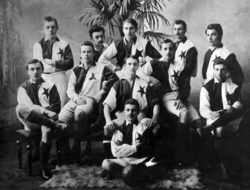
The club entered its first golden age in 1905 with the arrival of Johnny Madden, a Scottish manager and former Celtic player. Madden introduced innovative tactics and a professional philosophy that transformed the team. Between 1905 and 1930, Slavia became a dominant force, winning 134 of 169 domestic matches and 304 of 429 international fixtures. Madden retired from professional football in 1930 at the age of 66.
Mid-Century Triumphs and Challenges
Slavia's influence extended to the international stage, evidenced by the 1934 World Cup, where eight Slavia players were selected for the Czechoslovak national team. The club's second golden period was catalyzed by the acquisition of Josef Bican from Admira Vienna. With Bican leading the attack, Slavia secured league titles in 1940, 1941, 1942, and 1943, maintaining success even as many players were affected by the war.
However, the following decades brought instability. By 1951, the club had fallen to 11th place in the league. The 1950s and 1960s were marked by decline, resulting in relegations in 1961 and 1963. It took until 1965 for the club to return to the top flight of football.
Modern Era and European Ambitions
After a 49-year drought, Slavia reclaimed its 14th title in 1996. This era was highlighted by a semi-final appearance in the UEFA Cup and the contribution of four key players to the Czech team's silver medal win at UEFA Euro 1996.
The club's pursuit of Champions League glory saw five qualifying attempts between 1996 and 2005. Success finally arrived in the 2007–08 season after a 3–1 aggregate win over Ajax. In the group stage, Slavia faced Arsenal, Steaua București, and Sevilla. Despite a heavy 7–0 loss at the Emirates Stadium, a 0–0 draw in the second leg and a 1–1 draw in Bucharest allowed them to finish third in Group H, qualifying them for the UEFA Cup round of 32.
To support its growth, construction began in October 2006 on a new stadium at Eden. Capable of holding 21,000 spectators, the venue officially opened on May 7, 2008, with an exhibition match against Oxford University.
Financial Crisis and Ownership Transitions
Despite winning back-to-back Czech championships in 2007–08 and 2008–09, the club faced severe economic hardship. By autumn 2010, Slavia was in crisis, owing 112 million Czech koruna to its former owner, ENIC Sports Ltd. This debt led to aggressive cost-cutting and a squad purge, including the departure of midfielder Petr Trapp, who cited three months of unpaid wages.
The tension peaked on May 5, 2011, during a cup semi-final against Olomouc. Fans invaded the pitch in protest of the financial situation, leading to the match being suspended at 1–1 and Sigma being awarded a 3–0 victory.
The club's ownership has shifted significantly in recent years to ensure stability:
- September 2015: Acquired by CEFC China Energy Company.
- November 2018: Ownership transferred to Sinobo Group and CITIC Group.
- December 2023: Purchased by Czech businessman Pavel Tykač for a reported 2 billion Czech crowns.
Key Facts
- Founded: November 2, 1892 (as a literary and cycling club).
- First Football Match: March 25, 1896 (5–0 win vs AC Prague).
- First Golden Age: 1905–1930 under manager Johnny Madden.
- Stadium: Eden, opened in 2008 with a 21,000 capacity.
- Champions League Debut: 2007–08 group stage.
- Current Owner: Pavel Tykač (since December 2023).
| Period/Year | Event/Achievement | Key Figure/Detail |
|---|---|---|
| 1896 | First Football Match | Captain Karel Freja |
| 1905–1930 | First Golden Age | Manager Johnny Madden |
| 1940–1943 | Four Consecutive Titles | Josef Bican |
| 1996 | 14th League Title | UEFA Cup Semi-finalists |
| 2008 | New Stadium Opening | Eden Stadium |
| 2023 | Ownership Change | Pavel Tykač |
Frequently Asked Questions
When was Slavia Prague founded and what was its original purpose?
The club was founded on November 2, 1892, by medicine students in Vinohrady, Prague, originally serving as a literary and cycling club.
Who was Johnny Madden and why was he important?
Johnny Madden was a Scottish manager and former Celtic player who joined Slavia in 1905. He introduced new tactics that sparked a 25-year golden age, during which the club won the vast majority of its domestic and international matches.
How did Josef Bican impact the club?
Josef Bican's arrival from Admira Vienna ushered in a second golden period, leading Slavia to league titles in 1940, 1941, 1942, and 1943.
What caused the club's financial crisis in 2010?
The crisis was triggered by a debt of 112 million Czech koruna owed to the club's former owner, ENIC Sports Ltd, which led to severe cost-cutting and player departures.
Who currently owns Slavia Prague?
Since December 2023, the club has been owned by Czech businessman Pavel Tykač, who purchased it for approximately 2 billion Czech crowns.