Slaughterhouses: History, Regulation, and the Impact on Workers
A slaughterhouse, also known as an abattoir, is a specialized facility designed for the slaughter of livestock to provide food for human consumption. Once the process of slaughter is complete, the resulting meat is transferred to meat-packing facilities for further processing. While most abattoirs focus on food production, some facilities—known as knacker's yards or knackeries—handle animals unfit for human consumption, such as retired work horses.
Operating these facilities on a large scale presents complex challenges. Operators must balance logistics and public health requirements with animal welfare and environmental protections. Furthermore, because of cultural aversions to the process, the location of these facilities is often a subject of significant urban planning debate.
Key Facts
- Primary Purpose: Converting livestock into meat for food supply chains.
- Specialized Facilities: Knacker's yards handle animals not fit for human consumption.
- Historical Shift: Transitioned from open-air "shambles" to regulated, centralized abattoirs.
- Health Risks: Workers face high rates of repetitive strain, amputations, and psychological trauma.
- Regulation: Modern facilities require specialized water systems and veterinary inspections to prevent disease.
The Evolution of Slaughtering Practices
Historically, animal slaughter was an unregulated activity occurring in various open-air locations. In early London, stockyards were situated on the city's periphery, often in wet markets. These open-air sites were called shambles, a term still reflected in the street names of several English and Irish towns, such as York and Bandon. For example, Fishamble Street in Dublin was originally a fish-shambles.
The scale of these operations was immense; by 1910, Sheffield alone had 183 slaughterhouses, with an estimated 20,000 across England and Wales.
The Reform Movement
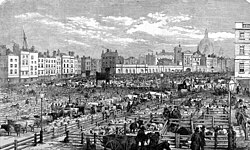
As urban populations grew, the lack of hygiene and the brutal treatment of animals in city centers sparked public outcry. Smithfield Market, which had traded meat since the 10th century, became a focal point of this disapproval. By the mid-19th century, roughly 220,000 cattle and 1.5 million sheep were forced through narrow London streets annually into a five-acre area.
Pressure from residents, butchers, and professionals led to the Town Police Clauses Act 1847 and eventually an Act of Parliament in 1852. This resulted in the creation of the Metropolitan Cattle Market in Islington in 1855. By 1868, a new market designed by Sir Horace Jones was completed under the Metropolitan Meat and Poultry Market Act.
Regulation and Industrial Expansion
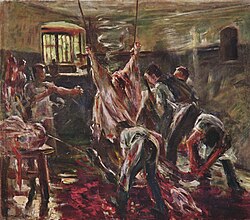
To prevent the spread of epizootics (animal epidemics)—such as the rinderpest outbreak of 1865—veterinary scientists like George Fleming and John Gamgee pushed for stricter inspections. This led to the appointment of meat inspectors in London by 1874 and the Public Health Act 1875, which mandated that local authorities provide central slaughterhouses.
Regulation often moved faster in British colonies. In Victoria, the Melbourne Abattoirs Act 1850 prohibited the slaughter of sheep, lambs, pigs, or goats outside of prescribed public abattoirs. By 1930, 80% of cattle in Scotland were slaughtered in public abattoirs.
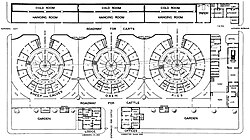
The growth of the industry was further fueled by the development of by-products. By 1932, the British by-product industry employed 310,000 people and was worth approximately £97 million annually. Facilities utilized every part of the animal: hooves were sent to Lancashire for glue, intestines to Glasgow for sausages, and hides to tanneries.
![Pork packing in Cincinnati. Print from 1873 showing four scenes in a packing house: "Killing, Cutting, Rendering, [and] Salting."](/images/b5/ed/b5ed9127e3bff7360cd367a913af63ccea2a27859d12cb947f8caf550de123c1.jpg)
Occupational Hazards and Worker Welfare
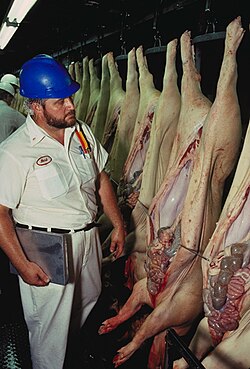
The industrial nature of modern slaughterhouses creates significant risks for employees. In the United States, slaughterhouse workers are three times more likely to suffer serious injuries than the average worker. Specifically, those handling pigs and cattle are nearly seven times more likely to experience repetitive strain injuries.
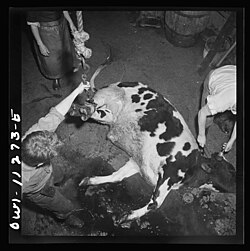
Physical injuries are frequent and severe. Reports indicate an average of two amputations per week among US slaughterhouse workers, with Tyson Foods averaging one amputation of a finger or limb per month. In the UK, a six-year study found that 78 workers lost limbs or fingers, and over 800 suffered serious injuries.
Psychological and Health Impacts
Beyond physical trauma, the work takes a heavy psychological toll. A 2016 study of Danish workers found that slaughterhouse employees experience lower physical and psychological well-being and higher rates of negative coping behaviors. This is often attributed to emotional dissonance—the need to disconnect emotionally from the animals they are killing.
Research by criminologist Amy Fitzgerald suggests that slaughterhouse employment is linked to increased arrest rates for violent crimes and sex offenses. Furthermore, a 2004 study in New Zealand observed excess mortality risks for all cancers, including lung cancer, among meat processing workers.
Summary of Industry Impacts
| Category | Key Issues | Observed Effects |
|---|---|---|
| Public Health | Disease spread (Epizootics) | Implementation of veterinary inspections and centralized abattoirs. |
| Physical Safety | Machinery and repetitive motion | High rates of amputations and repetitive strain injuries. |
| Mental Health | Emotional dissonance | Increased PTSD, anxiety, and substance abuse. |
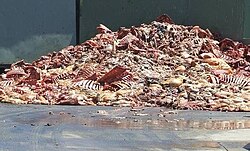
| Environment | Waste management | Need for specialized water systems to manage blood and offal. |
Frequently Asked Questions
What is the difference between a slaughterhouse and a knacker's yard?
A slaughterhouse (or abattoir) processes livestock intended for human food. A knacker's yard handles animals that are not fit for human consumption, such as old work horses.
Why were "shambles" moved out of city centers?
They were relocated due to extremely poor hygienic conditions, the brutal treatment of livestock, and general public disapproval of having large-scale slaughter in crowded urban areas.
What are the primary health risks for slaughterhouse workers?
Workers face high risks of repetitive strain injuries, accidental amputations, hearing loss due to loud noise, and increased mortality rates from certain cancers.
How does slaughterhouse work affect mental health?
The requirement to kill gentle animals often leads to emotional dissonance, which can manifest as PTSD, social withdrawal, anxiety, and an increase in violent behavior or domestic abuse.
What is the role of veterinary inspection in abattoirs?
Veterinary inspections are critical for ensuring hygiene standards and preventing the spread of animal diseases (epizootics), such as rinderpest, into the wider population.