Sir John Stephen Barrington Simeon: Life and Legacy of the 4th Baronet
Sir John Stephen Barrington Simeon was a prominent figure in British public life during the late 19th and early 20th centuries. Serving as a Member of Parliament for Southampton and holding the title of 4th Baronet, his life spanned military service, high-level political administration, and local leadership on the Isle of Wight.
Key Facts
- Full Name: Sir John Stephen Barrington Simeon, 4th Baronet DL.
- Lifespan: 31 August 1850 – 1909.
- Political Role: Member of Parliament (MP) for Southampton.
- Political Affiliation: Liberal Unionist.
- Military Rank: Honorary Colonel of the 1st Hampshire Royal Garrison Artillery (Volunteers).
- Birthplace: Swainston Manor, West Wight.
Early Life and Military Beginnings
Born on 31 August 1850 at Swainston Manor in West Wight, John Simeon entered the nobility early in his adulthood, succeeding his father as the 3rd baronet in 1870. His early career was marked by military service, where he served as an Ensign in the Rifle Brigade.
In 1872, he married Isabella Mary, the daughter of the Hon Ralph Heanage Dutton. Although the marriage remained childless, it marked a transition in his professional life, leading him to move away from active duty in the Rifle Brigade.
Political Career and Public Service
Simeon's entry into the upper echelons of British politics began in 1880 when he was appointed as the private secretary to the Rt Hon John Bright, a distinguished Member of Parliament. This experience paved the way for his own political aspirations.
In 1895, Simeon was elected as a Liberal Unionist—a political faction that broke away from the Liberal Party—representing Southampton in Parliament. He successfully maintained his seat through the election of 1900, serving the constituency until he left the House of Commons in 1906.
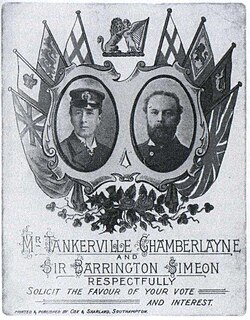
Beyond the halls of Parliament, Simeon contributed to local infrastructure. Shortly after his election, he commissioned the construction of a private railway station at Watchingwell, located approximately four miles (6 km) west of Newport.
Later Years and Military Honors
Simeon continued his association with military affairs later in life. On 5 December 1903, he was appointed Honorary Colonel of the 1st Hampshire Royal Garrison Artillery (Volunteers), a unit based in Southampton.
Sir John passed away in 1909, three years after leaving Parliament. He was succeeded in the baronetcy by his brother, Edmund Charles (1855–1915), who became the 5th baronet. Today, his memory is preserved through the Simeon Monument located in Castle Road, Newport, on the Isle of Wight.
Heraldic Symbolism
The Simeon family legacy is further detailed in their formal heraldry, which uses specific terminology to describe their coat of arms:
| Element | Description |
|---|---|
| Crest | A fox passant-reguardant (walking while looking backward) Proper, holding a trefoil slipped Vert (green) in its mouth. |
| Escutcheon | Per fess Sable (black) and Or (gold) with a counterchanged pale; featuring ermine spots and trefoils slipped. |
| Supporters | Dexter: a fox reguardant Proper with a trefoil slipped Vert; Sinister: a lion Gules (red) wearing a ducally crowned Or (gold) crown. |
| Motto | Serviendo; Nec Temere Nec Timide |
Frequently Asked Questions
When did Sir John Stephen Barrington Simeon serve in Parliament?
He entered Parliament in 1895 as a Liberal Unionist for Southampton, was re-elected in 1900, and served until 1906.
What was his military involvement?
He began his military career as an Ensign in the Rifle Brigade and was later appointed Honorary Colonel of the 1st Hampshire Royal Garrison Artillery (Volunteers) in 1903.
Who succeeded him as the 5th baronet?
Following his death in 1909, he was succeeded by his brother, Edmund Charles Simeon.
Where can people find a memorial to Sir John Simeon today?
A permanent memorial known as the Simeon Monument is located in Castle Road, Newport, on the Isle of Wight.
What was the purpose of the Watchingwell railway station?
The station was a private railway station commissioned by Sir John Simeon shortly after his election to Parliament in 1895.