Silla: The Long-Lasting Kingdom of the Korean Peninsula
Spanning nearly a millennium from 57 BCE to 935 CE, Silla stands as one of the most enduring and influential dynasties in Korean history. Originally established as a small chiefdom within the Jinhan confederacy, Silla eventually rose from a relatively weak state to become the dominant power on the Korean peninsula, ultimately unifying much of the region under a single rule.
While it began as one of the three competing powers—alongside Paekche and Goguryeo—Silla's strategic alliances and military innovations allowed it to transform from a minor player into a sophisticated, prosperous empire. Its capital, Seorabeol (modern-day Gyeongju), was once one of the largest and most vibrant metropolitan centers in the world.

Royal crown of Silla (second half of the fifth century)
Key Facts
- Duration: 57 BCE – 935 CE
- Capital: Seorabeol (modern Gyeongju)
- Major Achievement: Unified the Korean peninsula through an alliance with the Tang Dynasty.
- State Religion: Buddhism (adopted as the official state religion in 527 CE).
- Social Structure: A rigid hierarchy known as the "Bone Rank" system.
- Successor State: Goryeo
The Rise of a Centralized Monarchy
The foundations of Silla are steeped in history and legend. The kingdom's origins are traced back to the Park clan and the semi-mythological figure Hyeokgeose. Over the centuries, power shifted between the Miryang Park, Wolseong Seok, and Gyeongju Kim clans. By the reign of Naemul (356–402), the Gyeongju Kim clan established a hereditary monarchy, marking a significant step toward centralized governance.
As the kingdom grew, it expanded its influence by absorbing the Kaya confederacy. Under the leadership of King Jinheung (540–576), Silla developed a formidable military force and established the Hwarang, an elite group of youth warriors who played a crucial role in the kingdom's expansion and cultural identity.
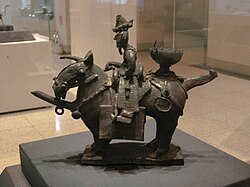
Earthenware Funerary Objects in the Shape of a Silla Warrior on Horseback
The Three Kingdoms Era
During the Three Kingdoms period, Silla was initially the smallest and least populated of the three major Korean powers. While Goguryeo and Paekche boasted much larger populations, Silla focused on internal consolidation and strategic diplomacy. This patience paid off in the 7th century when Silla formed a decisive alliance with the Chinese Tang Dynasty.
This alliance led to the subjugation of Paekche in 660 and Goguryeo in 668. Following these victories, Silla fought a series of wars against the Tang forces to prevent Chinese colonization, eventually establishing Unified Silla, which controlled most of the peninsula up to modern-day Pyongyang.
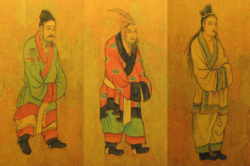
(left to right) A Paekche, Goguryeo, and Silla envoy depicted in a 6th-century painting.
Religion and Culture
Religion played a transformative role in Silla's development. Before the 6th century, the state practiced indigenous Shamanism and animism. However, the introduction of Buddhism in 527 CE changed the social and political landscape. According to legend, the martyrdom of the general Ichadon helped convince the monarchy to officially adopt the faith.
Buddhism became more than just a spiritual practice; it became a state religion that influenced art, architecture, and governance. This era saw the construction of magnificent temples and astronomical tools, reflecting a high level of scientific and artistic achievement.
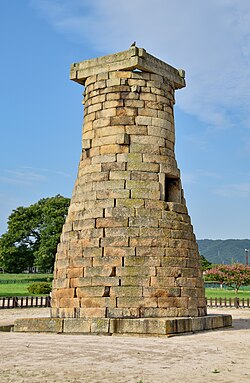
The astronomical observatory Cheomseongdae
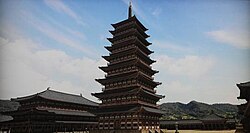
The Temple of the Golden Dragon, also known as Hwangryongsa, was destroyed during the Mongol Invasions.
Social Hierarchy and Governance
Silla society was governed by a complex and rigid social structure known as the Bone Rank system. This hereditary caste system determined everything from political eligibility to the size of one's house and the type of clothing one could wear. The highest ranks, known as the "True Bone" (Seonggol) and later "Sacred Bone," held the most significant political power.
The political administration was supported by the Hwabaek, a council of nobles that played a vital role in decision-making and maintaining the balance of power within the monarchy.
Historical Summary
| Period/Event | Approximate Date | Key Detail |
|---|---|---|
| Establishment | 57 BCE | Founded by the Park clan |
| Early Population | 200 CE | ~250,000 people |
| Introduction of Buddhism | 527/528 CE | Became the official state religion |
| Peak Population | 700 CE | ~6,000,000 people |
| Unified Silla Period | 668 CE – 935 CE | Control over most of the peninsula |
| Fall of Silla | 935 CE | Handed power to the Goryeo dynasty |
Frequently Asked Questions
What was the capital of Silla?
The capital of Silla was Seorabeol, which is known today as Gyeongju. During its peak, it was one of the largest cities in the world.
How did Silla unify the Korean peninsula?
Silla achieved unification by forming a strategic military alliance with the Tang Dynasty of China. Together, they defeated the rival kingdoms of Paekche and Goguryeo, and Silla subsequently fought to expel Tang forces to secure its own sovereignty.
What was the Bone Rank system?
The Bone Rank system was a strict hereditary social hierarchy in Silla. It dictated an individual's social status, political opportunities, and even daily lifestyle based on their lineage.
When did Buddhism become the official religion?
Buddhism was officially adopted as the state religion of Silla around 527–528 CE, following the influential martyrdom of the general Ichadon.
What happened to Silla after its fall?
After nearly 1,000 years of rule, Silla fragmented into the Later Three Kingdoms before finally handing over power to the Goryeo dynasty in 935 CE.