Shrubland Ecosystems: Characteristics, Classifications, and Global Biomes
Shrubland—also referred to as scrubland, scrub, brush, or bush—is a distinct plant community dominated by shrubs. While these landscapes are primarily defined by woody plants, they often integrate grasses, herbs, and geophytes (plants with underground storage organs). Depending on the region, shrubland may exist as a stable, mature vegetation type or serve as a transitional community following a disturbance, such as a wildfire.
These ecosystems can emerge naturally or result from human activities like logging and overgrazing. When human-made, they are more commonly described as shrubberies or bushes. Because of their susceptibility to fire, some shrubland areas are considered unsuitable for human habitation.
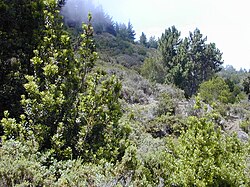
Key Facts
- Definition: A shrub is a much-branched woody plant under 8 meters in height.
- Fire Adaptation: Many species utilize lignotubers (woody swelling at the base of a stem), heavy seed production, and fire-induced germination to survive.
- Stability: Some shrublands are maintained by regular natural disturbances, including browsing and fire.
- Global Variety: Shrublands range from the xeric (dry) deserts to the salt-sprayed coasts of the Mediterranean.
Botanical Structural Form
In ecology and botany, shrubs are categorized by their height and branching patterns. Generally, tall shrubs range from 2 to 8 meters, small shrubs from 1 to 2 meters, and subshrubs are those under 1 meter.
A detailed descriptive system, widely used in Australia, classifies shrublands based on the foliage cover of the dominant species. This system distinguishes between different levels of density to define the structural form of the landscape.
Shrubs 2–8 Meters High
- Closed-shrubs: Dense foliage cover (70–100%).
- Open-shrubs: Mid-dense foliage cover (30–70%).
- Tall shrubland: Sparse foliage cover (10–30%).
- Tall open shrubland: Very sparse foliage cover (<10%).
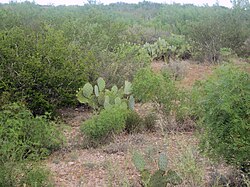
Shrubs Under 2 Meters High
- Closed-heath / Closed low shrubland: Dense foliage cover (70–100%).
- Open-heath / Mid-dense low shrubland: Mid-dense foliage cover (30–70%).
- Low shrubland: Sparse foliage cover (10–30%).
- Low open shrubland: Very sparse foliage cover (<10%).
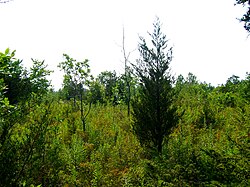
Global Shrubland Biomes
Shrublands often consist of dense thickets of sclerophyll shrubs (plants with hard, evergreen leaves) and small trees. These biomes are known by various regional names across the globe:
- Chaparral: California
- Matorral: Chile, Mexico, and Spain
- Maquis: France and the Mediterranean
- Macchia: Italy
- Fynbos: South Africa
- Kwongan: Southwest Australia
- Caatinga: Northeastern Brazil
- Cedar scrub: Texas Hill Country
- Eastern Suburbs Banksia Scrub: Sydney
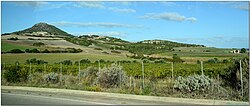
Desert and Xeric Scrublands
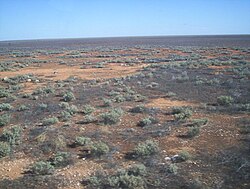
Xeric shrublands occur in the world's deserts or in regions with fast-draining sandy soils. Plants here have evolved specific adaptations to survive arid climates, including long taproots to reach deep groundwater, succulent stems or leaves for water storage, thorns to deter grazing animals, and small leaves to minimize water loss.
Mediterranean Scrublands
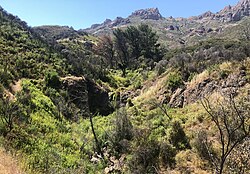
Found in five Mediterranean climate regions worldwide, these scrublands are frequently located near coastlines, where plants have adapted to salt air and wind. Regional variations include garrigue (France), phrygana (Greece), tomillares (Spain), and batha (Israel). Other examples include coastal sage scrub in California and strandveld in South Africa.
Interior and Dwarf Scrublands
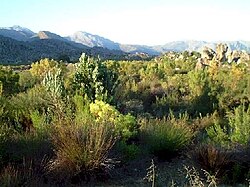
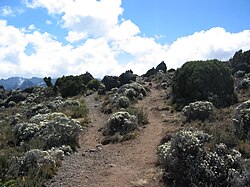
Interior scrublands typically emerge in semi-arid areas with nutrient-poor soils, such as the matas of Portugal or the Florida scrub. Some areas are dominated by dwarf-shrubs—low-growing or creeping plants—which characterize moorlands, heathlands, and the Mediterranean maquis and garrigues.
Summary of Shrubland Types
| Type | Typical Environment | Key Characteristics | Examples |
|---|---|---|---|
| Xeric | Deserts / Sandy soils | Succulence, thorns, taproots | Desert scrub, Caatinga |
| Mediterranean | Coastal / Mediterranean climates | Sclerophyll leaves, salt tolerance | Chaparral, Maquis, Fynbos |
| Interior | Semi-arid / Nutrient-poor soil | Adapted to poor soil quality | Florida scrub, Matas |
| Dwarf | Heathlands / Moorlands | Low-growing or creeping form | Garrigue, Moorland shrubs |
Frequently Asked Questions
What is the botanical definition of a shrub?
A shrub is defined as a woody plant that is much-branched, typically possessing many stems and reaching a maximum height of 8 meters.
How do shrubland plants survive frequent fires?
Many species have evolved specific adaptations such as lignotubers, the ability to produce a high volume of seeds, and seeds that only germinate after being triggered by fire.
What is the difference between a shrubland and a forest?
While forests are dominated by tall trees, shrublands are dominated by shrubs (plants under 8 meters). Shrublands can be a natural stable state or a result of forest degradation due to logging, overgrazing, or fire.
What are sclerophyll shrubs?
Sclerophyll shrubs are evergreen plants with hard, leathery leaves, which are characteristic of many shrubland biomes like the chaparral and fynbos.
What determines the classification of a shrubland's structural form?
Classification is based on the height of the dominant species and the percentage of foliage cover, ranging from "closed" (70–100% cover) to "very sparse" or "open" (less than 10% cover).