Shoot 'Em Up History: From Mechanical Galleries to Bullet Hell
Long before the digital era, the thrill of the hunt and the precision of target practice defined early entertainment. From 19th-century carnival shooting galleries to the high-octane "bullet hell" of modern gaming, the shoot 'em up (or "shmup") has evolved from simple mechanical targets into a complex art form of pattern recognition and reflex.
Key Facts
- Origins: Rooted in 19th-century carnival galleries and 20th-century electro-mechanical (EM) games.
- The Catalyst: Space Invaders (1978) established the core template of multiple lives and high scores.
- Subgenres: Includes vertical/horizontal scrollers, run and gun, rail shooters, and danmaku (bullet hell).
- Terminology: The term "shmup" was coined in 1985 by Zzap!64 magazine.
- Evolution: Shifted from simple space battles to complex, scripted patterns and narrative-driven experiences.
The Pre-Digital Roots and Early Mainframes
The concept of shooting games predates electronics, drawing from archery, bowling, and darts. By the turn of the 20th century, mechanical target games appeared in English arcades, reaching America by the 1920s. These evolved into electro-mechanical (EM) games—machines that used electrical components to automate mechanical movements—such as Sega's Periscope (1965).
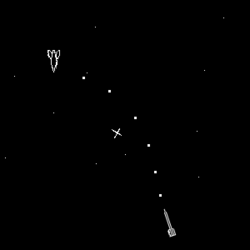
In the realm of early computing, Spacewar! (1962), developed at the Massachusetts Institute of Technology, is cited by some historians as the first true shoot 'em up video game. It featured a space battle between two craft and served as a precursor to the arcade hits of the following decade.
The Emergence of the Shmup Genre
While early games existed, Space Invaders (1978) by Tomohiro Nishikado of Taito is widely regarded as the genre's definitive origin. Inspired by H.G. Wells' The War of the Worlds and the mechanics of Breakout, it introduced enemies that descended toward the player at increasing speeds.
Unlike previous target games, Space Invaders featured enemies that fired back, introduced the concept of multiple lives, and popularized the pursuit of a high score. This success created a template that spawned over 100 clones and established the "progressively difficult level" paradigm used in most shooters today.
The Golden Age: Refinement and Diversification
From the late 1970s to the early 1980s, space shooters dominated the arcades. Namco's Galaxian (1979) introduced color graphics and individualized enemies, while Atari's Asteroids (1979) allowed players to rotate and move freely across the screen.
The Rise of Scrolling
The genre soon split into different scrolling perspectives:
- Vertical Scrolling: SNK's Ozma Wars (1979) introduced vertical backgrounds and energy supplies (similar to hit points), while Namco's Xevious (1982) pioneered shaded organic landscapes.
- Side-Scrolling: Williams Electronics' Defender (1981) featured a wrap-around world and a minimap, while Konami's Scramble (1981) introduced continuous single-direction scrolling with multiple levels.
Regional Design Philosophies
A divide emerged between Japanese and American developers. Japanese games tended to be more deterministic and scripted. In contrast, American developers, such as Eugene Jarvis (creator of Robotron: 2084), focused on algorithmic generation, physics, and random events.
Experimental Perspectives
Developers also toyed with 3D depth. While Nintendo's Radar Scope (1980) failed commercially, Atari's Tempest (1981) successfully introduced the "tube shooter" perspective. Sega's Zaxxon (1981) further innovated by using isometric graphics to simulate depth.
Run and Gun and Rail Shooters
In the mid-1980s, the focus shifted from spacecraft to characters on foot. Run and gun games, often featuring military themes, became dominant. Taito's Front Line (1982) and Capcom's Commando (1985) established the vertical scrolling standard for infantry combat.
Other milestones included Ikari Warriors (1986), which used rotary joysticks, and Konami's Contra (1987), acclaimed for its multi-directional aiming and cooperative play. Simultaneously, rail shooters—games where the player's path is predetermined—emerged with titles like Sega's Space Harrier (1985) and Thunder Blade (1988), the latter of which introduced force feedback vibration.
The Modern Era: Bullet Hell and Niche Appeal
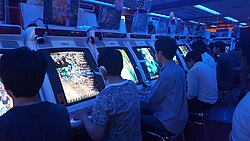
By the 1990s, a subgenre known as danmaku (Japanese for "barrage"), or "bullet hell," emerged. These games are defined by overwhelming numbers of enemy projectiles forming complex patterns, requiring players to navigate tiny gaps using collision boxes smaller than the character sprites.
Toaplan's Batsugun (1993) and Cave's DonPachi (1995) were pivotal in this movement, catering to hardcore players seeking extreme challenges. While the broader market shifted toward 3D, the shmup survived through dedicated series like Touhou Project—the most prolific fan-made shooter series—and refined titles like Treasure's Ikaruga (2001).
| Era | Key Innovation | Defining Example |
|---|---|---|
| Pre-1970s | Electro-mechanical targets | Sega Periscope |
| Late 1970s | High scores & multiple lives | Space Invaders |
| Early 1980s | Scrolling backgrounds | Xevious / Defender |
| Mid-1980s | On-foot combat (Run and Gun) | Contra / Commando |
| 1990s-Present | Complex projectile patterns (Danmaku) | DonPachi / Touhou Project |
Frequently Asked Questions
What is the difference between a shoot 'em up and a run and gun?
A traditional shoot 'em up typically features a vehicle or spacecraft, whereas a run and gun features characters on foot, often with military or action themes.
What does "bullet hell" actually mean?
Bullet hell, or danmaku, refers to games with an extreme density of enemy projectiles that create intricate patterns, forcing the player to navigate very small safe zones.
Who created the first shoot 'em up?
While Spacewar! (1962) is considered an early mainframe ancestor, Tomohiro Nishikado's Space Invaders (1978) is most frequently cited as the original game that defined the genre's commercial and mechanical template.
What is a rail shooter?
A rail shooter is a subgenre where the player's movement is restricted to a fixed path (like a train on a rail), focusing the gameplay entirely on aiming and shooting.
Where did the term "shmup" come from?
The term is believed to have been coined in July 1985 by editor Chris Anderson and reviewer Julian Rignall in the British Commodore 64 magazine Zzap!64.