Shamil Basayev and the Evolution of the Second Chechen War
The Second Chechen War was marked by a profound ideological shift in the region, moving from a nationalist struggle for independence toward a broader religious conflict. Central to this transformation was Shamil Basayev, a militant leader whose tactics and alliances fundamentally altered the world's perception of the Chechen cause. According to Michael Radu of the Foreign Policy Research Institute, Basayev shifted the narrative from a small nation resisting Russian imperialism to an outpost of global jihad.
This transition was mirrored in the religious landscape of Chechnya and the Northern Caucasus. The traditional blend of syncretism and Sufism (a mystical branch of Islam) was increasingly replaced by Wahhabism and Salafism—strict, fundamentalist interpretations of Islam—particularly among the youth. This ideological shift brought with it a new spirit of expansionism and a willingness to employ extreme violence.
Key Facts
- Ideological Shift: Basayev transitioned the Chechen resistance from nationalist goals to a global jihadist framework.
- Major Attacks: He claimed responsibility for the Moscow theater hostage crisis, the Beslan school siege, and the assassination of Akhmad Kadyrov.
- International Status: Designated as a terrorist by the U.S. State Department and the United Nations Security Council.
- Tactical Evolution: Introduced large-scale suicide bombings and "kamikaze" style attacks to the conflict.
- Financial Links: Alleged to have received substantial funding from Osama bin Laden.
The Early Years of the Conflict (1999–2001)
During the siege of Grozny in 1999, Basayev remained in the city, issuing threats of "kamikaze" attacks that were initially dismissed by many as bluffs. However, the brutality of the conflict soon became apparent. In January 2000, while leading his men through a minefield during the retreat from Grozny, Basayev stepped on a land mine. The resulting amputation of his foot and part of his leg was videotaped and later broadcast by Reuters and NTV, showing Basayev watching the procedure impassively under local anesthetic.
Despite his injury, Basayev evaded capture by hiding in the mountains and forests. He actively recruited foreign fighters from Afghanistan and other Islamic nations to bolster the Chechen cause. His ruthlessness was highlighted in April 2000 when he ordered the execution of nine Russian OMON prisoners after Russian forces refused to exchange them for Yuri Budanov, an officer accused of killing a Chechen girl.
By 2001, the conflict expanded internationally. The U.S. State Department alleged that Basayev trained in Afghanistan and sent fighters to serve in Al-Qaeda's "055" brigade. The Russian government's desperation to capture him was evident when General Gennady Troshev offered a one-million-dollar bounty for Basayev's head.
Escalation and High-Profile Terrorism (2002–2004)
The early 2000s saw a surge in high-casualty attacks. In November 2002, Basayev was regarded as the mastermind behind the Moscow theater hostage crisis, where 50 militants took approximately 800 hostages. The crisis ended in a bloody storming of the building by Russian forces using gas, resulting in the deaths of the militants and over 100 hostages.
Basayev continued to target government infrastructure. In December 2002, he used remote-controlled suicide bombers to destroy the four-story government headquarters in Grozny, killing roughly 80 people. In 2003, he claimed responsibility for a truck bombing in Znamenskoye that killed 59 people and a suicide attack targeting Akhmad Kadyrov, the Moscow-appointed head of the Chechen administration.
By August 2003, the United States and the United Nations officially designated Basayev as a terrorist. U.S. Secretary of State Colin Powell identified him as a significant risk to U.S. national security, citing links to Al-Qaeda and the Islamic International Peacekeeping Brigade.
The Beslan Massacre and Operation Boomerang
The year 2004 marked some of the most devastating attacks of the war. In May, Basayev claimed responsibility for the bombing that killed President Akhmad Kadyrov. This was followed by a June raid on Nazran, Ingushetia, which left approximately 90 people dead.
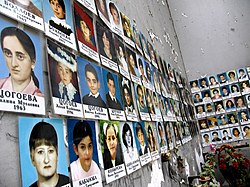
The most infamous event occurred in September 2004: the Beslan school siege. Over 350 people, mostly children, were killed. While Basayev did not participate in the seizure, he admitted to organizing and financing the operation through his Riyadus-Salihiin "Martyr Battalion," boasting that the attack cost only 8,000 euros.
During the same period, Basayev launched "Operation Boomerang," which included the bombing of a Moscow metro station and the destruction of two airliners via suicide bombers, killing 99 people in total.
Final Years and Political Maneuvering (2005–2006)
In his final years, Basayev attempted to use international media to voice his grievances. In an interview with journalist Andrei Babitsky, he acknowledged being viewed as a "bandit" or "terrorist" but argued that the Russian nation shared responsibility for the war due to its silent approval of the deaths of 40,000 Chechen children.
Despite numerous reports of his death—including one in February 2005—Basayev remained active. He rejoined the separatist government as first deputy chairman in August 2005 and led a raid on Nalchik in October of that year. By June 2006, he was appointed Vice President of Ichkeria by Dokka Umarov.
His final public statement in July 2006 expressed support for the execution of Russian diplomats in Iraq, framing it as a response to the murder of Chechen diplomat Zelimkhan Yandarbiyev.
Summary of Major Events
| Year | Event/Action | Outcome/Impact |
|---|---|---|
| 2000 | Mine injury in Grozny | Amputation of foot; transition to guerrilla warfare |
| 2002 | Moscow theater crisis | Over 100 hostages killed; Basayev named mastermind |
| 2003 | U.S./UN Designation | Officially labeled a global terrorist |
| 2004 | Beslan school siege | Over 350 deaths; organized by Riyadus-Salihiin |
| 2004 | Operation Boomerang | Metro and airliner bombings; 99 deaths |
| 2006 | Appointment as VP | Named Vice President of Ichkeria |
Frequently Asked Questions
Who was Shamil Basayev?
Shamil Basayev was a prominent Chechen militant leader during the Second Chechen War who shifted the insurgency from a nationalist struggle to a jihadist movement, employing suicide bombings and large-scale terrorism.
What was the Riyadus-Salihiin?
The Riyadus-Salihiin, or "Martyr Battalion," was a militant group led by Basayev that specialized in suicide attacks, including the Beslan school siege.
How did Basayev's ideology change over time?
He moved away from traditional Chechen Sufism toward Wahhabism and Salafism, which emphasized a more aggressive, expansionist form of Islam and aligned the Chechen cause with global jihad.
What was "Operation Boomerang"?
Operation Boomerang was a series of attacks in 2004 claimed by Basayev, involving the bombing of a Moscow metro station and two passenger aircraft.
Did Basayev have international support?
Yes, he welcomed foreign fighters from Afghanistan and other Islamic countries and was alleged by the U.S. State Department to have received funding from Osama bin Laden.