Exploring Seocho: The Economic and Cultural Heart of Seoul
Located in the southern part of Seoul, Seocho-gu (Seocho District) is a vital component of the prestigious Gangnam region. As one of the 25 autonomous districts of Seoul, Seocho is widely recognized as one of South Korea's wealthiest neighborhoods. It serves as a major hub for commerce, law, and high-end education, blending deep historical roots with a fast-paced, modern urban lifestyle.
Key Facts
- Status: Autonomous District in Seoul, South Korea.
- Economic Profile: One of the wealthiest districts in Korea, featuring major global headquarters like Samsung and Hyundai Motor Group.
- Education: Home to the elite "Gangnam School District 8."
- Transportation: A major transit hub served by six subway lines, including Line 2 and the Shinbundang Line.
- Culture: Hosts the Seoul Arts Center and the National Library of Korea.
A Rich Historical Legacy
The land currently occupied by Seocho has been inhabited since prehistoric times, often regarded as a cradle of Korean civilization due to its proximity to the Han River. Historically, the area served as the capital of the Baekje Kingdom (18 BC – 660 AD), then known as Wiryesong (Fortress Castle).
The modern transformation of Seocho began in 1965, when urban planning aimed to establish the area as a secondary metropolitan hub. Over two decades, it transitioned from rural landscapes into a dense urban center. Seocho was officially established as an independent district in January 1988, after separating from the jurisdiction of Gangnam District.
Geography and Administration
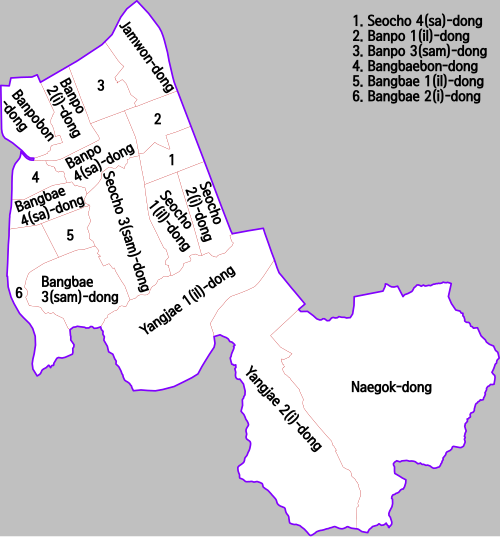
Seocho covers a total area of 46.92 km² and is characterized by a mix of high-density urban environments and natural landmarks. The district is divided into 18 administrative dongs (neighborhoods), including Seocho-dong, Banpo-dong, and Yangjae-dong.
The landscape is punctuated by significant natural features such as Umyeonsan, Guryongsan, and Cheonggyesan mountains, as well as the Yangjaecheon stream. This balance of nature and infrastructure makes it a highly desirable residential area.
District Overview
| Category | Details |
|---|---|
| Population (2025) | 409,387 |
| Population Density | 8,725/km² |
| Total Area | 46.92 km² |
| Time Zone | UTC+9 (KST) |
| Major Subway Lines | Lines 2, 3, 4, 7, 9, and Shinbundang Line |
Economic Powerhouse and Legal Hub
Seocho is a cornerstone of the South Korean economy. It is home to Samsung Town, an office park housing many important buildings of Samsung, the nation's largest conglomerate. Additionally, the Hyundai Motor Group, one of the world's largest automobile manufacturers, is headquartered here.
The district is also a renowned legal center. The presence of the Supreme Court of Korea and a high concentration of legal professionals has made areas like Acrovista popular residences for judges, lawyers, and prosecutors. This professional density contributes to the district's high income levels; in 2021, the average monthly income in Seocho was 3,770,000 KRW, significantly higher than the Seoul average of 2,980,000 KRW.
Education and Culture
Seocho is famous for its academic excellence. It is a key part of Gangnam School District 8, a region known for its highly competitive and elite high schools, such as Whimoon and Kyunggi. The quality of education is reflected in university admissions; for example, 10% of the 2022 Seoul National University freshman class hailed from schools within this district.
Cultural Landmarks
- Seoul Arts Center: A major cultural destination attracting nearly 3 million annual visitors, featuring the Music Hall, Opera House, and Hangaram Art Museum.
- National Library of Korea: Established in 1945, it houses over 10 million volumes.
- National Gugak Center: Dedicated to the preservation and promotion of traditional Korean court and folk music.
- Seorae Village: Known as "Little France," this affluent enclave is home to approximately 40% of the French population living in South Korea.
Transportation and Connectivity
Connectivity is one of Seocho's greatest strengths. The district is served by an extensive subway network, including the Seoul Subway Line 2 (the Circle Line), Line 3, Line 4, Line 7, Line 9, and the Shinbundang Line. Furthermore, the Gyeongbu Expressway, South Korea's longest highway, terminates in Seocho, facilitating easy travel across the country.
Notable Historical Events
While largely prosperous, the district has been the site of significant historical events. In 1995, the Sampoong Department Store collapse occurred in Seocho-dong, a tragedy caused by structural failure and negligence. More recently, the district faced challenges from extreme weather, including the 2011 Woomyeon Mountain avalanche and the record-breaking rainfall in August 2022 that caused flooding near Gangnam Station.
Frequently Asked Questions
What is the "Gangnam School District 8"?
It is a specialized school district administered by the Seoul Metropolitan Office of Education that encompasses both Seocho and Gangnam districts. It is famous for its elite high schools and high rates of admission to top-tier universities.
Why is Seorae Village called "Little France"?
Seorae Village is an affluent neighborhood in Banpo-dong that became a hub for the French community following the relocation of the French Embassy School to Seocho in 1985 and the entry of various French corporations into the Korean market.
Which major companies are based in Seocho?
Major global entities headquartered or maintaining significant presence in the district include Samsung (via Samsung Town) and the Hyundai Motor Group.
How is the economy of Seocho different from the rest of Seoul?
Seocho is one of the wealthiest districts in the city. Its residents have a higher average monthly income compared to the Seoul average, largely due to a high concentration of specialty professionals and major corporate headquarters.
Is Seocho well-connected by public transport?
Yes, Seocho is exceptionally well-connected, featuring access to six different subway lines and serving as the terminus for the Gyeongbu Expressway.