Secret Ballot: The History and Evolution of Anonymous Voting
The secret ballot, frequently referred to as the Australian ballot, is a voting method designed to ensure that a voter's identity remains anonymous during an election or referendum. By decoupling the voter's identity from their choice, this system serves as a critical safeguard for political privacy, preventing attempts to influence outcomes through intimidation, blackmail, or the buying of votes.
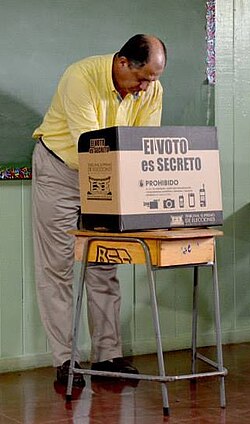
In its most fundamental form, the secret ballot utilizes paper slips where voters mark their preferences. To maintain anonymity, voters typically fold their ballots and place them into a sealed box. To further protect this privacy, polling places provide voting booths, ensuring that no one can observe the voter as they record their choice. Modern systems typically use printed ballots with candidate names and checkboxes to eliminate bias and prevent any link between the individual and their vote.
While anonymity is the standard in most modern democracies, some systems of direct democracy, such as the Swiss Landsgemeinde, continue to use public voting to allow all citizens to observe the outcome directly.
Key Facts
- Purpose: Prevents voter intimidation, blackmail, and vote buying.
- Mechanism: Uses anonymous ballots, sealed boxes, and private voting booths.
- Origins: Early implementations occurred in Ancient Rome, with modern versions emerging in 19th-century Australia.
- Global Standard: Protected by international law, including the UN Convention on the Rights of Persons with Disabilities.
- Alternative: Public voting methods include oral proclamation and the raising of hands.
Secret vs. Public Voting Methods
Historically, citizen voting has been divided between transparent, public methods and private, anonymous ones.
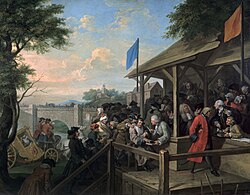
Public Methods
- Oral Proclamation: Votes are shouted aloud one by one at an assembly.
- Raising of Hands: Voters signal their choice visually during a gathering.
- Open Ballot Systems: Ballots are cast in a manner that is visible to others.
Private Methods
Private methods focus on the separation of the voter's identity from the ballot, utilizing physical barriers and sealed containers to ensure the vote remains a secret.
A Global History of the Secret Ballot
Ancient Rome
The concept of the secret ballot dates back to the Roman Republic through the Tabellariae Leges (Ballot Laws). Four laws were implemented between 139 BC and 107 BC to introduce secret voting for magistrates, the passage of laws, and jury deliberations, including those involving charges of treason.
France and the United Kingdom
France integrated secret ballots into its revolutionary legal framework, with the Constitution of the Year III (1795) and the constitution of 1848 mandating that all elections be held secretly. In some instances, voters could even hand-write candidates' names on white paper at home before folding them for privacy.
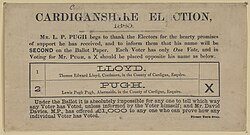
In the United Kingdom, the London School Board election of 1870 marked the first large-scale use of the secret ballot. This was followed by the Ballot Act 1872, which extended the practice generally. This shift significantly lowered campaigning costs by making the practice of "treating" (buying votes) unrealistic.
Australia and New Zealand
Australia is credited with pioneering the modern secret ballot. While Victoria and South Australia were long thought to be the first, records show that Tasmania implemented the system on February 7, 1856. This innovation led to the term "Australian ballot" being used internationally.
The United States
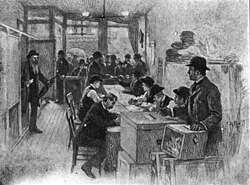
Until the late 19th century, U.S. elections often used partisan ballots printed by newspapers and distributed by party workers. The transition to the "Australian ballot" began after the 1884 presidential election. A true Australian ballot required four components: it had to be printed at public expense, list all candidates/proposals, be distributed only at the polling place, and be cast in secret.
Louisville, Kentucky, was the first U.S. city to adopt this system, and Massachusetts became the first state to do so statewide in 1888. The transition was completed in 1950 when South Carolina finally adopted government-printed ballots.
Modern Implementation and Accessibility
Ensuring Integrity in Singapore
Singapore employs rigorous measures to maintain ballot secrecy, including tamperproofing checks on boxes and the prohibition of electronic devices in polling stations. To facilitate accounting and potential court-ordered tracing, ballots include serial numbers with attached counterfoils. To prevent identification, voters are advised to use only a cross (X) and avoid any other identifying marks.
Accessibility for Disabled Voters
The 2008 United Nations Convention on the Rights of Persons with Disabilities mandates that all contracting states protect the right of disabled persons to vote by secret ballot. This is achieved through various means:
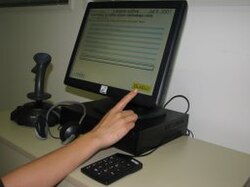
- Electronic Voting Machines: Used in the U.S., Netherlands, Slovenia, Albania, and India.
- Braille and Templates: Used in Canada, Ghana, the UK, and many African and Asian nations.
Exceptions and Audits
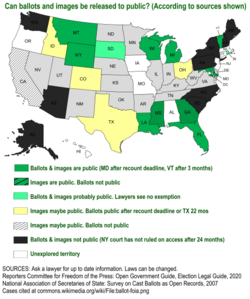
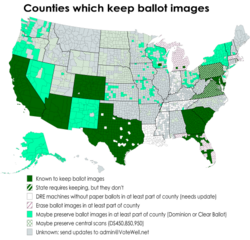
Some jurisdictions maintain "confidential" rather than strictly "secret" ballots for security. For example, in North Carolina, early and absentee ballots are assigned unique identifiers to allow for retrieval if a voter is found to be ineligible (e.g., if they passed away before election day). Additionally, many modern systems use scanned images of ballots to allow for independent audits without compromising the voter's identity.
Summary of Secret Ballot Adoption
| Date | Country/Region | Key Milestone |
|---|---|---|
| 139–107 BC | Ancient Rome | Tabellariae Leges implemented for assemblies and juries. |
| 1831 | France | Early adoption of secret voting. |
| 1856 | Australia | First implemented in Tasmania (Feb 7). |
| 1872 | United Kingdom | Ballot Act 1872 generalizes secret voting. |
| 1888–1950 | United States | Transition from partisan to government-printed ballots. |
| 1912 | Argentina | Sáenz Peña Law. |
Frequently Asked Questions
What is an Australian ballot?
An Australian ballot is a secret ballot printed at public expense that lists all candidates and proposals, is distributed only at the polling place, and is cast in secret.
Why is the secret ballot important for democracy?
It protects the voter from external pressure, such as intimidation, blackmail, or bribery, ensuring that the vote reflects the individual's true preference.
How do disabled voters maintain secrecy?
Depending on the country, disabled voters use specialized equipment such as electronic voting machines, Braille ballots, or paper templates to vote independently and privately.
Are there any exceptions to ballot secrecy?
Yes. Some regions, like North Carolina, use retrievable identifiers for absentee or early ballots to ensure eligibility. In the UK, the Election Court may order the matching of ballots to voters in rare cases of fraud allegations.
What is the difference between a secret ballot and an open ballot?
A secret ballot keeps the voter's choice anonymous, whereas an open ballot (such as raising hands or oral proclamation) makes the voter's choice public to others in the assembly.