Scottish Parliament
The Scottish Parliament (Pàrlamaid na h-Alba / Scots Pairlament) is the devolved legislature of Scotland. Established on 12 May 1999, it represents a modern era of governance, allowing Scotland to manage its own internal affairs while remaining part of the United Kingdom. As a unicameral body—meaning it consists of a single legislative chamber—it operates from the Scottish Parliament Building in Edinburgh.
The parliament's creation followed a long history of legislative evolution, succeeding the pre-union Parliament of Scotland and shifting specific powers away from the Parliament of the United Kingdom through the process of devolution.
Key Facts
- Founded: 12 May 1999.
- Structure: Unicameral with 129 seats.
- Voting System: Additional-member system (a form of mixed-member proportional representation).
- Current First Minister: John Swinney (SNP).
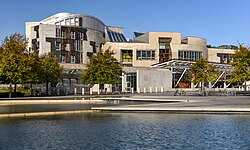
- Meeting Place: Scottish Parliament Building, Edinburgh.
- Legislative Scope: Manages devolved matters such as health, education, and justice.
Governance and Leadership
The Scottish Parliament is led by several key officials who ensure the smooth running of legislative business and the administration of the Scottish Government.
Executive and Presiding Leadership
The First Minister serves as the head of the Scottish Government. As of 8 May 2024, this role is held by John Swinney of the SNP. Supporting the executive are the Deputy First Minister and the Minister for Parliamentary Business.
The Presiding Officer acts as the speaker and impartial moderator of the parliament. Kenneth Gibson assumed this role on 14 May 2026, supported by Deputy Presiding Officers Clare Adamson and Katy Clark.
The Role of the Monarch
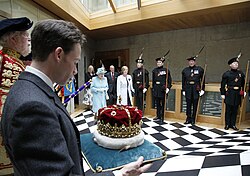
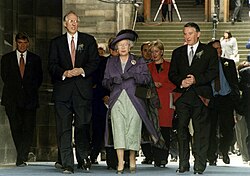
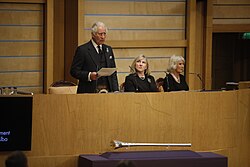
While the parliament is a devolved body, the British Monarch remains the head of state. King Charles III has addressed the chamber, continuing the tradition of royal involvement in the opening of parliamentary sessions.
Parliamentary Structure and Proceedings
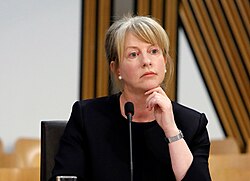
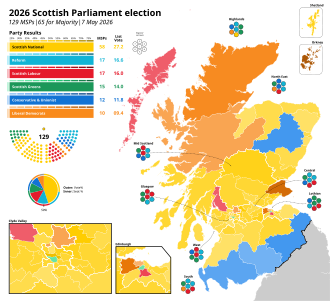
The parliament consists of 129 Members of the Scottish Parliament (MSPs). These members are elected using the Additional-member system, which combines constituency-based representation with regional lists to ensure a more proportional result.
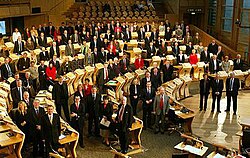
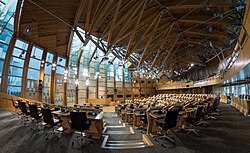
The Debating Chamber
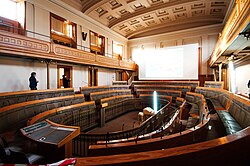
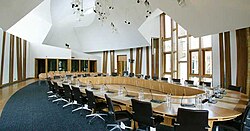
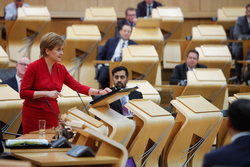
The heart of the parliament is the debating chamber, where MSPs gather to discuss policy and vote on legislation. The seating is arranged in a semicircle, placing ministers directly opposite the Presiding Officer and parliamentary clerks to facilitate debate.
Committees and Legislation
Much of the detailed work occurs within 16 specialized committees. These committees scrutinize government actions and examine proposed bills. Examples include the Health, Care and Sport Committee and the Education and Gaelic Committee.
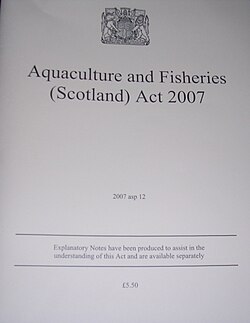
When a bill is introduced, it undergoes several legislative stages. Once it has passed through all stages and received the necessary approvals, it becomes an Act of the Scottish Parliament.
Powers and Jurisdiction
The Scottish Parliament operates under a system of devolved and reserved powers. Devolved powers are those the parliament can legislate on, while reserved powers remain the sole jurisdiction of the UK Parliament at Westminster.
Devolved Matters
The parliament has significant authority over domestic Scottish issues, including:
- Health and Social Care: Including abortion law and the NHS.
- Education: Early, primary, secondary, and tertiary training, as well as the Scots and Gaelic languages.
- Justice: Civil and criminal law, courts, police, and prisons.
- Environment: Agriculture, fisheries, forestry, and water sanitation.
- Infrastructure: Local government, housing, and most road and rail networks.
- Finance: Income tax on non-savings and non-dividend income.
Reserved Matters
Certain high-level functions are reserved to the UK government, such as:
- Foreign Affairs: Defence, national security, and international diplomacy.
- The Constitution: Including immigration and nationality.
- Macro-Economics: Financial services, markets, and most forms of taxation (e.g., VAT, Corporation Tax).
- Broadcasting: Telecommunications and postal services.
| Category | Details |
|---|---|
| Total Seats | 129 |
| Government (SNP) | 57 |
| Opposition (Labour, Reform UK, Greens, Cons, Lib Dems, Other) | 71 |
| Presiding Officer | 1 |
| Number of Committees | 16 |
Frequently Asked Questions
What is the difference between devolved and reserved powers?
Devolved powers are those transferred to the Scottish Parliament, allowing it to make laws on domestic issues like health and education. Reserved powers are kept by the UK Parliament in London and cover national interests such as defence, foreign policy, and immigration.
How are MSPs elected?
Members of the Scottish Parliament (MSPs) are elected via the Additional-member system. This means some MSPs represent specific constituencies, while others are elected from regional lists to ensure the total number of seats reflects the overall proportion of votes each party received.
What is the role of the Presiding Officer?
The Presiding Officer is the impartial leader of the parliament. They moderate debates in the chamber, ensure the standing orders (rules) are followed, and represent the parliament externally.
How does a bill become law in Scotland?
A bill is proposed and then moves through several legislative stages, which often include scrutiny by a relevant committee and debates in the main chamber. Once it passes all stages, it becomes an Act of the Scottish Parliament.
Where does the Scottish Parliament meet?
The parliament meets at the Scottish Parliament Building, located at Holyrood in Edinburgh.