Scottish Ambulance Service
The Scottish Ambulance Service (SAS) is one of the United Kingdom's largest emergency medical providers. Operating as a special health board within NHS Scotland, the service provides free, point-of-access emergency care to the public and healthcare professionals across the diverse geography of Scotland. Established in its current form on April 1, 1995, as an NHS trust, it transitioned to a special health board on April 1, 1999.
Headquartered in South Gyle, Edinburgh, the service employs over 6,000 staff, including approximately 1,300 paramedics and 1,200 technicians. The SAS manages a complex network of response vehicles and aircraft to ensure that medical aid reaches patients regardless of their location, from urban centers to the remote Highlands and Islands.
Key Facts
- Established: April 1, 1995 (as a Trust); April 1, 1999 (as a Special Health Board).
- Workforce: 6,196 staff as of 2022.
- Call Volume: Over 800,000 calls handled annually.
- Regional Reach: Divided into five operational divisions covering all of Scotland.
- Air Support: Operates the UK's only government-funded air ambulance service.
- Specialist Care: Includes the ScotSTAR retrieval service and Special Operations Response Teams (SORT).
Emergency Medical Service Capabilities
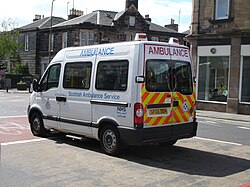
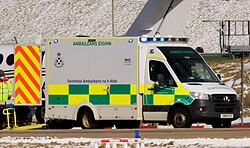
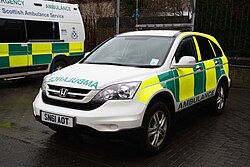
The SAS utilizes a prioritized response system based on patient needs. Depending on the urgency and nature of the emergency, the service may dispatch a traditional double-crewed ambulance, a single response car, or a paramedic practitioner.
Ambulance Control Centres
The backbone of the service is its three integrated command and control centres located in Edinburgh, Glasgow, and Inverness. These centers employ 350 to 400 call handlers and dispatchers who utilize the Advanced Medical Priority Dispatch System (AMPDS). This software allows for precise call prioritization and provides life-saving medical instructions to callers before a crew arrives on the scene. Additionally, these centers manage approximately 1 million patient transport journeys per year.
Critical Care and Advanced Interventions
Advanced practitioners within the service are equipped to perform high-level clinical interventions. These include DC cardioversion (restoring heart rhythm via electricity), transthoracic pacing, surgical airways, thoracostomy, and paediatric intubation. They also utilize point-of-care ultrasound and advanced clinical assessment to make critical decisions in the field.
Their pharmacological toolkit for critical care includes medications such as Ketamine for sedation, Salbutamol for respiratory distress, and Magnesium for asthma or pre-eclampsia.
Regional Structure and Specialized Teams
To manage Scotland's varied terrain, the service is split into five regional divisions.
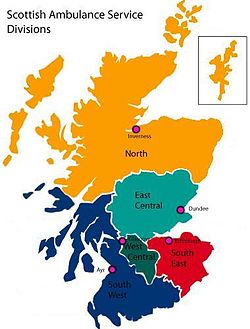
| Division | Covering Areas | Area Size (sq mi) | Divisional HQ |
|---|---|---|---|
| North | Highlands, Western Isles, Grampian, Orkney, Shetland | 15,607 | Inverness |
| East Central | Fife, Forth Valley, Tayside | 4,421 | Dundee |
| West Central | Greater Glasgow, Lanarkshire | 1,054 | Motherwell |
| South East | Edinburgh, Lothian and Borders | 2,457 | Edinburgh |
| South West | Argyll, Clyde islands, Ayrshire, Dumfries and Galloway | 6,670 | Ayr |
Specialist Prehospital Resources
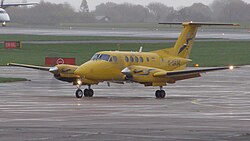
Beyond standard ambulances, several specialized teams enhance the trauma network:
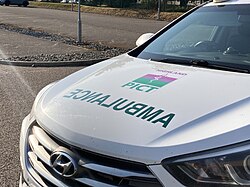
- Highland PICT Team: Based at Raigmore Emergency Department, this physician-led team addresses the lack of advanced prehospital care in the Highlands, seeing roughly 150 patients per month.
- ScotSTAR: Established on April 1, 2014, the Scottish Specialist Transport and Retrieval service coordinates paediatric, neonatal, and adult Emergency Medical Retrieval Service (EMRS) teams.
- SORT: The Special Operations Response Team provides preparedness for large-scale hazardous incidents involving chemical, biological, radiological, or nuclear materials.
Air Operations
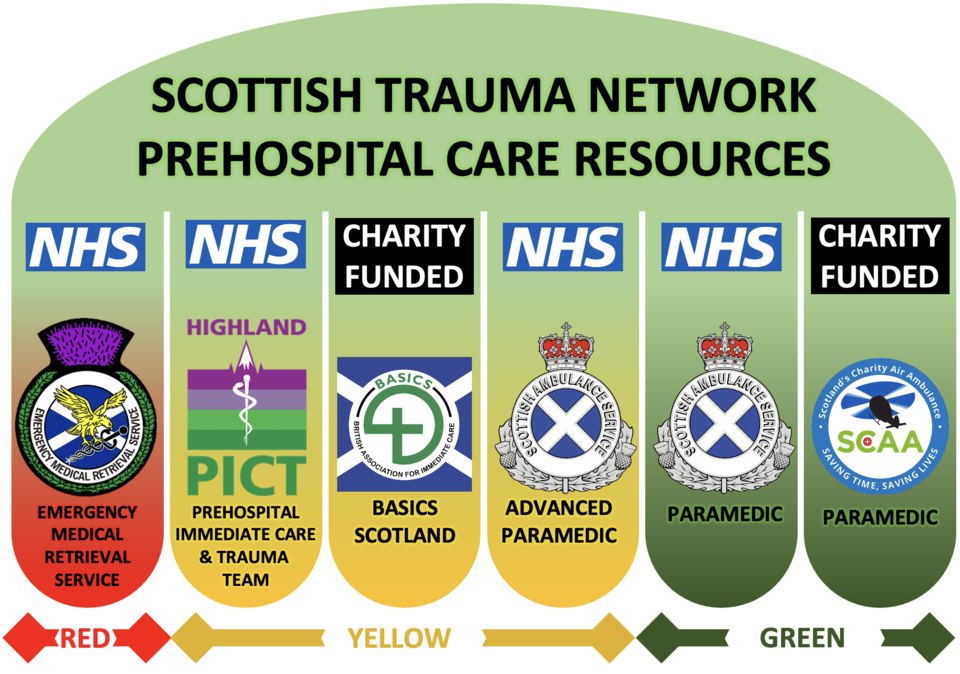
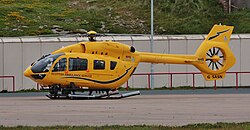
The SAS operates the only government-funded air ambulance service in the UK, contracted through Gama Aviation. The fleet includes two Airbus H145 helicopters and two Beechcraft B200C King Air fixed-wing aircraft. These assets are based at Glasgow, Inverness, and Aberdeen airports.
Complementing the state service is Scotland's Charity Air Ambulance (SCAA). Founded in 2010 and operational since 2013, SCAA provides additional coverage. As of October 2025, SCAA has upgraded its fleet with a highly capable H145 D3 helicopter at Aberdeen and an H135 T2e with night vision capabilities at its Perth base.
Operational Challenges and Controversies
In recent years, the service has faced significant systemic pressures. In 2021, staffing shortages became critical, leading the SAS to seek assistance from the military and firefighters to crew ambulances. This period was marked by reports of extreme wait times for emergency care.
Internal morale has also been a point of concern. A 2022 research report indicated that 87% of staff did not feel valued, and four out of five paramedics were considering leaving their roles, often citing grueling shifts of 15 to 20 hours.
Furthermore, the service has been criticized for its aging fleet. As of April 2024, 337 out of 1,298 ambulances were registered before February 2019, with the oldest active vehicle dating back to 2005.
Frequently Asked Questions
How is the Scottish Ambulance Service funded?
The Scottish Ambulance Service is part of NHS Scotland and is free at the point of access for all users.
What is the difference between SAS and SCAA?
The SAS is the government-funded national provider, while Scotland's Charity Air Ambulance (SCAA) is a charitable organization that provides additional air support to work alongside the state-funded aircraft.
What does the ScotSTAR service do?
ScotSTAR (Scottish Specialist Transport and Retrieval) manages the transfer of critically ill patients, including neonates and children, using specialist vehicles and aircraft to move them to advanced medical facilities.
How does the SAS prioritize 999 calls?
The service uses the Advanced Medical Priority Dispatch System (AMPDS) to categorize calls by urgency and provide immediate medical advice to callers over the phone.
What is the role of the SORT teams?
The Special Operations Response Teams are specially trained to handle large-scale hazardous incidents, specifically those involving chemical, biological, radiological, or nuclear (CBRN) materials.