Scientific Method: Principles of Empirical Inquiry and Knowledge Acquisition
The scientific method is a systematic, empirical approach used to acquire knowledge. It relies on a combination of careful observation, rigorous skepticism, hypothesis testing, and experimental validation. While it has characterized formal science since at least the 17th century, its roots extend back to ancient and medieval practices. At its core, the method acknowledges that human cognitive assumptions can distort how we interpret observations, necessitating a structured process to minimize bias.
Rather than a rigid checklist, the scientific method is a set of general principles. While textbooks often present it as a linear sequence, in practice, it is a creative and variable process. Some discoveries happen through a structured path, while others occur by chance or through the recognition of unexpected patterns.
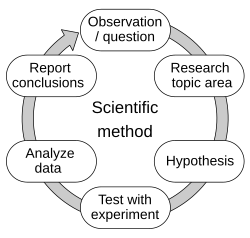
Key Facts
- Empirical Basis: Knowledge is derived from observable, measurable evidence rather than intuition or pure logic.
- Falsifiability: For a hypothesis to be scientific, it must be possible to conceive of an observation that would prove it wrong.
- Iterative Nature: The process is a cycle of predicting, testing, and refining based on results.
- Reasoning Types: It utilizes both inductive reasoning (forming generalizations from specific observations) and deductive reasoning (predicting specific results from a general theory).
The Core Elements of Scientific Inquiry
Although procedures vary across different scientific fields, most inquiries revolve around four fundamental components:
- Characterizations: The initial observations, definitions, and measurements of the subject being studied.
- Hypotheses: Theoretical or hypothetical explanations created to account for the observations.
- Predictions: The logical consequences derived from the hypothesis using inductive and deductive reasoning.
- Experiments: Rigorous tests designed to validate or invalidate the predictions and hypotheses.
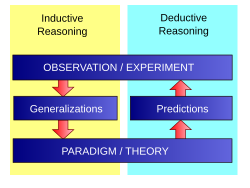
The Iterative Process of Discovery
In a practical setting, scientists often follow a pragmatic scheme to move from a question to a conclusion:
- Define a specific question.
- Gather information and resources through observation.
- Form an explanatory hypothesis.
- Test the hypothesis via reproducible experiments and data collection.
- Analyze and interpret the data to draw conclusions.
- Publish results for peer review and retesting by other scientists.
Foundational Principles and Philosophy
The integrity of the scientific method rests on honesty, openness, and the principle of falsifiability, a concept championed by Karl Popper. If a hypothesis cannot be tested against a possible conflicting outcome, it cannot be meaningfully validated.
Scientific theories also strive for certain qualitative properties to be considered robust:
- Parsimony: The preference for the simplest explanation that fits the data (often related to Occam's Razor).
- Elegance: The aesthetic and logical simplicity of a theory.
- Invariance: The consistency of a phenomenon across different conditions.
The relationship between theory and observation is symbiotic. Theory allows scientists to interpret data that would otherwise be meaningless. For example, the first observational evidence of positrons in 1932 was only interpretable because of prior theoretical frameworks.
![This cloud chamber photograph is the first observational evidence of positrons, 2 August 1932; interpretable only through prior theory.[111]](/images/91/3d/913d026a77dea9fc8085b73d7faad91eb65a744a7f40d64548bb2e208544a66e.png)
The Role of Chance and Complexity
Not all scientific breakthroughs follow a textbook path. Many significant discoveries are the result of serendipity—chance occurrences where the scientist possesses the knowledge to recognize the importance of an unexpected result. A classic example is Alexander Fleming's discovery of penicillin, which occurred when he noticed mould contaminating a bacteria culture.
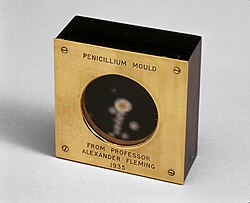
Furthermore, the study of complex systems and the use of mathematical modelling have expanded the method. In some cases, such as the precession of the perihelion of Mercury, observations provide the evidence that forces the refinement of existing physical laws.
![Precession of the perihelion – exaggerated in the case of Mercury, but observed in the case of S2's apsidal precession around Sagittarius A*[127]](/images/b8/0f/b80f7012445d79b5e5dcacaa7fd91829e33be9778d4f919c1db4eb56d485b10c.webp)
Summary of the Scientific Process
| Stage | Action | Goal |
|---|---|---|
| Understanding | Observation & Characterization | Identify a pattern or problem |
| Analysis | Hypothesis Formation | Propose a tentative explanation |
| Synthesis | Deduction | Predict a specific outcome |
| Review | Experimentation | Test the prediction against reality |
Frequently Asked Questions
What is the difference between inductive and deductive reasoning?
Inductive reasoning involves taking specific observations and using them to form a broad general rule or hypothesis. Deductive reasoning starts with a general theory and predicts specific results that should occur if that theory is true.
Why must a hypothesis be falsifiable?
Falsifiability ensures that a claim can be tested. If no possible evidence could ever prove a hypothesis wrong, then no amount of evidence can truly prove it right, making it a matter of belief rather than science.
Is the scientific method always a linear sequence of steps?
No. While often taught as a sequence, it is actually a flexible set of principles. Scientists may jump between steps, repeat them, or arrive at discoveries through chance and subsequent validation.
What is the role of parsimony in science?
Parsimony is the principle that, when presented with two competing explanations that explain the data equally well, the simpler one is generally preferred.
How does peer review fit into the scientific method?
Peer review occurs during the communication and iteration phase. By publishing results, scientists allow others to retest their experiments, ensuring that the findings are reproducible and not the result of error or bias.