Science Journal: History, Impact, and Evolution of a Global Academic Powerhouse
In the world of academic publishing, few names carry as much weight as Science. As the peer-reviewed flagship journal of the American Association for the Advancement of Science (AAAS), it stands as one of the most influential multidisciplinary publications globally. Unlike specialized journals that focus on a single niche, Science covers the entire spectrum of scientific disciplines, making it a critical hub for groundbreaking research and global scientific discourse.
Based in the District of Columbia, United States, with additional operations in Cambridge, England, the journal serves a massive global audience. With a weekly circulation of approximately 130,000 subscribers and an estimated total readership exceeding 400,000, it provides a platform where the world's most significant discoveries are first shared.
Key Facts
- Publisher: American Association for the Advancement of Science (AAAS).
- Impact Factor: 45.8 (2024).
- Acceptance Rate: Extremely competitive, with fewer than 7% of submitted articles accepted.
- Frequency: Published weekly.
- Scope: Multidisciplinary, covering all scientific fields.
- Readership: Estimated at over 400,000 people.
Editorial Scope and Influence
The primary mission of Science is to publish original scientific research and comprehensive research reviews. However, its utility extends beyond raw data; the journal also features science-related news, opinions on science policy, and discussions on the broader implications of technology and science on society.
Because of its high prestige and citation rate, publishing in Science is often a career-defining achievement for researchers, leading to increased visibility and professional advancement. This prestige is reflected in its 2024 impact factor—a measure of the average number of citations received per paper—which stands at 45.8.
Despite its status, the journal is not without criticism. Some methodological studies have suggested that high-prestige journals, including Science, may occasionally publish substandard structures, noting a potential decrease in reliability as journal rank increases.
A Turbulent History
The journey of Science began in 1880, founded by New York journalist John Michels. The venture was initially supported financially by Thomas Edison and later by Alexander Graham Bell. Interestingly, Edison received favorable editorial treatment during a period when his reputation was struggling due to delays in producing a commercially viable light bulb.
The journal's early years were marked by financial instability. The first iteration ended in March 1882, but was resurrected a year later by Alexander Graham Bell and Gardiner Greene Hubbard, who hired entomologist Samuel H. Scudder as editor. By 1894, the journal faced further financial hardship and was sold to psychologist James McKeen Cattell for $500 (approximately $18,610 in 2025).
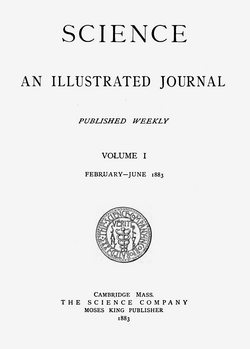
In 1900, through an agreement between Cattell and AAAS secretary Leland O. Howard, Science officially became the journal of the AAAS. The 20th century saw the publication of monumental works, including Thomas Hunt Morgan's research on fruit fly genetics, Albert Einstein's work on gravitational lensing, and Edwin Hubble's discoveries regarding spiral nebulae. Ownership fully transferred to the AAAS following Cattell's death in 1944.
Modern Editorial Leadership
The journal's modern era was shaped by several key editors. Graham DuShane (editor from 1956) expanded the journal by absorbing The Scientific Monthly in 1958, boosting circulation by over 62%. Philip Abelson (1962–1984) modernized publication practices and oversaw reports on the Apollo program and early AIDS research. Subsequent leaders included Daniel E. Koshland Jr., Floyd E. Bloom, Donald Kennedy, and Bruce Alberts.
Under Editor-in-Chief Marcia McNutt (appointed 2013), the brand expanded into specialized titles like Science Robotics and Science Immunology, and launched the open-access journal Science Advances. Following Jeremy M. Berg, Holden Thorp took the helm as editor-in-chief on August 19, 2019.
Access and Availability
While the latest editions are primarily available to subscribers and AAAS members, the journal employs a delayed open access model. This means research articles published after 1997 become free to the public (with registration) one year after their initial publication. Critical public-health articles are often made free immediately.
To support the global scientific community, Science participates in initiatives like HINARI, AGORA, and OARE to provide low-cost or free access to readers in developing countries. Additionally, the website offers free resources such as "ScienceNow" for breaking news and "ScienceCareers" for professional development.
| Feature | Detail |
|---|---|
| Founded | 1880 |
| Current Editor-in-Chief | Holden Thorp |
| ISSN (Print/Web) | 0036-8075 / 1095-9203 |
| Acceptance Rate | < 7% |
| Access Model | Subscription / Delayed Open Access |
| Key Affiliations | AAAS |
Frequently Asked Questions
Do you need to be a member of the AAAS to publish in Science?
No, membership in the AAAS is not required. The journal accepts submissions from authors worldwide regardless of their membership status.
What is the acceptance rate for articles submitted to Science?
The competition is very intense, with fewer than 7% of submitted articles being accepted for publication.
How does delayed open access work for this journal?
For articles published after 1997, the content becomes freely available to the public with online registration exactly one year after the original publication date.
What other journals are part of the Science family?
The family has expanded to include specialized publications such as Science Robotics, Science Immunology, and the open-access journal Science Advances.
Who were some of the famous scientists published in Science?
The journal has published landmark papers from Albert Einstein (gravitational lensing), Edwin Hubble (spiral nebulae), and Thomas Hunt Morgan (fruit fly genetics).