Satu Mare County: A Historical Overview of the Interwar Period
Historically situated in the northwestern reaches of Greater Romania, Satu Mare County served as a strategic border region touching both Czechoslovakia and Hungary. Located within the historical Crișana region, the county underwent significant administrative shifts during the early 20th century, reflecting the volatile geopolitical landscape of Central and Eastern Europe.
Following the administrative unification law of 1925, the county's territory was reorganized, though it retained its name. It was bordered by Hungary to the northwest, Czechoslovakia to the north, Maramureș County to the east, Someș County to the southeast, and Sălaj County to the south and southwest. Today, this historical territory is divided between the modern counties of Satu Mare and Maramureș.
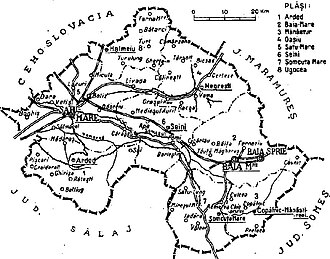
Key Facts
- Total Area: 4,242 km² (1,638 sq mi).
- 1930 Population: 294,875 inhabitants.
- Population Density: 69.51 people per km².
- Capital City: Satu Mare.
- Historic Region: Crișana.
Administrative Structure
By 1930, the county was organized into eight plăși (administrative districts), each with its own headquarters. These districts were:
- Plasa Arded (HQ: Arded)
- Plasa Baia Mare (HQ: Baia Mare)
- Plasa Mănăștur (HQ: Mănăștur)
- Plasa Oașiu (HQ: Oașiu)
- Plasa Satu Mare (HQ: Satu Mare)
- Plasa Seini (HQ: Seini)
- Plasa Șomcuta Mare (HQ: Șomcuta Mare)
- Plasa Ugocea (HQ: Ugocea)
In addition to the county seat of Satu Mare, the administration included the urban communes of Baia Mare and Baia Sprie.
Historical Timeline
Before World War I, the territory was part of Austria-Hungary, primarily within the Szatmár County of the Kingdom of Hungary. Following the Hungarian–Romanian War, the Romanian Army entered the region in early 1919. Formal transfer to the Kingdom of Romania occurred in June 1920 under the Treaty of Trianon.
In 1938, King Carol II introduced a new Constitution that replaced prefects with rezidenți regali (Royal Residents). Under this system, counties were merged into larger units called ținuturi (lands); Satu Mare County became part of Ținutul Crișuri.
The region's stability was interrupted in August 1940 when the Second Vienna Award transferred the county back to Hungary as part of Northern Transylvania. This lasted until October 1944, when Romanian forces, supported by the Soviet Union, recaptured the territory. The Battle of Carei marked the final reintegration of Northern Transylvania into Romania, a status reaffirmed by the 1947 Paris Peace Treaties.
The county was eventually disestablished by the communist government in 1950, becoming part of the Baia Mare Region (renamed Maramureș Region in 1960). It was not until 1968 that Satu Mare County was re-established as part of Romania's restored county system.
Demographics and Society
The 1930 census reveals a diverse ethnic and religious tapestry. The total population of 294,875 was composed of 60.5% Romanians, 25.2% Hungarians, 8.1% Jews, and 3.2% Germans.
Religiously, the majority were Greek Catholics (59.0%), followed by Roman Catholics (15.0%), Jews (8.6%), and Eastern Orthodox (4.4%).
Urban Population Dynamics
The urban centers, totaling 69,526 inhabitants, showed a different demographic profile. Hungarians made up 41.9% of the urban population, followed by Romanians (35.0%), Jews (18.6%), and Germans (1.6%).
Language and religion in cities also differed from the rural areas. Hungarian was the dominant mother tongue at 55.6%, followed by Romanian (31.1%) and Yiddish (10.6%). The urban religious distribution included Greek Catholics (33.7%), Reformed (23.0%), Jews (20.0%), and Roman Catholics (19.6%).
| Category | Total Population | Urban Population |
|---|---|---|
| Total Inhabitants | 294,875 | 69,526 |
| Dominant Ethnicity | Romanian (60.5%) | Hungarian (41.9%) |
| Dominant Religion | Greek Catholic (59.0%) | Greek Catholic (33.7%) |
| Dominant Language | N/A | Hungarian (55.6%) |
Frequently Asked Questions
When did Satu Mare County become part of Romania?
The territory was transferred to Romania from Hungary in June 1920 under the terms of the Treaty of Trianon, following the Romanian Army's entry into the region in 1919.
What were the "ținuturi" introduced in 1938?
Ținuturi were large administrative "lands" created by King Carol II to replace the standard county system. They were governed by Royal Residents appointed directly by the King rather than prefects.
How did the Second Vienna Award affect the county?
In August 1940, the Second Vienna Award resulted in the transfer of Satu Mare County and the rest of Northern Transylvania back to Hungarian control.
What was the ethnic composition of the urban areas in 1930?
The urban population was predominantly Hungarian (41.9%), followed by Romanians (35.0%) and Jews (18.6%).
When was the modern Satu Mare County re-established?
After being absorbed into the Baia Mare and Maramureș Regions between 1950 and 1968, Satu Mare County was re-established in 1968 when Romania restored its county administrative system.