Santos Dumont Airport: Rio de Janeiro's Iconic Urban Aviation Hub
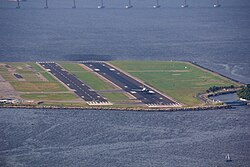
Perched on reclaimed land along the shores of Guanabara Bay, Santos Dumont Airport (SDU) is more than just a transport hub; it is a landmark of Brazilian aviation. Known for its stunning approach and its role in the world's first air shuttle service, the airport serves as a primary gateway for domestic travelers visiting Rio de Janeiro.
From its humble beginnings as a seaplane terminal to its current status as a high-traffic domestic center, Santos Dumont continues to balance operational challenges with its strategic importance to the city's economy and connectivity.

Key Facts
- Official Opening: November 30, 1936.
- Operator: Managed by Infraero since 1987.
- Primary Focus: Short-to-medium haul domestic traffic.
- Unique Feature: Famous for having some of the shortest runways capable of handling Boeing and Airbus aircraft.
- Strategic Location: Situated at an elevation of only 3 meters (9.8 ft) above mean sea level.
A History of Innovation and Adaptation
The airport's origins date back to 1934, when land was reclaimed from the sea to create an initial 1,300-foot (400 m) runway. By the time it officially opened on November 30, 1936, the runway had been extended to 2,300 feet (700 m). The very first commercial flight arrived on opening day, operated by a VASP Junkers Ju 52 from São Paulo–Congonhas.
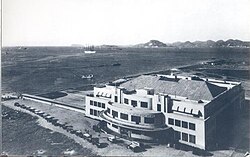
In 1959, the airport became the birthplace of the Ponte Aérea (Air Bridge), the first air shuttle service of its kind globally. This innovative system between Rio and São Paulo featured hourly departures, simplified ticketing, and a common check-in counter, becoming an instant success. While the exclusive partnership between airlines ended in 1999, the route remains one of the busiest in the world.

Evolution of Role and Infrastructure
As aviation grew, the airport's role shifted. The opening of Galeão Airport in 1952 moved international operations away from the city center, and the relocation of Brazil's capital to Brasília in 1960 further altered its domestic importance. Despite these shifts, the airport remained a cultural icon, even appearing in the 1979 James Bond film Moonraker.
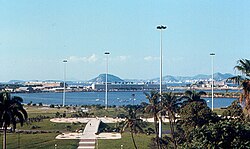
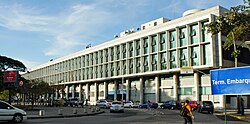
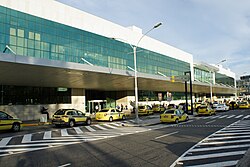
The facility has faced significant challenges, including a devastating fire on February 13, 1998, which forced a closure until August of that year. To prepare for the 2014 FIFA World Cup and the 2016 Summer Olympics, Infraero invested BRL 152.2 million to modernize the passenger arrivals terminal, a project completed in 2013.
Current Operations and Infrastructure
Today, Santos Dumont operates as a public and military facility. While it was long considered the secondary airport to Galeão, a shift occurred around 2020, with Santos Dumont handling a larger share of Greater Rio's total traffic. In 2022, it transported over 10 million passengers, significantly outpacing Galeão.
To manage this imbalance, the Civil Aviation National Council implemented temporary restrictions in 2024, limiting services to airports within 400km of Rio. However, following international pressure, these were replaced by an annual passenger cap of 6.5 million.
Runway and Technical Specifications
The airport utilizes two asphalt runways, both characterized by their relatively short lengths, which require precision piloting for larger commercial jets.
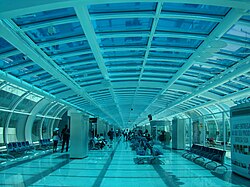
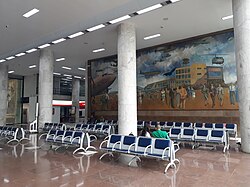
The airport's layout is optimized for efficiency, with the original terminal building now handling arrivals and a newer terminal, opened in 2007, managing all departures.
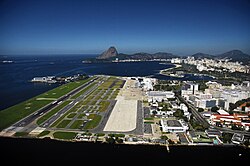
The visual experience of landing at SDU is world-renowned, as aircraft glide past the iconic Sugarloaf Mountain before touching down.
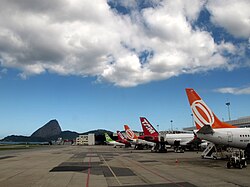
The current runway configuration is as follows:
| Runway Direction | Length (m) | Length (ft) | Surface |
|---|---|---|---|
| 02R/20L | 1,323 | 4,341 | Asphalt |
| 02L/20R | 1,260 | 4,134 | Asphalt |
Airlines and Connectivity
The airport is a focus city for three major carriers, providing essential links to Brazil's other major urban centers:
- Azul Brazilian Airlines: Connects to Belo Horizonte–Confins, Campinas, and São Paulo (Congonhas and Guarulhos).
- Gol Linhas Aéreas: Operates flights to Brasília and São Paulo–Congonhas.
- LATAM Brasil: Serves Brasília, São Paulo (Congonhas and Guarulhos), and seasonal routes to Porto Seguro and Salvador da Bahia.
Frequently Asked Questions
Why is Santos Dumont Airport famous?
It is renowned for its stunning location on Guanabara Bay, its history as the creator of the first air shuttle (Ponte Aérea), and the technical challenge of landing on its relatively short runways.
Who operates the airport?
The airport is currently operated by Infraero, which took over management in 1987.
Can international flights land at Santos Dumont?
No, international operations were gradually shifted to Galeão Airport starting in 1952. Santos Dumont primarily handles domestic short-to-medium haul traffic, general aviation, and military operations.
What happened to the passenger traffic balance between SDU and Galeão?
By 2022, Santos Dumont became the busier of the two, accounting for approximately 63% of Greater Rio's traffic. This led to government interventions to redistribute flights back to Galeão to ensure a better balance.
What are the current flight restrictions at SDU?
Following a period of distance-based restrictions, the airport currently operates under an annual cap of 6.5 million passengers as of 2024.