Santo Daime: The Syncretic Tradition of the Brazilian Amazon
Santo Daime is a universalistic and syncretic religion that emerged in the 1930s within the Brazilian state of Acre. Founded on the teachings of Raimundo Irineu Serra, affectionately known as Mestre Irineu, the faith blends a diverse array of spiritual influences. It incorporates elements of folk Catholicism, Kardecist Spiritism, African animism, and indigenous South American shamanism, specifically the practice of vegetalismo.
At its core, the religion promotes a wholesome lifestyle guided by the motto of "harmony, love, truth and justice," while emphasizing values such as humility, fraternity, purity of heart, and strength. While it began as a local practice in the Amazon, Santo Daime evolved into a global movement during the 1990s.

Key Facts
- Founder: Raimundo Irineu Serra (Mestre Irineu), a grandson of slaves and migrant from Maranhão.
- Sacrament: Ayahuasca, referred to within the religion as Daime.
- Core Values: Harmony, love, truth, and justice.
- Primary Practice: Collective singing of hymns (hinários) during ceremonial "works" (trabalhos).
- Global Reach: Expanded internationally via the ICEFLU branch to at least 43 countries.
The History of the Doctrine
The roots of Santo Daime trace back to the 1920s in the western Brazilian territory of Acre. Mestre Irineu, born in 1892 to African parents, migrated to the region in 1912 during the rubber tapping boom. It was in the border regions of Brazil, Bolivia, and Peru that he first encountered ayahuasca.
Following a period of eight days in solitude in the forest, during which he experienced a series of visions, Irineu began conducting spiritual ceremonies. He became a beacon for those seeking healing—particularly those who were sick and unable to afford or find success with standard medical practices.
Because many early practitioners were illiterate, the teachings were not written but were instead experiential. They were transmitted through the singing of inspired hymns. These collections, known as hinários, became the sacred texts of the faith. Mestre Irineu's primary collection, O Cruzeiro ("The Cross"), contains approximately 130 hymns that chronicle his spiritual evolution until his death in 1971.
Rituals and Ceremonial Work
Ceremonies in Santo Daime are called trabalhos (works). These events last several hours and involve the consumption of Daime, a psychoactive decoction containing dimethyltryptamine (DMT), at regular intervals.
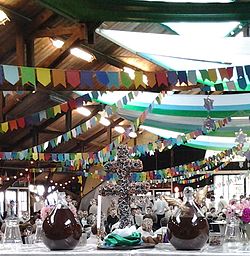
The format of a "work" varies depending on its focus. For instance, a concentração (concentration) work involves periods of silent, seated meditation lasting between one and two hours, interspersed with the singing of hymns. Other ceremonies may involve dancing in simple geometrical formations.
The Role of Hymns and Music
Hymns are the primary vehicle for transmitting the religion's teachings and are intended to facilitate a direct experience of the divine. The music is characterized by rhythmic accompaniment from maracás (shakers) and folk instruments like the flute, accordion, and guitar.
The rhythms follow specific time signatures, including Marcha (4:4), Valsa (3:4), and Mazurca (6:4). While Mestre Irineu's hymns are foundational, many members "receive" their own hymns through divine epiphany, treating these not as artistic creations but as spiritual testaments.
Denominational Diversification and Conflict
The passing of Mestre Irineu in 1971 led to a schism within the community, resulting in two primary, often opposing, factions:
- Alto Santo: The orthodox branch led by Peregrina Gomes Serra. It is non-expansionist and remains restricted to the city of Rio Branco.
- ICEFLU (formerly CEFLURIS): Founded by Sebastião Mota de Melo (Padrinho Sebastião). This branch attracted middle-class counterculture members and aggressively expanded the doctrine globally.
This rift has led to significant socio-political disputes. Alto Santo formed alliances with the Brazilian government to have ayahuasca recognized as cultural heritage, while simultaneously attempting to delegitimize ICEFLU by labeling them "neo-ayahuasqueiros." Conversely, ICEFLU's headquarters in the Purus National Forest often align more closely with the legal definition of a "traditional community" than the urban-based Alto Santo.
Legal Status and Academic Research
Because of its use of an entheogen (a psychoactive substance used in a religious context), Santo Daime has faced numerous legal challenges worldwide.
| Region | Legal Status / Outcome |
|---|---|
| Brazil | Explicitly legal for religious use since 1986. |
| United States | Gray area; specific injunctions favor certain churches (e.g., UDV and some Santo Daime churches in Oregon/California). |
| Canada | Religious exemptions granted to churches in Montreal and Toronto. |
| Netherlands | Legalized following a 2001 court case. |
| France | Illegal; ingredients were declared narcotic scheduled substances. |
| Italy | Illegal as of a 2023 court ruling. |
Academic interest has also grown, notably through "The Hoasca Project" and studies led by José Carlos Bouso. A longitudinal study funded by the Multidisciplinary Association for Psychedelic Studies found no evidence of cognitive impairment or mental health deterioration in long-term ritual users of ayahuasca.
Frequently Asked Questions
What is the difference between Ayahuasca and Daime?
Ayahuasca is the general name for the psychoactive decoction used by various indigenous and spiritual groups in South America. "Daime" is the specific name given to this sacrament within the Santo Daime religion.
Who was Mestre Irineu?
Raimundo Irineu Serra, known as Mestre Irineu, was the founder of Santo Daime. A migrant to the Amazon and grandson of slaves, he established the religion's foundations based on visions he received while using ayahuasca in the forest.
How are the hymns in Santo Daime created?
Hymns are not composed as art but are "received" through divine epiphany. These hinários are sung during ceremonies to connect the practitioner with the divine and the spiritual experiences of the founders.
Is the use of Daime legal?
Legality varies by country. It is legal for religious use in Brazil and the Netherlands, and some specific churches have won exemptions in Canada and the US. However, it remains illegal in countries like France and Italy.
What happens during a Santo Daime ceremony?
Participants consume the Daime sacrament and engage in collective singing of hymns. Depending on the type of "work," they may spend hours in silent meditation (concentration) or dance in geometrical formations.