San Francisco and North Pacific Railroad: Pioneering Rail in Northern California
The San Francisco and North Pacific Railroad (SF&NP) played a pivotal role in the development of Northern California, providing the first extensive standard gauge rail service to Sonoma County. A standard gauge refers to the distance between the inner sides of the rails, which in this case was 4 feet 8.5 inches (1,435 mm), allowing for compatibility with other major rail networks.
While the vision for the railroad was originally conceived by Asbury Harpending, who secured many of the necessary right-of-ways, the project was ultimately purchased and constructed by Peter Donahue. Donahue officially began the era of SF&NP operations by driving the first spike on August 30, 1869.
Key Facts
- Operational Period: 1869 to 1907.
- Founder: Constructed by Peter Donahue.
- Gauge: 4 ft 8.5 in (1,435 mm) standard gauge.
- Primary Reach: Connected the San Francisco Bay area to Sonoma and Mendocino Counties.
- Successor: Eventually merged into the Northwestern Pacific Railroad.
Early Development and Expansion
Before the SF&NP, Sonoma County had limited rail experience. The Sonoma County Railroad Company operated the Petaluma and Haystack Railroad starting in 1864, a one-mile line connecting Petaluma to ferry services at Haystack Landing. However, after a locomotive explosion on August 27, 1866, the coaches were pulled by horses.
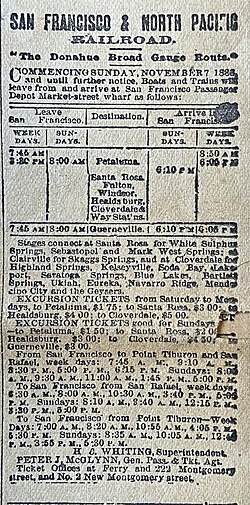
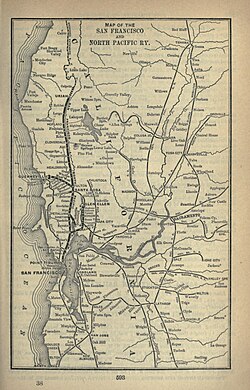
The SF&NP began its northward construction from Petaluma in 1869. Due to difficulties reaching an agreement with the City of Petaluma, the railroad established its own southern ferry terminus at Donahue Landing on the Petaluma River. The line expanded rapidly, reaching Santa Rosa in 1870 and Cloverdale in 1872.
Branch Lines and Regional Growth
To further penetrate the region, the SF&NP utilized several subsidiary companies. In 1874, the Fulton and Guerneville Railroad was formed to build a branch from Fulton to Guerneville on the Russian River, which was completed in 1877. Notably, an 1877 atlas claimed that across the entire 60-mile line, no cut was deeper than 10 feet.
Further expansion continued into the late 19th century:
- 1889: Service extended north to Ukiah in Mendocino County via the Cloverdale and Ukiah Railroad (formed 1886).
- 1890: A branch from Santa Rosa to Sebastopol was completed by the Santa Rosa, Sebastopol and Green Valley Railroad (formed 1889).
The Shift to Tiburon and Final Years
In 1879, the SF&NP extended its reach south from Petaluma to San Rafael in Marin County. By 1882, the San Francisco and San Rafael Railroad was established to push the line another 9 miles south to a new ferry landing in Tiburon. By 1884, the SF&NP moved its primary ferry terminal facilities to Tiburon, leading to the gradual decline of Donahue Landing.
The railroad faced significant financial challenges during the Panic of 1893. In 1898, the SF&NP was leased by the California Northwestern Railway Company, an entity created by the Southern Pacific Railroad to access redwood lumber mills near Humboldt Bay. The California Northwestern managed eastward connections to the Southern Pacific and extended the line north to Willits before the entire operation merged into the Northwestern Pacific Railroad in 1907.
SF&NP Operational Summary
| Year | Milestone / Extension | Key Location |
|---|---|---|
| 1869 | Construction begins / First spike driven | Petaluma / Donahue Landing |
| 1870 | Northward extension | Santa Rosa |
| 1872 | Northward extension | Cloverdale |
| 1877 | Branch line completion | Guerneville |
| 1879 | Southward extension | San Rafael |
| 1884 | Ferry terminal relocation | Tiburon |
| 1889 | Northward extension | Ukiah |
| 1890 | Branch line completion | Sebastopol |
| 1907 | Final merger | Northwestern Pacific Railroad |
Frequently Asked Questions
Who was responsible for building the SF&NP?
While Asbury Harpending originally conceived the railroad and obtained many right-of-ways, Peter Donahue purchased the project and oversaw its construction, driving the first spike in 1869.
Why did the railroad move its terminus from Donahue Landing to Tiburon?
The railroad extended its lines south through San Rafael to reach Tiburon, where new ferry landing facilities were established in 1884 to improve access to the San Francisco Bay.
What happened to the SF&NP after the Panic of 1893?
The railroad struggled financially and was leased in 1898 by the California Northwestern Railway Company, which was part of the Southern Pacific Railroad's strategy to reach redwood mills.
What was the final fate of the San Francisco and North Pacific Railroad?
After being leased by the California Northwestern, the SF&NP was eventually merged into the Northwestern Pacific Railroad in 1907.
What was unique about the construction of the 60-mile line in 1877?
According to a Sonoma County atlas from 1877, the railroad line was constructed such that there was no cut deeper than 10 feet along its entire 60-mile length.