Samoa's Journey to Independence: From German Colony to Sovereign Nation
The history of Samoa is a compelling narrative of colonial transition, resilience, and a steadfast commitment to non-violent resistance. From its time as a German colony to its administration under New Zealand, the path to sovereignty was marked by both tragedy and triumph, eventually making Samoa a pioneer of independence in the Pacific region.
The Occupation of German Samoa in World War I
At the start of World War I, Samoa was a colony of Germany. Recognizing the strategic importance of the wireless station near the capital, Apia—which served the German East Asia Squadron—the British government urged New Zealand to seize the facility as a matter of urgent imperial service.
On August 15, 1914, the Samoa Expeditionary Force set sail, landing in Apia two weeks later. While Germany did not officially surrender its colonies, the occupation occurred without any fighting. Although often cited as the first enemy territory to fall to imperial forces, the seizure of Togoland during the West Africa Campaign had actually occurred four days prior.
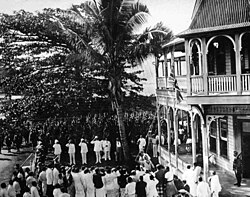
Administrative Transitions and the 1918 Pandemic
Following the occupation, Colonel Robert Logan served as the military administrator for the duration of the war. By 1918, the colony's population consisted of approximately 38,000 Samoans and 1,500 Europeans. However, this period was marred by a devastating health crisis.
Between 1918 and 1919, an influenza epidemic claimed the lives of roughly one-fifth of the population. A subsequent Royal Commission of Inquiry determined that the epidemic was introduced on November 7, 1918, via the SS Talune from Auckland. Colonel Logan had allowed the ship to berth without implementing quarantine precautions, leading to a rapid spread of the virus across Upolu and the rest of the territory.
The League of Nations Mandate
The governance of the islands shifted from military to civil administration on May 1, 1920, supported by the Samoa Constitution Order. On December 17, 1920, the League of Nations formally granted a Class C Mandate—a type of colonial administration—over the territory to the Dominion of New Zealand.
The Samoa Act 1921, which took effect on April 1, 1922, established a governance structure where a New Zealand-appointed administrator in Apia held executive power, reporting to the Minister of External Affairs in Wellington. While a local legislative council existed, final authority remained with New Zealand. This era was characterized by the repression of free speech, freedom of association, and media freedom, with critics of the administration often facing banishment.
Following the end of World War II in 1945, the mandate's status was updated to a United Nations Trust Territory.
The Mau Movement and the Path to Sovereignty
Resistance to colonial rule manifested in the Mau (meaning "strongly held opinion"), a non-violent movement that began in Savai'i in the early 1900s. Initially led by the orator chief Lauaki Namulauulu Mamoe, the movement resurged in the 1920s to oppose New Zealand's administration. Key figures included Olaf Frederick Nelson, a merchant of mixed Samoan and Swedish descent, who provided political and financial support despite being exiled.
The tension reached a breaking point on December 28, 1929, an event now remembered as Black Saturday. High chief Tupua Tamasese Lealofi III led a peaceful, uniformed demonstration in downtown Apia. During an attempt by New Zealand police to arrest the chief, a struggle ensued. Police fired into the crowd and utilized a Lewis machine gun to disperse the demonstrators.
Chief Tamasese was shot from behind and killed while calling for peace. Ten other people died, and approximately fifty were injured. Despite this violence, the Mau remained non-violent and expanded its influence, including the formation of a powerful women's branch.
The persistence of the Samoan people eventually led to success. In 1962, Western Samoa gained its independence and signed a Friendship Treaty with New Zealand, becoming the first Pacific nation to achieve independence.
Key Facts
- First Pacific Independence: Samoa was the first country in the Pacific to become independent (1962).
- 1918 Pandemic: Approximately 20% of the population died due to influenza introduced by the SS Talune.
- Black Saturday: A tragic event on December 28, 1929, where Chief Tupua Tamasese Lealofi III and ten others were killed during a peaceful protest.
- The Mau: A non-violent movement meaning "strongly held opinion" that fought for Samoan autonomy.
- Official Apology: In 2002, New Zealand PM Helen Clark apologized for the banishment of leaders, the quarantine failure, and the Apia shootings.
| Year | Event | Significance |
|---|---|---|
| 1914 | NZ Occupation | Seizure of German wireless station in Apia. |
| 1918 | Influenza Epidemic | One-fifth of the population perished. |
| 1920 | League of Nations Mandate | Formal transfer of administration to New Zealand. |
| 1929 | Black Saturday | Violent crackdown on the non-violent Mau movement. |
| 1962 | Independence | Samoa becomes a sovereign nation. |
| 2002 | Formal Apology | NZ acknowledges past administrative failures. |
Frequently Asked Questions
Why did New Zealand occupy Samoa in 1914?
New Zealand occupied Samoa at the request of the British government to seize a strategic wireless station in Apia used by the German East Asia Squadron during the outbreak of World War I.
What was the cause of the 1918 influenza epidemic in Samoa?
The epidemic was caused by the arrival of the SS Talune from Auckland on November 7, 1918. The ship was allowed to berth without quarantine precautions, leading to the rapid spread of the virus.
What was the Mau movement?
The Mau was a non-violent popular movement, meaning "strongly held opinion," that opposed colonial administration and advocated for Samoan independence.
What happened on Black Saturday?
On December 28, 1929, New Zealand police fired upon a peaceful Mau demonstration in Apia, killing High chief Tupua Tamasese Lealofi III and ten others, and injuring approximately fifty people.
When did Samoa become independent?
Samoa gained its independence in 1962, making it the first country in the Pacific region to do so.
Did New Zealand ever apologize for its colonial actions?
Yes. In 2002, Prime Minister Helen Clark formally apologized for the banishment of Samoan leaders, the failure to quarantine the SS Talune, and the shootings in Apia.