Samagar: The Mongol General of the Ninth Crusade Era
In the complex geopolitical landscape of the 13th century, the intersection of Mongol ambition and European religious zeal created brief, volatile alliances. One of the key figures in these attempted collaborations was Samagar (also known as Cemakar), a Mongol general serving under Abaqa Khan, the ruler of the southwestern Ilkhanate (a Mongol state in Persia).
While historical records of Samagar's personal life are sparse, his military actions in 1271 highlight the strategic attempts by the Mongol Empire and the Crusaders to dismantle the power of the Mamluks in the Holy Land.
Key Facts
- Role: General under Abaqa Khan of the Ilkhanate.
- Major Campaign: Led a force of 10,000 horsemen into Syria in 1271.
- Strategic Goal: Attempted coordination with Prince Edward of the Ninth Crusade.
- Opponent: The Mamluk Sultanate led by Baibars.
- Political Influence: Assisted in the escape of Arghun, contributing to the eventual defeat of Ahmed Tekuder.
The Alliance with the Ninth Crusade
The Ninth Crusade saw the arrival of the English Prince Edward (the future Edward I) in Acre on May 9, 1271. Upon his arrival, Edward found the situation critical; the Mamluk leader Baibars was actively besieging Bohemond VI in the city of Tripoli.
Recognizing that his own forces were insufficient to turn the tide, Edward sought a strategic partnership with the Mongols. He sent an embassy to Abaqa Khan, requesting military assistance to launch a joint attack against Baibars. Abaqa responded favorably on September 4, 1271, appointing Samagar to lead a "mighty force" to aid the Crusaders.
The Syrian Campaign of 1271
In mid-October 1271, Samagar entered Syria, leading a force composed of 10,000 Mongol horsemen drawn from the occupation army in Seljuk Anatolia, supported by auxiliary Seljukid troops. Despite being a relatively minimal force—as Abaqa was preoccupied with conflicts in Turkestan—the Mongol advance caused widespread panic.
The mere presence of the Mongols triggered a mass exodus of Muslim populations toward Cairo, fueled by memories of previous Mongol campaigns. Samagar's forces successfully defeated the Turcoman protectors of Aleppo and drove the Mamluk garrison out of the city. The advance continued further into the region, reaching Apamea and Maarat an-Numan.
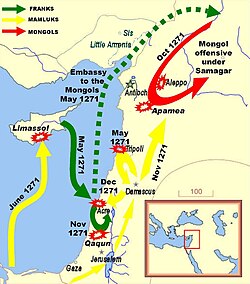
Despite these initial successes, the promised coordination between the Mongols and the Crusaders never materialized. The two forces never combined their strengths. When Baibars launched a counter-offensive from Egypt on November 12, 1271, Samagar and his troops retreated across the Euphrates with their loot, avoiding a direct confrontation with the full Mamluk army.
| Detail | Information |
|---|---|
| Commander | Samagar (Cemakar) |
| Force Size | 10,000 Mongol horsemen + Seljukid auxiliaries |
| Key Cities Affected | Aleppo, Maarat an-Numan, Apamea |
| Primary Adversary | Baibars (Mamluk Sultanate) |
| Outcome | Initial victory at Aleppo followed by retreat beyond the Euphrates |
Political Intrigue and the Coup
Beyond his military campaigns, Samagar played a role in the internal power struggles of the Mongol Empire. According to the accounts of Marco Polo, Samagar was among the Mongol nobles who assisted Arghun in escaping the captivity of Ahmed Tekuder.
Persuaded by Buqa noyan, Samagar and other nobles supported Arghun's bid for power. This political shift culminated in the defeat of Tekuder's army and his eventual execution on August 10, 1284.
Frequently Asked Questions
Who was Samagar?
Samagar, also known as Cemakar, was a Mongol general serving Abaqa Khan of the Ilkhanate during the late 13th century.
Did Samagar ever fight alongside the Crusaders?
No. Although he was sent to Syria specifically to coordinate with Prince Edward of the Ninth Crusade, the two forces never actually combined their operations.
What was the result of Samagar's invasion of Syria?
Samagar successfully captured Aleppo and pushed toward Apamea, causing a mass exodus of the local population. However, he retreated across the Euphrates before the Mamluk army under Baibars could engage him in a full-scale battle.
How many troops did Samagar lead in 1271?
He led a force of 10,000 Mongol horsemen, supplemented by auxiliary Seljukid troops.
What role did Samagar play in Mongol internal politics?
He assisted in the escape of Arghun from the captivity of Ahmed Tekuder, which helped lead to Tekuder's eventual defeat and execution in 1284.