Saint Maron: The Father of the Maronite Church
Saint Maron, also known as Maroun or Maro, was a 4th-century Syriac Christian hermit whose spiritual legacy laid the foundation for one of the most enduring Christian communities in the Middle East. A priest who transitioned to a life of solitude, Maron became a beacon of holiness in the Taurus Mountains, attracting followers through his devotion, miracles, and a unique approach to spirituality that bridged the gap between the physical and the divine.
His influence extended far beyond his immediate circle, eventually leading to the establishment of the Maronite Church, which today remains in full communion with the Holy See and the Catholic Church.
Key Facts
- Born: 340 AD in Coele Syria (modern-day Syria).
- Died: 410 AD in Kalota, Coele Syria.
- Role: Hermit monk and founder of the spiritual movement that became the Maronite Church.
- Veneration: Recognized by both the Catholic Church and the Eastern Orthodox Church.
- Feast Days: February 9 (Maronite Church) and February 14 (Eastern Orthodox Church).
- Legacy: Known for his asceticism, healing gifts, and missionary zeal.
The Life and Solitude of Saint Maron
Born in the middle of the 4th century in the Eastern Roman Empire, Maron began his religious journey as a priest. Seeking a deeper connection with God, he retired to the Taurus Mountains in the region of Cyrrhus, near Antioch. At the time, Antioch was the third-largest city in the Roman Empire and a premier center for Christian learning, where Maron is believed to have studied alongside John Chrysostom.
Maron's life in the mountains northwest of Aleppo was defined by simplicity and a quest to discover God's presence in all things. His reputation for holiness grew throughout the empire; around 405 AD, John Chrysostom wrote to him expressing deep respect and requesting his prayers.
Monastic Spirituality and Asceticism
Saint Maron practiced a form of asceticism—the practice of severe self-discipline and abstention from all forms of indulgence—that was distinct for its time. Rather than separating the physical world from the spiritual, Maron used the natural environment to deepen his faith.
He lived in the open air adjacent to a temple that he converted into a church, exposing himself to the elements, including rain, hail, and snow, as part of his meditative practice. Theodoret of Cyrrhus noted that this approach to spirituality gained wide acceptance in Syria and Lebanon. By the year 440 AD, records indicate that at least fifteen men and three women had adopted these practices under Maron's guidance.
Missionary Work and the Spread of the Faith
While Maron was a mystic, he was also a zealous missionary. He sought to heal both physical ailments and "lost souls," preaching the message of Christ to everyone he encountered. A pivotal moment in his mission was the conversion of a temple in Kafr Nabu into a Christian church, which served as a catalyst for the spread of Christianity into Mount Lebanon.
Following Maron's death in 410 AD, his teachings were carried forward by his disciples. Most notably, Abraham of Cyrrhus, known as the Apostle of Lebanon, traveled to the Mount Lebanon region to convert non-Christians to the faith using the teachings of Saint Maron.
Historical Debates and Clarifications
The exact location of Saint Maron's burial remains a subject of scholarly debate. Some sources suggest he was buried in Arethusa (modern-day al-Rastan) along the Orontes River, while others point to Brad village north of Aleppo.
Additionally, historical accounts by William of Tyre during the Crusades suggested that the Maronites followed "heresies" (specifically monothelitism) for five hundred years. However, many scholars and Maronite historians argue that William likely confused Saint Maron with a different individual named Maro from Edessa, maintaining that the Maronite Church has always remained in full communion with Rome.
Veneration and Global Recognition
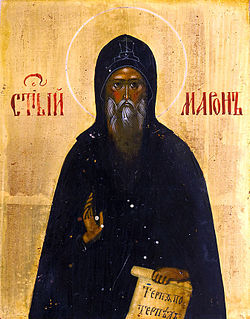
Saint Maron is traditionally depicted in a black monastic habit with a hanging stole, holding a long crosier topped with a globe and a cross. His legacy is honored globally through various eparchies (dioceses) in Brooklyn, Canada, and Australia, as well as in the town of Volperino, Italy, which once housed his relics.
In recent years, his significance has been highlighted by the Vatican. On February 23, 2011, Pope Benedict XVI unveiled a 15-foot statue of Saint Maron on the outer wall of Saint Peter's Basilica. The statue features an inscription in Syriac: "The righteous will flourish like a palm tree, they will grow like a cedar of Lebanon."
| Category | Details |
|---|---|
| Timeline | 340 AD – 410 AD |
| Primary Region | Taurus Mountains, Syria and Lebanon |
| Key Disciple | Abraham of Cyrrhus |
| Spiritual Focus | Asceticism, Mysticism, and Nature |
| Church Affiliation | Maronite Church (Catholic Communion) |
Frequently Asked Questions
Who was Saint Maron?
Saint Maron was a 4th-century Syriac Christian priest and hermit who lived in the Taurus Mountains. He is revered as the father of the spiritual movement that became the Maronite Church.
What is unique about Saint Maron's spirituality?
Unlike some ascetic traditions that shunned the physical world, Saint Maron integrated the natural environment into his faith, using the elements of nature to deepen his mystical relationship with God.
How did the Maronite Church reach Lebanon?
The faith spread to Mount Lebanon primarily through Abraham of Cyrrhus, a disciple of Saint Maron, who acted as a missionary to convert the non-Christian populations of the region.
Where is Saint Maron's statue located in the Vatican?
A 15-foot statue of Saint Maron is located on the outer wall of Saint Peter's Basilica in the Vatican, unveiled by Pope Benedict XVI in 2011.
When is Saint Maron's feast day?
His feast day is celebrated on February 9 by the Maronite Church and on February 14 by the Eastern Orthodox Church.