Saint Joseph College: A Legacy of Education and Public Service
Located in Emmitsburg, Maryland, the grounds of the former Saint Joseph College represent a unique intersection of American religious history and modern emergency management. Spanning 107 acres, this site evolved from the first free parochial school for girls in the United States into a premier federal training complex.
The Vision of Elizabeth Ann Seton
The history of the campus began in June 1809, when Elizabeth Ann Seton—who would later be canonized as the first native-born U.S. saint—arrived in Emmitsburg. She established Saint Joseph's Academy and Free School, marking a milestone in American education as the first free parochial school (a school supported by a parish) for girls in the country.
Mother Seton was instrumental in shaping the future of American education. She authored classroom textbooks and provided rigorous training for her Catholic sisters to serve as educators. By accepting students regardless of their ability to pay, she laid the essential foundation for the Catholic parochial school system across the United States.
Evolution and Academic Transition
Over the next century and a half, the institution expanded and adapted to meet the needs of its students. The original academy evolved through several iterations:
- Saint Joseph College High School (1890–1946)
- Saint Joseph's High School (1946–1982)
- Saint Joseph College (1902–1973), which operated as a four-year liberal arts college for women.
Despite its long history, Saint Joseph College ceased operations in 1973. This closure was driven by rising operating costs and a decline in enrollment. To ensure the continuity of education, the students and faculty were merged with Mount Saint Mary's University, a liberal arts institution located approximately two miles south on U.S. Highway 15. While the college closed, the Daughters of Charity continue to uphold Mother Seton's legacy of global education.
Architectural Significance
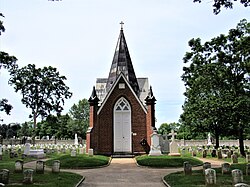
The campus is noted for its diverse and historic architecture. Key structures include the Burlando Building, designed in the Second Empire style, and an early 19th-century brick barn. One of the most striking features is St. Joseph's Chapel, which blends Italianate (inspired by 16th-century Italian Renaissance villas) and Romanesque Revival (characterized by semi-circular arches) architectural styles.
Transition to the National Fire Academy
In 1979, the U.S. Government purchased the campus to repurpose it for national safety and emergency response. Today, the site serves as a hub for critical federal agencies and training centers.
The campus now houses the National Fire Academy, the United States Fire Administration, and the National Emergency Training Center. It is also home to the Emergency Management Institute (EMI), which is operated by the Directorate of Preparedness branch of the Federal Emergency Management Agency (FEMA).
Additional facilities on the grounds include the National Fire Data Center, the Learning Resource Center (LRC) library, and the National Fallen Firefighters Memorial.
Key Facts
- Founder: Elizabeth Ann Seton, the first native-born U.S. saint.
- Campus Size: 107 acres.
- Educational Milestone: Established the first free parochial school for girls in the U.S. in 1809.
- Closure: Saint Joseph College closed in 1973 due to costs and declining enrollment.
- Current Use: Site of the National Fire Academy and FEMA's Emergency Management Institute.
- Architectural Styles: Second Empire, Italianate, and Romanesque Revival.
| Era | Primary Institution/Entity | Key Purpose |
|---|---|---|
| 1809–1973 | Saint Joseph's Academy / College | Catholic education for girls |
| 1973 | Mount Saint Mary's University | Merger of students and faculty |
| 1979–Present | U.S. Government / FEMA | National fire and emergency training |
Frequently Asked Questions
Who was Elizabeth Ann Seton?
Elizabeth Ann Seton was the founder of Saint Joseph's Academy and Free School and is recognized as the first native-born saint of the United States.
Why did Saint Joseph College close in 1973?
The college ceased operations due to a combination of rising operating costs and declining student enrollment numbers.
What happened to the students and faculty after the college closed?
They were merged with Mount Saint Mary's University, located two miles south of the campus in Emmitsburg.
What federal agencies currently operate on the campus?
The campus hosts the National Fire Academy, the United States Fire Administration, the National Emergency Training Center, and FEMA's Emergency Management Institute.
What architectural styles are present on the campus?
The campus features Second Empire architecture in the Burlando Building, as well as Italianate and Romanesque Revival styles in St. Joseph's Chapel.