Russian Far East: A History of Expansion, Conflict, and Administration
The Russian Far East is a vast region defined by its strategic position on the Pacific coast and a complex history of imperial ambition, geopolitical struggle, and administrative evolution. Spanning over one-third of Russia's total landmass, this territory has served as a critical gateway for trade and a flashpoint for international conflict for centuries.
Russian Expansion and Early Settlement
The Russian presence on the Pacific coast began in 1647 with the establishment of Okhotsk. Throughout the 19th century, the Russian Empire consolidated its control over the region, notably through the annexation of portions of Chinese Manchuria between 1858 and 1860. In 1856, the Primorskaya Oblast was created as a distinct administrative division, with Khabarovsk serving as its center.
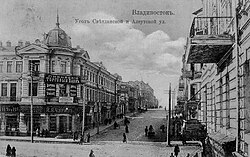
A pivotal moment in this expansion was the founding of Vladivostok in 1860. While it provided a necessary Pacific seaport, the city was initially operational only during the summer months, driving Russia's desire for a year-round warm-water port.
Administrative Evolution
The definition of the "Far East" shifted frequently during the first half of the 20th century. Various entities shared the name but possessed different boundaries, including the Ukrainian Far Eastern Movement (1918–1922), the Far Eastern Republic (1920–1922), the Far-Eastern Oblast (1922–1926), and the Far-Eastern Krai (1926–1938).
For decades, there was no official boundary separating "Siberia" from the "Far East," with the phrase "Siberia and the Far East" used generally for all regions east of the Ural Mountains. This changed in 2000 with the creation of federal districts—large administrative groupings of federal subjects. The Far Eastern Federal District was established, later expanding in 2018 to include Zabaykalsky Krai and the Republic of Buryatia.
| Administrative Unit | Type of Subject |
|---|---|
| Amur, Magadan, Sakhalin | Oblast |
| Primorsky, Khabarovsk, Zabaykalsky | Krai |
| Sakha (Yakutia), Buryatia | Republic |
| Chukotka, Jewish Autonomous Oblast | Autonomous Okrug/Oblast |
| Kamchatka (with Koryak Autonomous Okrug) | Oblast |
The Russo-Japanese War and Early 20th Century Conflict
At the turn of the century, Russia sought a permanent warm-water port to support the Imperial Russian Navy and maritime trade. This led to the lease of Port Arthur from China in 1896. However, tensions rose as Japan sought to protect its influence over Korea and adjacent territories.
War broke out in February 1904 after the Imperial Japanese Navy attacked the Russian 1st Pacific Squadron at Port Arthur. The conflict ended in 1905 with a Japanese victory. Under the Treaty of Portsmouth, Russia evacuated Manchuria and ceded the southern half of Sakhalin to Japan. Japan also gained the lease of the Liaodong Peninsula, including Port Arthur and Talien.
The Soviet Era: Purges and Forced Labor
The Soviet period was marked by severe internal repression and strategic military maneuvers. Between 1937 and 1939, Joseph Stalin ordered the deportation of over 200,000 Koreans to Uzbekistan and Kazakhstan due to fears they might act as Japanese spies. These Koryo-saram (ethnic Koreans in the post-Soviet space) suffered immense losses during transport in cattle trains and were forbidden from using the Korean language or leaving Central Asia for 15 years.
Infrastructure development in the remote northern regions of the Far East relied heavily on the Gulag—the Soviet system of forced labor camps. After Stalin's death in 1953, forced labor was gradually replaced by volunteer workers attracted by higher wages.
World War II and Soviet-Japanese Clashes
From 1931 to 1945, the border between the Soviet Union and Japanese-controlled Manchuria was a site of frequent conflict. This included the Battle of Lake Khasan in 1938, sparked by disputes over the demarcation of boundaries established by the 1860 Treaty of Peking.
During World War II, Primorsky Krai became a strategic hub. The Soviets used it as a Pacific headquarters to plan an invasion of Korea and Japan, while Japan viewed it as a potential jumping-off point for an invasion of Eastern Russia. In August 1945, Soviet and Mongolian troops invaded Manchukuo, Mengjiang, Korea, and South Sakhalin. Following the war, the USSR annexed the Kuril Islands and southern Sakhalin.
The Cold War and Modern Russia
During the Cold War, the region remained a high-security zone. Vladivostok hosted the 1974 Strategic Arms Limitation Talks (SALT), where the US and USSR agreed on limits for nuclear weapons systems. Due to the presence of the Soviet Pacific Fleet, many cities in Primorsky Krai became closed cities, restricting access to authorized personnel.
Tensions persisted, evidenced by American reconnaissance flights from Alaska and the 1983 shoot-down of Korean Air Lines Flight 007. In recent years, the Russian government has focused on repopulating the region, notably through the 2016 proposal of the Russian Homestead Act.
Key Facts
- Total Area: 6.2 million square kilometres, exceeding one-third of Russia's total landmass.
- Strategic Ports: Vladivostok (founded 1860) and Port Arthur (leased 1896).
- Major Conflict: The Russo-Japanese War (1904–1905) resulted in the loss of southern Sakhalin.
- Humanitarian Crisis: Over 200,000 Koreans were deported to Central Asia between 1937 and 1939.
- Modern Governance: The region is managed as the Far Eastern Federal District, established in 2000.
Frequently Asked Questions
What is the Far Eastern Federal District?
It is a large administrative grouping of Russian federal subjects established in 2000 to streamline governance in the region, covering 6.2 million square kilometres.
Why was Port Arthur so important to Russia?
Unlike Vladivostok, which was only operational in the summer, Port Arthur was a warm-water port that could operate year-round, making it essential for the Imperial Russian Navy and trade.
Who are the Koryo-saram?
The Koryo-saram are ethnic Koreans who were forcibly deported from the Russian Far East to Uzbekistan and Kazakhstan by the Soviet government under Stalin between 1937 and 1939.
What was the significance of the Treaty of Portsmouth?
Signed on September 5, 1905, it ended the Russo-Japanese War, requiring Russia to evacuate Manchuria and cede southern Sakhalin to Japan.
What is the Russian Homestead Act?
Proposed by President Vladimir Putin in 2016, it is an initiative designed to encourage people to move to and populate the Russian Far East.