Rubber: From Natural Latex to Industrial Elastomers
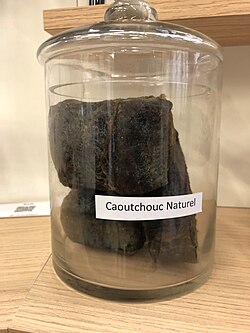
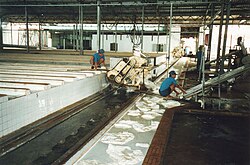
Rubber, known historically as India rubber, caucho, or caoutchouc, is a versatile material that has shaped modern industry. At its core, rubber consists of polymers of the organic compound isoprene. In its natural state, it is harvested as latex—a sticky, milky white colloid—which is then refined into a durable material used in everything from medical gloves to vehicle tires.
While natural rubber is derived from biological sources, the rising industrial demand of the 19th century eventually led to the creation of synthetic alternatives in 1909. Today, the global market relies on a combination of both, though natural rubber remains indispensable for its unique resilience and elasticity.
Key Facts
- Primary Source: Most natural rubber comes from the Pará rubber tree (Hevea brasiliensis).
- Chemical Nature: It is a polymer of isoprene, specifically cis-1,4-polyisoprene.
- Major Producers: Thailand, Indonesia, and Vietnam are the leading global producers.
- Key Process: Vulcanization transforms rubber from a thermoplastic into a more stable thermoset material.
- Global Output: In 2022, over 15.1 million tonnes of natural rubber were produced.
The Science of Rubber
Chemical Composition
Natural rubber is an elastomer—a polymer with viscoelasticity, meaning it can stretch and return to its original shape. Chemically, it is composed of cis-1,4-polyisoprene with a molecular weight ranging from 100,000 to 1,000,000 daltons. It typically contains small amounts (up to 5% of dry mass) of proteins, resins, fatty acids, and inorganic salts.

Natural vs. Synthetic Polyisoprene
While both natural and synthetic rubbers can be made of polyisoprene, they are derived from different precursors. Natural rubber is synthesized via isopentenyl pyrophosphate, whereas synthetic versions are derived from isoprene. Some other natural sources, such as gutta-percha, consist of trans-1,4-polyisoprene, a structural isomer with different properties.

Vulcanization and Material Properties
In its raw form, rubber is a thermoplastic. However, through a process called vulcanization (redeveloped by Charles Goodyear in 1839), it becomes a thermoset. This chemical stabilization prevents the material from becoming too soft when hot or too brittle when cold. The final characteristics of a rubber product are often enhanced by adding fillers like carbon black or whiting.
Production and Cultivation
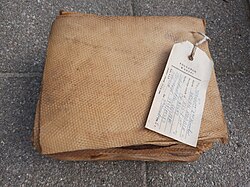
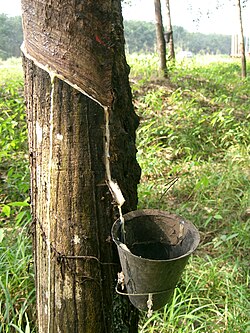
Harvesting Latex
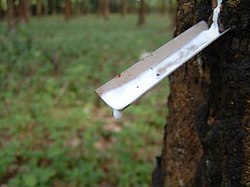
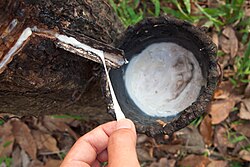
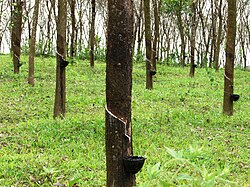
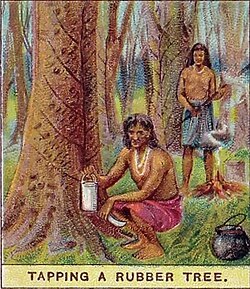
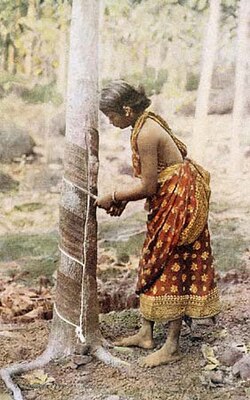
The primary method of collection is tapping, where incisions are made in the bark of the Hevea brasiliensis tree to allow the latex to flow into collection vessels.
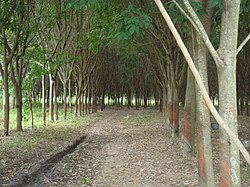
Optimal Growing Conditions
Rubber trees require specific tropical environments to thrive:
- Temperature: A range of 20 to 34 °C (68 to 93 °F), with a monthly mean of 25 to 28 °C.
- Humidity: Atmospheric humidity around 80%.
- Sunshine: Approximately 2,000 hours of sunshine per year.
- Environment: Protection from strong winds.
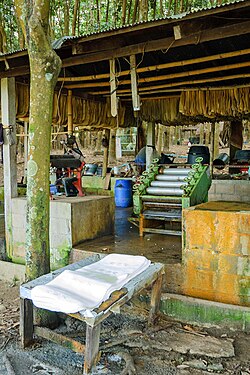
Global Economics
Asia dominates the industry, accounting for roughly 90% of output as of 2021. Because synthetic rubber is petroleum-based, the price of natural rubber is heavily influenced by global crude oil prices. Recent events, such as the COVID-19 pandemic, caused price spikes (approximately 30%) due to a surge in demand for medical gloves and supply shortages caused by climate-related disasters.
Historical Evolution
The scientific study of rubber began in 1736 when Charles Marie de La Condamine introduced samples to the Académie Royale des Sciences in France. In 1770, Joseph Priestley noted the material's ability to remove pencil marks, giving rise to the term "rubber."
The 19th century saw the expansion of the trade from South America to Asia. In 1876, Henry Wickham smuggled 70,000 seeds from Brazil to England, which were later distributed to India, Sri Lanka, and Malaysia. However, the history of rubber is also marked by brutality; in the Congo Free State under King Leopold II, rubber production was enforced through forced labor and extreme violence, including the amputation of hands to enforce quotas.

Summary of Rubber Characteristics
| Feature | Natural Rubber | Synthetic Rubber |
|---|---|---|
| Source | Latex (Hevea brasiliensis) | Petroleum-based chemicals |
| Primary Component | cis-1,4-polyisoprene | Various synthetic polymers |
| Key Precursor | Isopentenyl pyrophosphate | Isoprene |
| Main Producers | Thailand, Indonesia, Vietnam | Global chemical plants |
| Key Property | High resilience and buoyancy | Tailorable chemical resistance |
Frequently Asked Questions

What is the difference between latex and rubber?
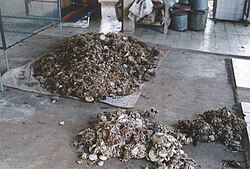
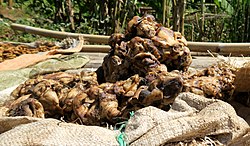
Latex is the raw, milky fluid collected from the rubber tree. Rubber is the refined, processed version of this latex, which may be further treated through vulcanization for industrial use.
What is vulcanization?
Vulcanization is a chemical process that stabilizes rubber, changing it from a thermoplastic to a thermoset. This makes the material more durable and less sensitive to temperature changes.
Why is natural rubber price linked to oil?
Since synthetic rubber is derived from petroleum, it serves as a direct substitute for natural rubber. When oil prices change, the cost of synthetic rubber shifts, influencing the market price of natural rubber.
Which countries produce the most natural rubber?
Thailand, Indonesia, and Vietnam are the three largest producers, collectively accounting for about 61% of global natural rubber production in 2022.
Can rubber be degraded by microorganisms?
Yes, certain bacteria and actinomycetes are capable of metabolizing and degrading both natural and vulcanized rubber.