Rosario Strait: A History of Exploration and Naming
Located in the Pacific Northwest, the Rosario Strait serves as a vital maritime corridor. Its history is a complex tapestry of international exploration, where Spanish, British, and American interests overlapped, leading to a series of name changes that reflect the geopolitical tensions of the 18th and 19th centuries.
Early Spanish Exploration
The European recording of the strait began in 1790 with Spanish explorers Manuel Quimper and Juan Carrasco. Sailing aboard the Princesa Real, they initially believed the waterway was a bay and named it Boca de Fidalgo in honor of Salvador Fidalgo. By 1791, José María Narváez corrected this geographical assumption, determining that the waterway was actually a strait and renaming it Canal de Fidalgo.
During the same year, Francisco de Eliza named the larger body of water now known as the Strait of Georgia as Gran Canal de Nuestra Señora del Rosario la Marinera.
British and American Influence
In 1792, George Vancouver explored the region. While he gave the Strait of Georgia its current name in honor of King George III, he did not assign a specific name to the Rosario Strait.
Decades later, in 1847, the American explorer Charles Wilkes renamed the waterway Ringgold Channel after one of his officers during the Wilkes Expedition. However, this name was short-lived. That same year, British Captain Henry Kellett reorganized the British Admiralty charts. In an effort to remove "pro-American" designations, Kellett affirmed the names provided by Vancouver and the Spanish. He adopted a shortened version of Eliza's original name for the Strait of Georgia to designate the Rosario Strait, effectively erasing the name given by Wilkes.
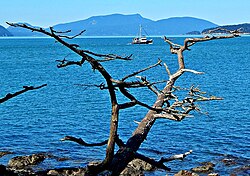
Geopolitical Significance and the Pig War
Following the Oregon Treaty, the Rosario Strait became a point of strategic interest. The British believed it offered the deepest channel to the open sea from the terminus of the 49th Parallel boundary in the Strait of Georgia. It remains, in fact, the shortest shipping route.
Conversely, the Americans preferred the Haro Strait—located west of the San Juan Islands—as the boundary. The Haro Strait is wider but slightly longer. This dispute over the San Juan Islands eventually led to a conflict known as the Pig War, which was ultimately resolved through arbitration, establishing the boundary in the Haro Strait.
Key Facts
- First Named: 1790 by Manuel Quimper and Juan Carrasco as Boca de Fidalgo.
- Shortest Route: It is the shortest shipping route to the open sea from the 49th Parallel boundary.
- Naming Conflict: The name "Ringgold Channel" was removed by Captain Henry Kellett to favor British and Spanish nomenclature.
- Boundary Dispute: The preference for Haro Strait over Rosario Strait was a central element of the San Juan Islands dispute (the Pig War).
| Year | Explorer/Official | Name Assigned |
|---|---|---|
| 1790 | Quimper & Carrasco | Boca de Fidalgo |
| 1791 | José María Narváez | Canal de Fidalgo |
| 1847 | Charles Wilkes | Ringgold Channel |
| 1847 | Henry Kellett | Rosario Strait (shortened from Eliza's name) |
Frequently Asked Questions
Why was the name "Ringgold Channel" removed?
Captain Henry Kellett of the British Admiralty removed the name because it was considered "pro-American," as it had been assigned by Charles Wilkes. Kellett preferred to affirm Spanish and British names on the official charts.
What is the difference between Rosario Strait and Haro Strait in terms of shipping?
Rosario Strait is the shortest shipping route to the open sea from the 49th Parallel boundary, while Haro Strait is wider but slightly longer.
Who first identified that Rosario Strait was a strait and not a bay?
José María Narváez determined it was a strait in 1791, leading him to rename it Canal de Fidalgo.
How does the "Pig War" relate to these waterways?
The Pig War was a dispute over the San Juan Islands. The resolution of this conflict determined the boundary location, with the Americans successfully advocating for the boundary to be placed in the Haro Strait rather than the Rosario Strait.
Who named the Strait of Georgia?
George Vancouver gave the Strait of Georgia its current name in 1792, naming it after King George III.