Ron Gilbert: The Visionary Behind SCUMM and Monkey Island
Few figures have shaped the landscape of the adventure game genre as profoundly as Ron Gilbert. From his early days experimenting with programmable calculators to revolutionizing how stories are told in digital spaces, Gilbert's career is a testament to the fusion of cinematic storytelling and technical innovation. He is perhaps best known for creating the SCUMM engine, a tool that defined an era of point-and-click gaming.
Early Inspirations and Formative Years
Raised in La Grande, Oregon, Ron Gilbert was the son of David E. Gilbert, a physics professor and former president of Eastern Oregon University. While he initially aspired to be a film director, a turning point occurred at age thirteen when he began using an HP-65 programmable calculator. The ability to program games, such as a Battleship-like title included on the device, sparked a lifelong passion for game development.
Gilbert viewed programming as a creative outlet that complemented his love for cinema. He was particularly influenced by the 1977 film Star Wars, which inspired him to explore how technology could allow players to interact with characters and narratives. This passion led him and friend Tom McFarlane to produce two Super-8 films: Stars Blasters (1978) and Tomorrow Never Came (1979).
By 1979, Gilbert began programming on a NorthStar Horizon home computer. He spent countless hours analyzing the frames and layouts of arcade classics like Donkey Kong, Pac-Man, Asteroids, Space Invaders, and Robotron: 2084, replicating them and then experimenting with modifications. He also used Atari 2600 magazine advertisements as blueprints for new games, which he would then playtest with friends to refine the experience.
The LucasArts Era and the Birth of SCUMM
Gilbert's professional journey began in 1983 while studying at Eastern Oregon State College. He and Tom McFarlane developed a program called Graphics BASIC, which they sold to HESware. After a brief tenure at HESware programming for the Commodore 64 (C64), Gilbert joined Lucasfilm Games (later known as LucasArts), where he initially worked on C64 ports of Atari 800 games.
In 1985, collaborating with artist Gary Winnick, Gilbert co-developed Maniac Mansion. This title introduced two revolutionary concepts: cutscenes (a term coined by Gilbert to describe non-interactive sequences that advance the plot) and the Script Creation Utility for Maniac Mansion, or S.C.U.M.M.
The S.C.U.M.M. engine became the backbone for nearly all subsequent LucasArts adventure games, with the exceptions of Escape From Monkey Island and Grim Fandango. The engine's name became a piece of gaming lore when Gilbert included the "SCUMM Bar" as a location in The Secret of Monkey Island.
During his time at LucasArts, Gilbert authored several legendary titles, including The Secret of Monkey Island and Monkey Island 2: LeChuck's Revenge.
Expanding Horizons: Humongous and Cavedog
In 1992, Gilbert left LucasArts to co-found Humongous Entertainment with producer Shelley Day. The studio focused on children's software, producing hits such as Putt-Putt, Freddi Fish, Pajama Sam, Fatty Bear, and the Backyard Sports series, many of which utilized an offshoot of the S.C.U.M.M. engine.
Seeking to create games for a more mature audience, Gilbert founded Cavedog Entertainment in 1995. During this period, he was recognized by both GameSpot and Computer Gaming World in 1996 and 1997 as one of the 15 most influential people in computer gaming history. While at Cavedog, he produced Total Annihilation and worked on Good & Evil. However, Good & Evil was cancelled when Cavedog closed in 1999; Gilbert later attributed this failure to the difficulty of simultaneously designing a game and managing a company.
Independent Ventures and Later Career
Following Cavedog, Gilbert transitioned into independent design and commentary. He launched the "Grumpy Gamer" blog, where he provided industry insights and animated cartoons with Clayton Kauzlaric. His later work includes collaborations with Hothead Games on Penny Arcade Adventures: On the Rain-Slick Precipice of Darkness and the adventure/RPG DeathSpank.
Gilbert also maintained a connection to his most famous creations, contributing to the design of Telltale Games' Tales of Monkey Island. In 2012, he joined Tim Schafer at Double Fine Productions specifically to create The Cave, which was released in 2013.
In 2014, Gilbert reunited with Gary Winnick to create Thimbleweed Park. The project was successfully funded via Kickstarter and released in 2017. More recently, Gilbert returned to his most beloved franchise with Return to Monkey Island, released in 2022 via his company Terrible Toybox and Devolver Digital.
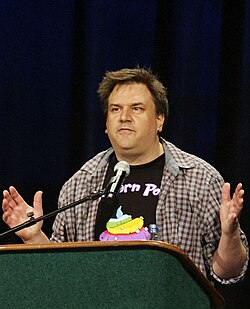
Looking forward, Gilbert announced on February 2, 2025, that he plans to release a new title, Death By Scrolling, within the year 2025.
Key Facts
- S.C.U.M.M. Engine: Invented by Gilbert, this scripting language revolutionized the point-and-click adventure genre.
- Industry Firsts: Coined the term "cutscene" to describe story-advancing cinematic sequences.
- Major Works: Created Maniac Mansion, The Secret of Monkey Island, and Thimbleweed Park.
- Entrepreneurship: Founded Humongous Entertainment and Cavedog Entertainment.
- Recent Success: Returned to the Monkey Island series in 2022 with Return to Monkey Island.
| Period/Year | Company/Project | Key Contribution/Role |
|---|---|---|
| 1983 | HESware | Developed Graphics BASIC; programmed C64 games |
| 1985 | LucasArts | Co-developed Maniac Mansion and the SCUMM engine |
| 1992 | Humongous Entertainment | Co-founder; created Putt-Putt and Freddi Fish |
| 1995 | Cavedog Entertainment | Founder; produced Total Annihilation |
| 2017 | Independent | Released Thimbleweed Park |
| 2022 | Terrible Toybox | Released Return to Monkey Island |
Frequently Asked Questions
What is the SCUMM engine?
SCUMM stands for the Script Creation Utility for Maniac Mansion. It is a scripting language created by Ron Gilbert that allowed developers to create adventure games more efficiently, becoming the standard for LucasArts' point-and-click titles.
Did Ron Gilbert invent the cutscene?
Yes, Ron Gilbert coined the term "cutscene" to describe the sequences in Maniac Mansion that interrupt gameplay to advance the story or show events happening offscreen.
What is Ron Gilbert's relationship with Disney?
After Disney acquired LucasArts in 2012, they became the owners of the Monkey Island and Maniac Mansion IPs. Gilbert has expressed a desire to buy these franchises back, a move supported by a fan petition with approximately 29,000 signatures.
What is the most recent game Ron Gilbert has worked on?
His most recent major release was Return to Monkey Island in 2022. Additionally, he announced plans in February 2025 to release a new game titled Death By Scrolling later that year.
Why was the game Good & Evil cancelled?
The project was cancelled when Cavedog Entertainment closed in 1999. Gilbert later stated that the project suffered because he attempted to design the game while simultaneously running the company.