Roman Coloniae: The Strategic Outposts of the Ancient Empire
The Roman colonia (plural: coloniae) was a cornerstone of Rome's expansion and administration. Originally conceived as strategic settlements of Roman citizens designed to secure federated or conquered territories, these outposts served as military garrisons and cultural beacons. Over time, the nature of the colonia evolved from a purely defensive tool into a prestigious designation, eventually denoting the highest status a Roman city could achieve. This ancient system is the direct etymological origin of the modern term "colony."
Key Facts
- Purpose: Initially established as military garrisons to secure conquered lands.
- Types: Divided primarily into Roman colonies (smaller, citizen-led) and Latin colonies (larger military strongholds).
- Veteran Settlement: Used extensively by leaders like Augustus to provide land to retired legionaries.
- Cultural Impact: Acted as primary engines for Romanization, spreading the Latin language, laws, and customs.
- Status: Evolved from military outposts to the highest rank of city status in the Imperial era.
The Structure of Early Colonization
During the Roman Republic, which lacked a permanent standing army, Rome utilized its own citizens as a form of garrison. These settlers were strategically "planted" in conquered towns to maintain order and defense. There were two distinct categories of these settlements:
Roman Colonies (Coloniae Civium Romanorum)
Often referred to as coloniae maritimae because they were frequently situated near the coast—such as Ostia (350 BC) and Rimini (268 BC)—these were smaller settlements. Typically, about three hundred Roman veterans and their families were settled here. Each family was assigned between 1 and 2.5 hectares of agricultural land from the ager colonicus (state-owned land), while also gaining free use of the ager compascus scripturarius (common state land) for woodland and pasture.
Latin Colonies (Coloniae Latinae)
Latin colonies were significantly larger and functioned as military strongholds, often placed directly within or adjacent to enemy territory. Similar to the Athenian cleruchy, these colonists were granted larger estates of up to 35 hectares. However, this came with a trade-off: settlers lost their Roman citizenship, though they could regain it upon returning to Rome.
By 133 BC, political reforms introduced by tribunes shifted the focus toward supporting the urban poor, establishing new colonies as agricultural settlements, such as Tarentum in 122 BC.
Evolution Through the Imperial Era
The transition from Republic to Empire fundamentally changed the role of the colonia. Under Julius Caesar and later Augustus, the system became a massive social program. Augustus settled over a hundred thousand veterans across the empire, using these colonies to integrate new territories. This process accelerated Romanization—the spread of Roman laws, customs, and the Latin language.
In the later Imperial period, the process shifted again. Instead of founding new settlements, the title of "colony" was often granted to existing provincial cities as a mark of prestige or to provide tax exemptions. By the time of the Severan emperors, the practice of settling retired legionaries in new colonies had largely ceased.
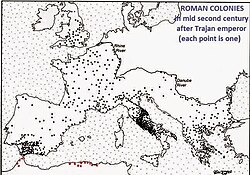
Historical Timeline and Expansion
According to the historian Livy, Rome's first colonies were established around 752 BC at Antemnae and Crustumerium in Latium. For the first few centuries, colonization remained a defensive strategy within Italy. The first expansion outside the Italian peninsula occurred in 206 BC with the founding of Italica in Hispania by Publius Cornelius Scipio during the Second Carthaginian War.
By the second century AD, Roman North Africa boasted the highest density of colonies in the empire, with the Italic population making up more than one-third of the region's total population.
| Modern Name | Latin Name | Country | Founder/Promoter | Date/Period |
|---|---|---|---|---|
| Cologne | Colonia Claudia Ara Agrippinensium | Germany | Claudius | 50 AD |
| Mérida | Colonia Emerita Augusta | Spain | Augustus | 25 BC |
| York | Eboracum | United Kingdom | Caracalla | Early 3rd Century AD |
| Arles | Colonia Iulia Paterna Arelatensis Sextanorum | France | Julius Caesar | 45 BC |
| Sarmizegetusa | Colonia Ulpia Traiana Sarmizegetusa | Romania | Trajan | 106–110 AD |
Legacy and Societal Impact
The impact of the coloniae extended far beyond military security. While they served as a reserve of experienced veterans for emergencies, their primary value lay in the creation of new Roman citizens and army recruits.
Culturally, these settlements acted as living examples of Roman life for native populations. Because veterans often married local women, the colonies became hubs of cultural integration, blending Roman administration with local demographics within a few generations.
Frequently Asked Questions
What is the difference between a Roman colony and a Latin colony?
Roman colonies were smaller, settled by citizens who kept their rights and received smaller land grants (1–2.5 hectares). Latin colonies were larger military strongholds where settlers received larger estates (up to 35 hectares) but forfeited their Roman citizenship.
How did colonies contribute to the spread of the Latin language?
By placing Roman veterans and their families in diverse territories, the colonies established centers of Roman culture. Local populations adopted the Latin language and Roman customs through daily interaction and the legal influence of the colony's administration.
Who was the most prolific founder of colonies during the Empire?
Augustus was responsible for a massive colony creation program, settling over 100,000 veterans to stabilize the empire and reward his soldiers after the civil wars.
Did all colonies start as new cities?
No. While many were new settlements, many others were created by expanding existing occupied settlements or by granting the legal status of "colony" to already established provincial cities.
Where was the highest density of Roman colonies located?
Roman North Africa had the highest density of colonies per region, with Italic populations constituting over one-third of the total population by the second century AD.