Rockefeller Museum: A History of Jerusalem's Archaeological Landmark
The Rockefeller Museum stands as a testament to the complex intersection of art, archaeology, and geopolitics in Jerusalem. Originally conceived to house the region's most significant finds, the institution has transitioned through three distinct political eras, reflecting the turbulent history of the land it documents.
The Vision and Funding of a New Museum
Before the museum's inception, archaeological efforts in Jerusalem were fragmented. The British Mandate's Department of Antiquities and the British School of Archaeology operated out of an old building with limited exhibition space. While the Franciscan Biblical Museum had been established in 1902, and an Ottoman Imperial Museum of Antiquities (Müze-i Hümayun) existed from 1901 to 1917, there was a pressing need for a dedicated, modern facility.
In 1919, town planner Patrick Geddes first proposed a dedicated antiquities museum. By 1924, Mandate authorities suggested a tourism tax to fund the venture. The project gained critical momentum in 1925 when James Henry Breasted, director of the University of Chicago's Oriental Institute, visited Mandatory Palestine. Recognizing the need for a proper repository for regional artifacts, Breasted—with the encouragement of British High Commissioner Lord Plumer—secured a donation of two million dollars from American philanthropist John D. Rockefeller Jr.
Construction and Architectural Design (1930–1948)
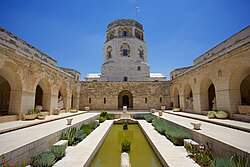
The museum was designed by Austen Harrison, the chief architect of the Mandatory Department of Public Works. Harrison envisioned a white limestone structure that blended Eastern and Western architectural styles. Construction began on June 19, 1930, though progress was temporarily halted by the discovery of fifth-century B.C. tombs on the site.
The building is renowned for its artistic details. Above the main entrance is a stone bas-relief depicting the meeting of Asia and Africa. The inner courtyard features a gargoyle fountain and ten stone reliefs representing various cultures, all carved in 1934 by British sculptor Eric Gill.
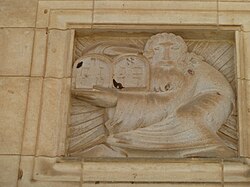
Gill also designed the museum's signage in English, Arabic, and Hebrew. The Hebrew lettering was particularly significant, as it was inspired by fonts found on Second Temple-era artifacts, such as ossuaries (stone coffins) and the Uzziah tablet.
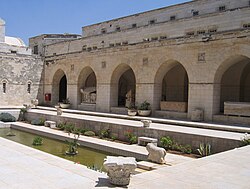
The institution opened as the Palestine Archaeological Museum on January 13, 1938. However, the celebration was marred by the murder of British archaeologist James Leslie Starkey. The museum remained under British administration until it closed to the public on April 1, 1948.
The Jordanian Period (1948–1967)
Following the closure, a council of twelve international trustees was appointed on April 20, 1948, to manage the museum. This diverse board included representatives from the British Academy, the British Museum, the French National Academy, the French Ministry of Foreign Affairs, the Hebrew University of Jerusalem, the Royal Swedish Academy, and the American School of Oriental Research, as well as officials from various Arab governments.
After the 1948 Arab–Israeli War, the museum served as a secondary headquarters for the Jordanian Department of Antiquities, led by Gerald Lankester Harding until 1956. During the 1950s, the institution was embroiled in controversies regarding the movement of artifacts to Amman and the Israeli side. In 1966, King Hussein nationalized the museum during the Jordanian annexation of the West Bank.
The Israeli Period (1967–Present)
The museum's status changed abruptly during the 1967 Six-Day War. An Israeli paratroop brigade captured the site, utilizing the museum's hexagonal tower as a strategic lookout during fierce fighting with Jordanian forces. Following the Israeli victory, the institution was renamed the Rockefeller Museum.
One of the most significant events of this period was the relocation of the Dead Sea Scrolls—the museum's most prized collection—to the Israel Museum in West Jerusalem. This move, along with the fact that the Copper Scroll and other fragments were taken to the Jordan Museum in Amman, has led to ongoing disputes over ownership.
Since 1967, the Rockefeller Museum has been jointly managed by the Israel Museum and the Israel Antiquities Authority (formerly the Israel Department of Antiquities and Museums).
Key Facts
- Founder/Donor: John D. Rockefeller Jr. donated $2 million for construction.
- Architect: Austen Harrison designed the white limestone building.
- Artistic Contributions: Eric Gill created the courtyard reliefs, fountain, and multilingual signage.
- Original Name: Opened in 1938 as the Palestine Archaeological Museum.
- Major Artifacts: Formerly housed the Dead Sea Scrolls before their move to the Israel Museum.
- Current Management: Jointly run by the Israel Museum and the Israel Antiquities Authority.
| Period | Era/Administration | Key Event |
|---|---|---|
| 1930–1948 | British Mandate | Construction and opening as Palestine Archaeological Museum. |
| 1948–1966 | International Trustees | Managed by a 12-member international council. |
| 1966–1967 | Jordanian Nationalization | Nationalized by King Hussein. |
| 1967–Present | Israeli Administration | Renamed Rockefeller Museum; scrolls moved to Israel Museum. |
Frequently Asked Questions
Who funded the construction of the museum?
The museum was funded by a two-million-dollar donation from American philanthropist John D. Rockefeller Jr., following a proposal by James Henry Breasted.
What is the significance of the signage in the museum?
The signage, created by Eric Gill, features Hebrew lettering inspired by authentic Second Temple-era artifacts, including the Uzziah tablet and various ossuaries.
Where are the Dead Sea Scrolls located now?
The majority of the collection was moved to the Israel Museum in West Jerusalem, while some parts, including the Copper Scroll, are held at the Jordan Museum in Amman.
Why was construction delayed in 1930?
Construction was delayed because workers discovered tombs dating back to the fifth century B.C. at the building site.
Who currently manages the Rockefeller Museum?
The museum is currently managed jointly by the Israel Museum and the Israel Antiquities Authority.