Road Interchanges: Engineering the Flow of Modern Traffic
In the world of road transport, an interchange (known as a grade-separated junction in British English) is a sophisticated road junction designed to allow traffic to move between two or more highways without the need for crossing traffic to stop. Unlike a standard intersection where roads cross at the same level, interchanges use grade separation—the use of bridges or underpasses—to ensure that at least one route can pass through the junction without interruption.
These structures are essential for controlled-access highways (freeways) and limited-access highways (expressways), though they are occasionally implemented at junctions between surface streets to reduce congestion and improve safety.
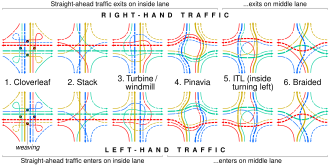
Key Facts
- Purpose: To eliminate at-grade crossings, allowing continuous traffic flow on major routes.
- First Cloverleaf: Patented by Arthur Hale in 1915; first opened in Woodbridge, New Jersey, on December 15, 1929.
- System vs. Service: System interchanges connect multiple highways; service interchanges connect a highway to a non-controlled-access road.
- Global Variation: Layouts are mirrored in countries where vehicles drive on the left side of the road.
- Evolution: Modern designs often replace older cloverleafs to improve safety and efficiency.
The Evolution of Highway Junctions
The concept of the controlled-access highway emerged during the 1920s and 1930s across Italy, Germany, Canada, and the United States. Early versions of these roads still featured at-grade intersections, but as traffic increased, engineers developed interchanges to bridge the gap between high-speed highways and busy surface streets.
The Bronx River Parkway and Long Island Motor Parkway were pioneers in implementing grade separations. The cloverleaf design, which became a staple of mid-century infrastructure, was inspired by an Argentinian magazine and realized in New Jersey in 1929. By 1935, the design reached Europe, with the "traffic carousel" (Slussen) opening in Stockholm, Sweden.
System Interchanges: Connecting Major Highways
A system interchange is a high-capacity junction that connects multiple controlled-access highways without any signalized intersections. These are categorized by their geometry and the number of "legs" (connecting roads) they possess.
Four-Legged Interchanges
Four-legged interchanges are the most common system junctions, designed to handle traffic from four directions.
- Cloverleaf Interchange: Named for its four-leaf clover appearance, this design uses non-directional loop ramps to handle left turns. While historically common, many are being replaced due to safety and efficiency concerns.
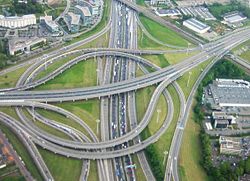
- Stack Interchange: A high-capacity design typically featuring four levels. It consists of two perpendicular highways and additional levels for left-turn ramps. Some variations, like the I-10 and I-405 junction in Los Angeles, use a 3-level design by spacing out semi-directional ramps.
- Turbine Interchange: Similar to a stack, but the left-turn ramps are separated and kept at the same level rather than being stacked vertically.
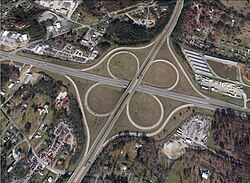
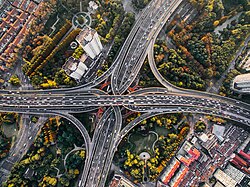
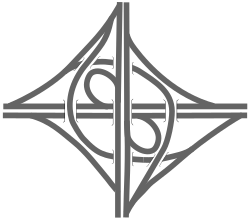
Specialized and Hybrid Designs
Engineers often use hybrid or specialized designs to fit specific geographic or traffic needs:
- Combination Interchanges: These may blend turbine and stack elements (turbine-stack hybrids) to optimize flow.
- Braided Interchanges: These use "braided" ramps to eliminate weaving—the dangerous crossing of traffic streams entering and exiting the highway. A notable early example was built at I-95 and I-695 in Baltimore.
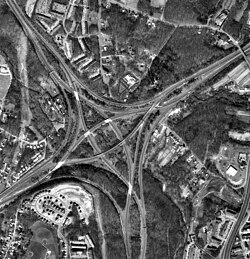
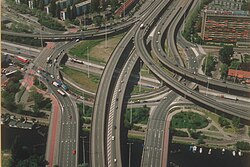
- Windmill and Roundabout Interchanges: Complex designs, such as the Kleinpolderplein in Rotterdam, utilize roundabouts to manage multi-directional flow.
![The Vaanplein [nl] junction in Barendrecht, Netherlands was a windmill before it was renovated in 1997.NL-ZH 51°51′55″N 4°30′55″E / 51.8654°N 4.5154°E](/images/d1/d4/d1d470452b7e190d7c899466317e72088650bb40f2f73ba3ee06509a46d4ed17.jpg)
Three-Legged Interchanges
When a highway terminates or joins another, three-legged designs are used:
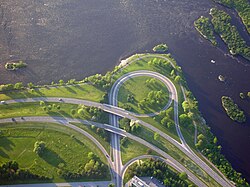
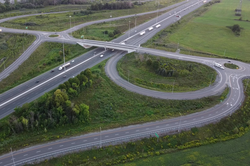
- Trumpet Interchange: A common design for T-junctions.
- T and Y Interchanges: These can be directional or semi-directional. Semi-directional T interchanges may be two-level or three-level depending on land cost and urban density.
Service Interchanges: Highway to Local Road Access
A service interchange connects a controlled-access route to a road that is not controlled-access. These are designed to transition traffic from high-speed environments to local street networks.
Common Service Layouts
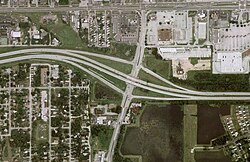
- Diamond Interchange: The most typical service design, featuring four ramps that form a diamond shape.
- Partial Cloverleaf: A hybrid that uses some loop ramps to reduce traffic congestion at specific turns.
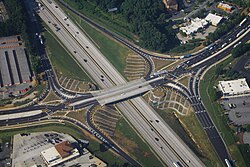
- Diverging Diamond Interchange (DDI): A modern design where traffic briefly crosses to the opposite side of the road to allow for left turns without crossing opposing traffic. First appearing in France in the 1970s, the DDI was "reinvented" around 2000 and first implemented in the U.S. in Springfield, Missouri, in 2009.
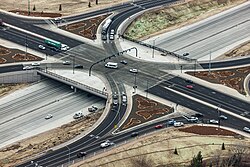
- Single-Point Urban Interchange (SPUI): These consolidate all turning movements into a single, multi-phase traffic signal, reducing the overall footprint of the junction.
Interchange Comparison Summary
| Interchange Type | Primary Use | Key Characteristic | Traffic Flow |
|---|---|---|---|
| Cloverleaf | System/Service | Loop ramps | Continuous, but prone to weaving |
| Stack | System | Multi-level (usually 4) | High capacity, directional |
| Turbine | System | Same-level left ramps | High capacity, smoother curves |
| Diamond | Service | Four simple ramps | Signalized at surface road |
| Diverging Diamond | Service | Crossover traffic flow | Reduced conflict points |
| Trumpet | System (3-leg) | Single loop ramp | Efficient for terminating roads |
Frequently Asked Questions
What is the difference between a system and a service interchange?
A system interchange connects two or more controlled-access highways (like two freeways), whereas a service interchange connects a controlled-access highway to a local road or surface street that is not controlled-access.
Why are cloverleaf interchanges being replaced?
While they provide a basic way to handle four-way traffic without signals, cloverleafs often suffer from weaving, where vehicles entering the highway must cross paths with vehicles exiting, creating safety hazards and congestion.
How does a Diverging Diamond Interchange (DDI) work?
In a DDI, the two directions of traffic on the non-freeway road cross to the opposite side of the road between the ramp terminals. This allows drivers to turn left onto the highway ramps without ever having to cross the path of oncoming traffic.
What is a "stack" in highway engineering?
A stack refers to a multi-level interchange where ramps are layered vertically. A standard four-level stack includes the two main highways and two additional levels for the left-turn ramps that cross over or under them.
What is a braided interchange?
A braided interchange uses separate, overlapping ramps to separate entering and exiting traffic, effectively "braiding" the roads to eliminate the dangerous weaving movements found in traditional cloverleafs.