River Stour Navigation: History, Decline, and Restoration
The River Stour, winding through the landscapes of Essex and Suffolk, has a long and complex history as a commercial artery. Once a bustling route for barges transporting coal and building materials between Manningtree and Sudbury, the navigation system faced centuries of financial struggle, competition from the railways, and eventual decay. Today, it stands as a testament to industrial heritage and a focal point for modern conservation efforts.
The Early Struggle for Navigability
While there are no records of boat use prior to the 17th century, efforts to make the river navigable began in 1634 when Daniel Biatt, the mayor of Sudbury, collaborated with Dr. Warren and Mr. Spencer. Although Spencer obtained letters patent in 1638 to authorize navigation from Manningtree to Sudbury, the project stalled due to the English Civil War and Spencer's own financial difficulties. Subsequent attempts in 1658 by Mr. Maynard and later efforts by John Little and Benjamin Dodd also failed to establish a reliable system.
The turning point came with the River Stower Navigation Act 1705. Granted to the mayor and aldermen of Sudbury on February 16, 1706, this Act of Parliament formally authorized the creation of a navigable route. To maintain goodwill with local millers, the Act allowed them to transport millstones and building materials without paying tolls.
Engineering the Waterway
The initial construction involved a combination of 13 flash locks (simple gates that released a surge of water to push boats downstream) and 13 pound locks (chambers with gates at both ends to raise or lower vessels). Because the towpath was intermittent, winches and engines were installed on the banks to haul boats through the flash locks.
Funding was unconventional; rather than a government grant, 48 shares of £100 each were issued. Despite raising £9,000—spending £6,500 on works, £800 on 16 barges, and £1,700 on warehousing—the company remained chronically underfunded. By May 1709, the route was operational, with barges carrying 2,211 tons of coal to Sudbury.
Expansion and the Railway Era
By the late 18th century, the navigation required administrative renewal. The River Stower Navigation Act 1781 appointed new commissioners, including Golding Constable (father of painter John Constable) and the brothers of Thomas Gainsborough. This era saw the completion of a full towpath and extensive dredging, leading to a surge in revenue; tolls rose from £700 in 1782 to double that amount by 1817.
To stay competitive, the proprietors invested £12,000 in modernization, including the Ballingdon Cut to serve limekilns and brickworks, and a bypass at Wormingford. However, the arrival of the railway in the mid-19th century proved fatal. Although the Eastern Counties Railway initially missed Sudbury, the subsequent arrival of the Colchester, Stour Valley, Sudbury & Halstead Railway caused income to plummet from a peak of £3,400 in 1848 to £1,400 by 1852.
The navigation's decline was further accelerated by poor infrastructure. In 1850, the towpath was so fragmented that horses had to jump over 123 fences or leap onto moving barges to switch banks. A failed experiment with steam barges in the 1860s could not reverse the trend. By 1914, the River Stour Navigation Company Ltd declared bankruptcy.
Modern Restoration and Current Use
After the dissolution of the navigation trust in 1937, the river fell into disrepair. Interest was revived in 1954 by canoeists from the Chelmsford Boat Club, leading to the formation of the River Stour Trust in 1968. This volunteer-led organization has worked tirelessly to protect the public's right to navigate the river.
Significant milestones in restoration include the clearing of the Sudbury basin by the US Air Force in 1981 and the restoration of Flatford Lock in 1990, supported by a £90,000 grant from Rio Tinto Zinc. The Millennium Commission also provided £167,890 in 1995 to assist with the Great Cornard lock.
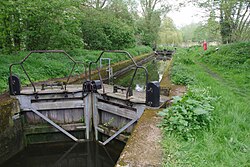
Today, the Environment Agency manages the river. Powered boats are strictly limited to the section between Ballingdon Bridge and Henny Mill, with a speed limit of 4 mph (6.4 km/h). The remainder of the route from Brundon Mill to Cattawade is open to non-powered craft, such as kayaks and canoes, though users must portage around several fixed structures.
Key Facts
- Primary Route: Manningtree (Essex) to Sudbury (Suffolk).
- Key Legislation: Navigation Acts of 1705 and 1781.
- Peak Traffic: Coal was the primary commodity transported.
- Infrastructure: Originally featured 13 flash locks and 13 pound locks.
- Modern Access: Non-powered craft are permitted; powered boats are restricted to the Sudbury area.
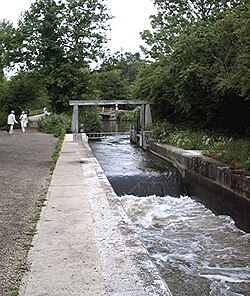
- Lock Dimensions: Rebuilt locks (1928) are 95ft long, 10ft wide, with a 2.75ft draught.
| Period/Year | Event | Impact |
|---|---|---|
| 1705/1706 | River Stower Navigation Act | Formal authorization to make the river navigable. |
| 1781 | Second Navigation Act | Appointment of new commissioners and full towpath construction. |
| 1840s-1850s | Railway Competition | Sharp decline in toll revenue and commercial traffic. |
| 1914 | Bankruptcy | The Navigation Company ceased operations. |
| 1968 | River Stour Trust Formed | Beginning of organized restoration and preservation efforts. |
Frequently Asked Questions
Can I use a motorboat on the River Stour?
Powered boats are only permitted on the section of the river near Sudbury, specifically from Ballingdon Bridge to Henny Mill, where a speed limit of 4 mph is enforced. Other sections are reserved for non-powered craft.
What is the difference between a flash lock and a pound lock?
A flash lock is a simpler gate that releases a sudden "flash" of water to carry a boat over a shallow area, whereas a pound lock is a chamber with gates at both ends that allows a boat to be raised or lowered safely between two different water levels.
Who manages the river today?
The Environment Agency is the official navigation authority. The River Stour Trust works alongside them to protect the waterway and restore locks.
Are the locks still operational?
Locks at Great Cornard, Stratford St Mary, Dedham, and Flatford are operational but must be operated by Environment Agency staff. Users must provide advance notice to navigate through them.
How can I explore the river as a tourist?
The Stour Valley Adventure Centre in Sudbury offers canoe, kayak, and paddle board rentals, including a two-day trip from Sudbury to Cattawade. Additionally, the River Stour Trust provides skippered boat trips and private charters in Flatford and Sudbury from Easter to October.